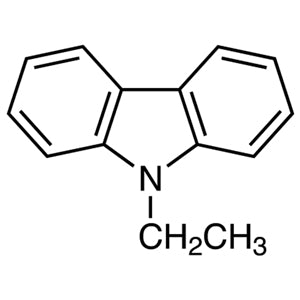
TCI E0247 with CAS number 86-28-2 is 9-Ethylcarbazole, an aromatic heterocyclic compound that serves as one of the dependable starting materials in organic materials chemistry. Its carbazole framework consists of two benzene rings fused to a central pyrrole ring, with the nitrogen atom substituted by an ethyl group. In the laboratory, this compound acts as a heterocyclic building block for constructing larger target molecules, while also functioning as an electron-donor unit in the design of functional molecules intended for materials research.
The characteristics that lead researchers to select this compound are its high thermal and chemical stability, the electron-rich nature of its aromatic core, and its improved solubility compared with carbazole lacking a nitrogen substituent. The ethyl group on the nitrogen acts as a permanent protecting group, so no side reactions occur at the N–H position during chemical transformations. Electrophilic reactivity directed toward the 3- and 6-positions allows researchers to carry out bromination, formylation, acylation, or nitration selectively, producing functionalized derivatives with reproducible results.
In Indonesian laboratories, this material is used in materials research where a stable, electron-rich heterocyclic scaffold is required as a synthetic entry point. It supports university and institutional research groups working on organic materials chemistry, as well as synthetic work that builds larger target molecules step by step from a well-defined heterocyclic core. Its predictable substitution behaviour makes it suitable for method development and for repeated preparations across a research programme.
TCI brochures (PDF)
- Carbazoles 2025-06-27 · p. 3
Related TCI products
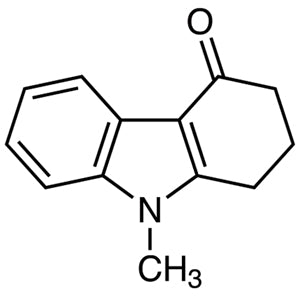
- TCI T2942 27387-31-1 1,2,3,4-Tetrahydro-9-methylcarbazol-4-one
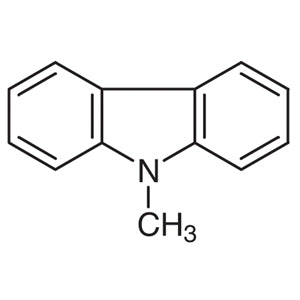
- TCI M0960 1484-12-4 9-Methylcarbazole
- TCI E0578 81380-24-7 9-Ethylcarbazole-3-carboxaldehyde N-Ethyl-N-(m-tolyl)hydrazone
- TCI E0577 1274948-12-7 9-Ethylcarbazole-3-carboxaldehyde N-Ethyl-N-(o-tolyl)hydrazone
- TCI E0576 84678-52-4 9-Ethylcarbazole-3-carboxaldehyde N-Ethyl-N-phenylhydrazone
- TCI E0575 88107-84-0 9-Ethylcarbazole-3-carboxaldehyde N-Butyl-N-phenylhydrazone
- Heterocyclic building block synthesis — the defined carbazole framework provides a reliable starting point for assembling larger target molecules through stepwise functionalization in organic synthesis work.
- Electron-donor unit in functional molecule design — the electron-rich aromatic core allows researchers to incorporate a donor fragment when designing molecules for organic materials chemistry studies.
- Selective bromination at the 3- and 6-positions — directed electrophilic reactivity lets researchers install halogen handles cleanly for subsequent coupling chemistry with reproducible outcomes.
- Formylation and acylation chemistry — the same positional selectivity supports introduction of carbonyl functionality, giving access to aldehyde and ketone derivatives useful for further elaboration.
- Nitration for functionalized derivative preparation — selective substitution on the electron-rich ring system yields nitro derivatives that serve as intermediates in further synthetic transformations.
| Brand | TCI |
|---|---|
| CAS number | 86-28-2 |
| Molecular formula | — |
| Purity | — |
| Category | Chemistry > Building Blocks > Heterocyclic Building Blocks |
| Pack sizes | available in standard TCI catalogue pack sizes; please confirm the current packaging option when ordering |
| Physical form | — |
| Storage | keep in a tightly closed container, stored under the conditions stated on the manufacturer's label and safety data sheet |
- Chemical name: 9-Ethylcarbazole
Store 9-Ethylcarbazole in its original tightly closed container in a cool, dry, and well-ventilated area, away from direct sunlight, heat sources, and incompatible chemicals. Amber glass or the manufacturer's supplied packaging is suitable for keeping the material protected from light and moisture. Handle the compound inside a fume hood using appropriate personal protective equipment, including safety glasses, gloves, and a laboratory coat. Avoid generating dust during weighing and transfer operations, and close the container promptly after use. Always consult the manufacturer's safety data sheet before handling, and follow institutional procedures for waste collection and disposal of residues.
—
Produk Terkait
-
1,2,3,4-Tetrahydro-9-methylcarbazol-4-one TCI T2942
Regular price From Rp 769.650,00Regular price -
9-Methylcarbazole TCI M0960
Regular price From Rp 1.749.300,00Regular price -
9-Ethylcarbazole-3-carboxaldehydeN-Ethyl-N-(m-tolyl)hydrazone TCI E0578
Regular price Rp 2.942.100,00Regular price -
9-Ethylcarbazole-3-carboxaldehydeN-Ethyl-N-(o-tolyl)hydrazone TCI E0577
Regular price Rp 2.942.100,00Regular price -
9-Ethylcarbazole-3-carboxaldehydeN-Ethyl-N-phenylhydrazone TCI E0576
Regular price Rp 2.969.400,00Regular price -
9-Ethylcarbazole-3-carboxaldehydeN-Butyl-N-phenylhydrazone TCI E0575
Regular price Rp 2.545.200,00Regular price -
9-Ethylcarbazole-3-carboxaldehydeN-Benzyl-N-phenylhydrazone TCI E0574
Regular price Rp 2.625.000,00Regular price -
9-Ethylcarbazole-3-carboxaldehydeDiphenylhydrazone TCI E0571
Regular price Rp 1.829.100,00Regular price