TCI E0578 9-Ethylcarbazole-3-carboxaldehyde N-Ethyl-N-(m-tolyl)hydrazone is a positional isomer within the carbazole hydrazone family, distinguished by a meta-tolyl group attached to its terminal nitrogen atom. The compound is used in laboratory settings as a positive charge transport material within organic layers, particularly in research on photoconductors, electroluminescent devices, and photorefractive materials. Like other members of its family, this material is formulated together with a binder polymer into a coating solution and then cast into thin films, which become the subject of charge mobility measurements, absorption spectroscopy, and experimental device performance testing.
The meta position of the methyl group gives this isomer a character distinctly different from the ortho isomer. Because the substituent sits far from the point of attachment, its steric hindrance is considerably lighter, allowing the aromatic rings to maintain reasonably good planar alignment with the conjugated system. The methyl group still contributes electron density that enriches the amino center and slightly lowers the oxidation potential of the molecule. The result is a combination of preserved charge delocalization together with improved solubility, which makes this isomer a practical choice when researchers need both reliable transport behavior and workable coating formulations.
In Indonesian laboratories, this building block is typically found in university materials chemistry groups, organic electronics research centers, and institutional laboratories working on thin film device fabrication. It is commonly handled in small quantities on the bench, dissolved in appropriate solvents together with binder polymers, and applied to substrates by spin coating or casting. Researchers comparing isomer families frequently order several related hydrazones side by side so that structural effects on charge transport can be evaluated under identical preparation conditions.
TCI brochures (PDF)
- Carbazoles 2025-06-27 · p. 4
Related TCI products
- TCI T3454 640292-02-0 5-(p-Tolyl)isoxazole-3-carboxaldehyde
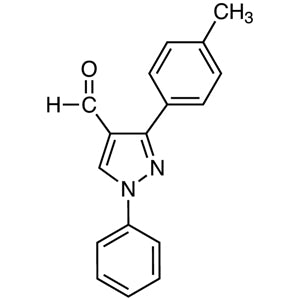
- TCI P2657 36640-52-5 1-Phenyl-3-(p-tolyl)-1H-pyrazole-4-carboxaldehyde
- TCI E0577 1274948-12-7 9-Ethylcarbazole-3-carboxaldehyde N-Ethyl-N-(o-tolyl)hydrazone
- TCI E0576 84678-52-4 9-Ethylcarbazole-3-carboxaldehyde N-Ethyl-N-phenylhydrazone
- TCI E0575 88107-84-0 9-Ethylcarbazole-3-carboxaldehyde N-Butyl-N-phenylhydrazone
- TCI E0574 75238-79-8 9-Ethylcarbazole-3-carboxaldehyde N-Benzyl-N-phenylhydrazone
- Hole transport layer research: the molecule functions as a positive charge carrier material in organic layers, making it directly applicable to studies of transport mechanisms in device stacks.
- Organic photoconductor studies: the carbazole hydrazone framework supports photoconductive film work, allowing investigators to correlate molecular structure with measured photoresponse behavior.
- Electroluminescent device fabrication: researchers incorporate this compound into experimental emissive device architectures where controlled hole injection and transport through the organic layer are required.
- Photorefractive material formulation: the material is blended with binder polymers into composite films used for photorefractive response measurements and optical characterization experiments in the laboratory.
- Structure-property isomer comparison: the meta-substituted variant serves as a reference point against ortho isomers when examining how substituent position influences planarity, oxidation potential, and solubility.
| Brand | TCI (Tokyo Chemical Industry) |
|---|---|
| CAS number | 81380-24-7 |
| Molecular formula | — |
| Purity | — |
| Category | Chemistry > Building Blocks > Heterocyclic Building Blocks |
| Pack sizes | available in standard research quantities; please confirm currently offered pack sizes when ordering |
| Physical form | — |
| Storage | store according to the manufacturer's stated conditions on the product label and accompanying documentation |
- Product Code: E0578
Store this product in a tightly closed original container, kept in a cool, dry, and well ventilated area away from direct sunlight, heat sources, and strong oxidizing agents. Organic hydrazone compounds of this type are generally best protected from prolonged light exposure, so amber glass or opaque secondary packaging is advisable for portioned material. Handle the solid inside a fume hood when weighing or dissolving, and wear a laboratory coat, chemical resistant gloves, and safety glasses throughout. Avoid generating dust, avoid inhalation and skin contact, and wash hands thoroughly after handling. Always consult the manufacturer's Safety Data Sheet before first use, and dispose of residues and contaminated consumables through the laboratory's designated chemical waste stream.
—
Produk Terkait
-
5-(p-Tolyl)isoxazole-3-carboxaldehyde TCI T3454
Regular price Rp 3.763.200,00Regular price -
1-Phenyl-3-(p-tolyl)-1H-pyrazole-4-carboxaldehyde TCI P2657
Regular price From Rp 1.060.500,00Regular price -
9-Ethylcarbazole-3-carboxaldehydeN-Ethyl-N-(o-tolyl)hydrazone TCI E0577
Regular price Rp 2.942.100,00Regular price -
9-Ethylcarbazole-3-carboxaldehydeN-Ethyl-N-phenylhydrazone TCI E0576
Regular price Rp 2.969.400,00Regular price -
9-Ethylcarbazole-3-carboxaldehydeN-Butyl-N-phenylhydrazone TCI E0575
Regular price Rp 2.545.200,00Regular price -
9-Ethylcarbazole-3-carboxaldehydeN-Benzyl-N-phenylhydrazone TCI E0574
Regular price Rp 2.625.000,00Regular price -
9-Ethylcarbazole-3-carboxaldehydeDiphenylhydrazone TCI E0571
Regular price Rp 1.829.100,00Regular price -
9-Ethylcarbazole-3-carboxaldehydeN-Methyl-N-phenylhydrazone TCI E0570
Regular price Rp 2.068.500,00Regular price