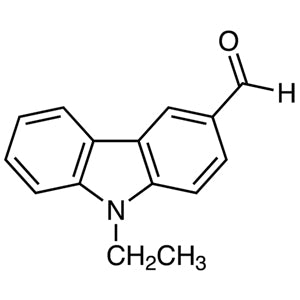
TCI E0570 9-Ethylcarbazole-3-carboxaldehyde N-Methyl-N-phenylhydrazone is an aromatic hydrazone compound built around a carbazole core that has been ethylated at its nitrogen atom and connected through a hydrazone bridge to an N-methyl-N-phenylamino group. In the laboratory this material is known primarily as a positive charge carrier, or hole transport material, meaning a compound capable of moving charge through an organic layer without the assistance of any metal. Its role is functional rather than preparative: the compound is used directly as an active component within a thin film, not merely as an intermediate destined to be reacted further into another molecule.
The property that leads researchers to select this compound is the combination of a strongly electron-rich carbazole core with a hydrazone group able to stabilise a positive charge once ionisation has taken place. The N-methyl-N-phenyl substituent is the most compact variant within this family of carbazole hydrazones, so the molecular weight remains relatively small and the density of charge-carrying units inside the layer stays high at any given loading percentage. The compound also dissolves well in common organic solvents and disperses readily together with binder polymers, which keeps film formation straightforward.
In Indonesian laboratories this material is typically handled in organic electronics and materials chemistry groups working on thin-film coating, at universities, research institutes and industrial development units. It is generally ordered as a research-scale building block for solution preparation, film casting and comparative testing of charge transport behaviour, and it is stored alongside other light-sensitive organic reagents in a dedicated cabinet so that it remains available for repeated small-scale formulation work.
TCI brochures (PDF)
- Organic Light-Emitting Diode (OLED) Materials 2026-08-18 · p. 5
- Carbazoles 2025-06-27 · p. 3
Related TCI products
- TCI E0574 75238-79-8 9-Ethylcarbazole-3-carboxaldehyde N-Benzyl-N-phenylhydrazone
- TCI E0571 73276-70-7 9-Ethylcarbazole-3-carboxaldehyde Diphenylhydrazone
- TCI E0578 81380-24-7 9-Ethylcarbazole-3-carboxaldehyde N-Ethyl-N-(m-tolyl)hydrazone
- TCI E0577 1274948-12-7 9-Ethylcarbazole-3-carboxaldehyde N-Ethyl-N-(o-tolyl)hydrazone
- TCI E0576 84678-52-4 9-Ethylcarbazole-3-carboxaldehyde N-Ethyl-N-phenylhydrazone
- TCI E0575 88107-84-0 9-Ethylcarbazole-3-carboxaldehyde N-Butyl-N-phenylhydrazone
- Hole transport layer formulation, where the electron-rich carbazole core and the charge-stabilising hydrazone bridge allow positive charge to move through an organic film without any metallic component.
- Organic photoconductor research, in which the compound serves as the active charge-carrying species dispersed in a binder polymer rather than as a reactive synthetic intermediate awaiting further transformation.
- Solution-processed thin-film preparation, because good solubility in common organic solvents makes it straightforward to prepare casting or coating solutions at controlled loading percentages.
- Comparative structure-property studies across the carbazole hydrazone family, since the N-methyl-N-phenyl group is the most compact substituent variant and provides a useful low-molecular-weight reference point.
- High carrier-density layer studies, where the relatively small molecular weight delivers a greater number of charge-carrying units per unit mass at an equivalent loading percentage in the film.
| Brand | TCI (Tokyo Chemical Industry) |
|---|---|
| CAS number | 75232-44-9 |
| Molecular formula | — |
| Purity | — |
| Category | Chemistry > Building Blocks > Heterocyclic Building Blocks |
| Pack sizes | available in standard TCI research-scale catalogue pack sizes; please confirm the pack size when ordering |
| Physical form | — |
| Storage | keep in a cool, dry place, protected from light |
- Chemical class: aromatic hydrazone with an N-ethylated carbazole core and an N-methyl-N-phenylamino group
Store the container tightly closed in a cool, dry and well-ventilated place, away from direct sunlight, heat sources and strong oxidising agents. Amber glass bottles or the original supplier packaging are suitable, since carbazole hydrazones are best protected from prolonged light exposure. Handle the solid in a fume hood using gloves, safety glasses and a laboratory coat, and avoid generating dust when weighing. Use clean, dry spatulas to prevent contamination of the bulk material, close the container promptly after each use, and consult the manufacturer's safety data sheet before preparing solutions or disposing of residues.
—
Product Categories
Produk Terkait
-
9-Ethylcarbazole-3-carboxaldehydeN-Benzyl-N-phenylhydrazone TCI E0574
Regular price Rp 2.625.000,00Regular price -
9-Ethylcarbazole-3-carboxaldehydeDiphenylhydrazone TCI E0571
Regular price Rp 1.829.100,00Regular price -
9-Ethylcarbazole-3-carboxaldehydeN-Ethyl-N-(m-tolyl)hydrazone TCI E0578
Regular price Rp 2.942.100,00Regular price -
9-Ethylcarbazole-3-carboxaldehydeN-Ethyl-N-(o-tolyl)hydrazone TCI E0577
Regular price Rp 2.942.100,00Regular price -
9-Ethylcarbazole-3-carboxaldehydeN-Ethyl-N-phenylhydrazone TCI E0576
Regular price Rp 2.969.400,00Regular price -
9-Ethylcarbazole-3-carboxaldehydeN-Butyl-N-phenylhydrazone TCI E0575
Regular price Rp 2.545.200,00Regular price -
N-Ethylcarbazole-3-carboxaldehyde TCI E0359
Regular price From Rp 1.140.300,00Regular price -
9-Ethylcarbazole TCI E0247
Regular price Rp 1.220.100,00Regular price