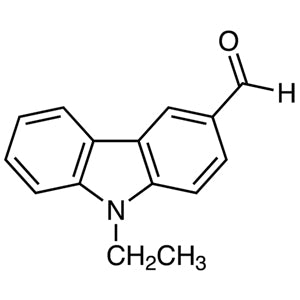
TCI E0576 9-Ethylcarbazole-3-carboxaldehyde N-Ethyl-N-phenylhydrazone is a hydrazone compound that links an N-ethylcarbazole core to an N-ethyl-N-phenylamino group through a hydrazone bridge. It belongs to the family of organic charge-transport materials that have been widely studied in photoconductor research and molecular electronics. In the laboratory, this material is used directly as a functional component of thin films rather than as a synthetic intermediate, which means that purity and lot-to-lot consistency have a direct impact on the reproducibility of the electrical and optical measurement data obtained from it.
The N-ethyl-N-phenyl variant occupies an interesting middle position within the carbazole hydrazone family. Its ethyl group is small enough to keep the molecular weight moderate, so the density of charge-carrier centres remains high, yet it already introduces a degree of conformational flexibility that assists the formation of amorphous layers. The accompanying phenyl group maintains delocalisation of the positive charge over the amino centre, producing a radical cation that is relatively stable after oxidation. This combination of properties makes the compound a frequently chosen starting point when researchers assemble a series of experiments.
In Indonesian laboratories, materials of this type are typically handled in university and institutional research groups working on organic electronics, photoconductive coatings, and molecular materials characterisation. Because the compound functions as the active layer component itself, users generally order it for film-casting and device-fabrication work, where consistent material quality across repeat orders is essential for comparing results between experimental runs conducted over an extended research programme.
TCI brochures (PDF)
- Carbazoles 2025-06-27 · p. 3
Related TCI products
- TCI E0578 81380-24-7 9-Ethylcarbazole-3-carboxaldehyde N-Ethyl-N-(m-tolyl)hydrazone
- TCI E0577 1274948-12-7 9-Ethylcarbazole-3-carboxaldehyde N-Ethyl-N-(o-tolyl)hydrazone
- TCI E0575 88107-84-0 9-Ethylcarbazole-3-carboxaldehyde N-Butyl-N-phenylhydrazone
- TCI E0574 75238-79-8 9-Ethylcarbazole-3-carboxaldehyde N-Benzyl-N-phenylhydrazone
- TCI E0571 73276-70-7 9-Ethylcarbazole-3-carboxaldehyde Diphenylhydrazone
- TCI E0570 75232-44-9 9-Ethylcarbazole-3-carboxaldehyde N-Methyl-N-phenylhydrazone
- Organic photoconductor research: the compound serves as a hole-transport component in thin-film layers, where its stable radical cation supports repeatable photoconductive response measurements across successive experimental runs.
- Molecular electronics studies: researchers incorporate this hydrazone into model device structures to examine how carbazole-based charge-transport centres behave under applied electrical bias in controlled laboratory conditions.
- Amorphous thin-film formation: the conformational flexibility contributed by the ethyl substituent assists glass-forming behaviour, making the material suitable for preparing uniform non-crystalline layers by solution casting methods.
- Comparative structure-property investigations: as a middle member of the carbazole hydrazone family, it functions as a reference compound when research groups benchmark substituent effects on charge-carrier density.
- Optical and electrical characterisation work: the material is applied directly as a functional layer, allowing spectroscopic and conductivity measurements to be correlated with film composition without interference from synthetic precursors.
| Brand | TCI (Tokyo Chemical Industry) |
|---|---|
| CAS number | 84678-52-4 |
| Molecular formula | — |
| Purity | — |
| Category | Chemistry > Building Blocks > Heterocyclic Building Blocks |
| Pack sizes | available in standard TCI research-scale packaging; please confirm the currently listed pack configurations when ordering |
| Physical form | — |
| Storage | keep in the closed original container under the conditions stated on the manufacturer label |
- Product Code: E0576
Store the container tightly closed in a cool, dry, and well-ventilated area, protected from direct sunlight and away from sources of heat or ignition. Amber glass or the original manufacturer container is preferred, since organic charge-transport compounds of this class can be sensitive to prolonged light exposure. Handle the material inside a fume hood while wearing a laboratory coat, chemical-resistant gloves, and safety glasses, and avoid generating dust when weighing the solid. Keep the container sealed between uses to limit moisture uptake and contamination that could affect film quality. Always consult the manufacturer safety data sheet before use, and dispose of residues and contaminated consumables through the laboratory's designated chemical waste stream.
—
Produk Terkait
-
9-Ethylcarbazole-3-carboxaldehydeN-Ethyl-N-(m-tolyl)hydrazone TCI E0578
Regular price Rp 2.942.100,00Regular price -
9-Ethylcarbazole-3-carboxaldehydeN-Ethyl-N-(o-tolyl)hydrazone TCI E0577
Regular price Rp 2.942.100,00Regular price -
9-Ethylcarbazole-3-carboxaldehydeN-Butyl-N-phenylhydrazone TCI E0575
Regular price Rp 2.545.200,00Regular price -
9-Ethylcarbazole-3-carboxaldehydeN-Benzyl-N-phenylhydrazone TCI E0574
Regular price Rp 2.625.000,00Regular price -
9-Ethylcarbazole-3-carboxaldehydeDiphenylhydrazone TCI E0571
Regular price Rp 1.829.100,00Regular price -
9-Ethylcarbazole-3-carboxaldehydeN-Methyl-N-phenylhydrazone TCI E0570
Regular price Rp 2.068.500,00Regular price -
N-Ethylcarbazole-3-carboxaldehyde TCI E0359
Regular price From Rp 1.140.300,00Regular price -
9-Ethylcarbazole TCI E0247
Regular price Rp 1.220.100,00Regular price