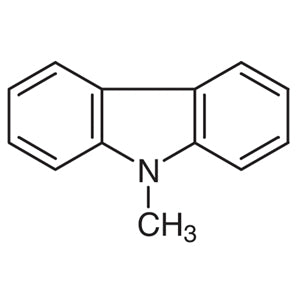
TCI M0960 9-Methylcarbazole is a carbazole derivative bearing a methyl group attached to the ring nitrogen atom. Carbazole itself is an electron-rich tricyclic aromatic system and ranks among the most important scaffolds in organic materials chemistry. Because the nitrogen is methyl-substituted, this compound no longer carries the reactive N–H hydrogen, which makes it a stable and easily handled molecular model for studying the electronic behaviour of the carbazole core. In the laboratory the material serves both as a synthetic intermediate and as a model compound in photophysics and organic electronics research.
The properties that make this compound a preferred choice are its strong electron-donating character and the high thermal stability characteristic of carbazole systems, combined with fluorescence in the ultraviolet-blue region. The methyl group on the nitrogen improves solubility in organic solvents compared with unsubstituted carbazole, while at the same time preventing unwanted side reactions at the N–H position during subsequent transformations. Positions 3 and 6 on the ring remain open for halogenation and cross-coupling reactions, so the compound is a practical starting point for building larger conjugated molecules.
In Indonesian laboratories this material is typically used in university and institutional research settings working on organic synthesis and functional materials. It fits routine bench work where a defined carbazole building block is needed for multi-step preparations, as well as spectroscopic and photophysical studies where a stable reference compound is required. Its ease of handling and storage suits laboratories that run projects over extended periods without dedicated inert-atmosphere infrastructure.
TCI brochures (PDF)
- Carbazoles 2025-06-27 · p. 3
Related TCI products
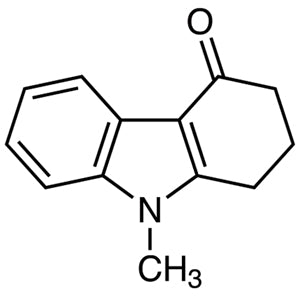
- TCI T2942 27387-31-1 1,2,3,4-Tetrahydro-9-methylcarbazol-4-one
- TCI E0578 81380-24-7 9-Ethylcarbazole-3-carboxaldehyde N-Ethyl-N-(m-tolyl)hydrazone
- TCI E0577 1274948-12-7 9-Ethylcarbazole-3-carboxaldehyde N-Ethyl-N-(o-tolyl)hydrazone
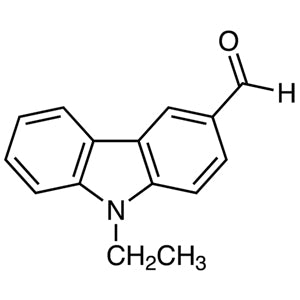
- TCI E0359 7570-45-8 N-Ethylcarbazole-3-carboxaldehyde
- TCI E0247 86-28-2 9-Ethylcarbazole
- TCI E0071 86-28-2 9-Ethylcarbazole
- Heterocyclic building block synthesis — the free 3 and 6 positions accept halogenation and cross-coupling, making it a practical entry point toward larger conjugated carbazole architectures.
- Organic electronics research — its strong electron-donating character and high thermal stability make it a representative model for hole-transporting and host material studies in the laboratory.
- Photophysical characterisation — fluorescence in the ultraviolet-blue region allows the compound to serve as a stable reference material in emission and absorption measurements.
- Model compound studies of the carbazole core — with the reactive N–H replaced by methyl, the electronic behaviour of the ring system can be examined without interference from N–H chemistry.
- Multi-step organic synthesis intermediates — improved solubility in organic solvents relative to unsubstituted carbazole simplifies reaction setup, workup, and purification during extended preparative sequences.
| Brand | TCI |
|---|---|
| CAS number | 1484-12-4 |
| Molecular formula | — |
| Purity | — |
| Category | Chemistry > Building Blocks > Heterocyclic Building Blocks |
| Pack sizes | available in standard TCI research-scale packaging; please confirm the required size when ordering |
| Physical form | — |
| Storage | keep in a tightly closed container, protected from light, in a cool and dry place |
- Product code: M0960
Store the material in its original tightly closed container in a cool, dry, and well-ventilated area, away from direct sunlight and sources of heat or ignition. Amber glass or the supplier's original packaging is suitable for protecting the compound from light. Handle in a fume hood using standard laboratory personal protective equipment, including safety glasses, gloves, and a laboratory coat, and avoid generating or inhaling dust during weighing and transfer. Keep containers closed when not in use, label all working solutions clearly, and consult the supplier safety data sheet before first use and for disposal guidance.
—
Produk Terkait
-
1,2,3,4-Tetrahydro-9-methylcarbazol-4-one TCI T2942
Regular price From Rp 769.650,00Regular price -
9-Ethylcarbazole-3-carboxaldehydeN-Ethyl-N-(m-tolyl)hydrazone TCI E0578
Regular price Rp 2.942.100,00Regular price -
9-Ethylcarbazole-3-carboxaldehydeN-Ethyl-N-(o-tolyl)hydrazone TCI E0577
Regular price Rp 2.942.100,00Regular price -
N-Ethylcarbazole-3-carboxaldehyde TCI E0359
Regular price From Rp 1.140.300,00Regular price -
9-Ethylcarbazole TCI E0247
Regular price Rp 1.220.100,00Regular price -
9-Ethylcarbazole TCI E0071
Regular price From Rp 717.150,00Regular price -
3,6-Dimethylcarbazole TCI D4512
Regular price From Rp 6.175.050,00Regular price -
9-Ethylcarbazole-3-carboxaldehydeN-Ethyl-N-phenylhydrazone TCI E0576
Regular price Rp 2.969.400,00Regular price