

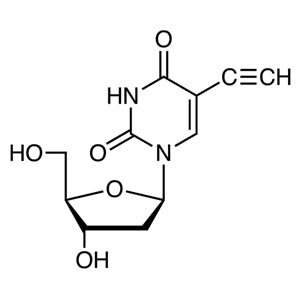
5-Ethynyl-2'-deoxyuridine (EdU) is a chemical compound widely used in molecular biology and biomedical research to directly monitor cell proliferation within a living environment. This compound is capable of incorporating into the DNA of dividing cells, making it an effective tool for identifying actively cycling cells. EdU is particularly valuable in studies that require real-time observation of cellular processes, such as cell growth, differentiation, and apoptosis. Its ability to integrate into DNA during replication allows researchers to track cell division with high specificity and accuracy.
EdU is preferred due to its chemical stability, reactivity, and efficient cellular uptake. Its structure closely resembles a DNA nucleotide, enabling it to be incorporated into DNA during replication. This feature makes it ideal for use in conjugation chemistry, especially in click chemistry techniques, which allow for the specific and rapid attachment of other molecules to DNA. The compound's reactivity and compatibility with various detection methods further enhance its utility in laboratory settings.
In Indonesian laboratories, EdU is commonly used in applied research, including studies on cell growth, drug response, and diagnostic technique development. Its application supports a wide range of biological investigations, from cancer research to tissue regeneration studies. The compound's reliability and effectiveness make it a key reagent in both academic and industrial research environments.
- Cell proliferation studies benefit from EdU’s ability to label dividing cells, providing insights into cell cycle dynamics and growth patterns.
- Cancer research utilizes EdU to monitor tumor cell proliferation and assess the effectiveness of therapeutic interventions.
- Tissue regeneration studies rely on EdU to track cell division in regenerating tissues, aiding in the understanding of repair mechanisms.
- Drug response analysis employs EdU to evaluate how cells respond to various treatments by measuring changes in proliferation rates.
- Diagnostic technique development incorporates EdU to create new methods for detecting and analyzing cellular activity in clinical samples.
| Brand | TCI |
|---|---|
| CAS number | 61135-33-9 |
| Molecular formula | — |
| Purity | — |
| Category | Chemistry > Chemical Biology > Conjugation Chemistry/Click Chemistry |
| Pack sizes | Available in various quantities as per standard laboratory reagent packaging |
| Physical form | Solid powder |
| Storage | Store in a cool, dry place away from light |
EdU should be stored in a cool, dry environment, away from direct light to maintain its chemical stability. It is recommended to use airtight containers to prevent moisture absorption, which could affect its reactivity. When handling EdU, laboratory personnel should wear appropriate personal protective equipment, such as gloves and safety goggles, to avoid skin or eye contact. The compound is generally non-toxic but should be handled with care as with any chemical reagent. Proper labeling of storage containers is essential to ensure safe access and prevent accidental exposure. Regular monitoring of storage conditions ensures the compound remains effective for its intended applications in research.
—
Produk Terkait
-
5-Bromobenzoxazole TCI B5515
Regular price From Rp 1.696.800,00Regular price -
BMS-599626 TCI B5520
Regular price From Rp 3.525.900,00Regular price -
6-Bromobenzo[b]thiophene TCI B5523
Regular price Rp 3.392.550,00Regular price -
3-tert-Butyl4-Methyl(4R,5S)-2,2,5-Trimethyloxazolidine-3,4-dicarboxylate TCI B5538
Regular price Rp 2.969.400,00Regular price -
Biotin-PEG4-Azide TCI B5546
Regular price Rp 7.897.050,00Regular price -
Benzo[b]benzo[4,5]thieno[2,3-d]thiophene TCI B5551
Regular price From Rp 903.000,00Regular price -
2-Bromo-5-(4-hexylphenyl)thiophene TCI B5553
Regular price Rp 3.207.750,00Regular price -
Biotin-PEG4-Amine TCI B5560
Regular price From Rp 1.510.950,00Regular price


![6-Bromobenzo[b]thiophene (CAS 17347-32-9) - TCI B5523 - AMI Scientific](http://amiscientific.com/cdn/shop/files/TCI2510B5523.jpg?v=1767092466&width=533)


![Benzo[b]benzo[4,5]thieno[2,3-d]thiophene (CAS 248-70-4) - TCI B5551 - AMI Scientific](http://amiscientific.com/cdn/shop/files/TCI2510B5551.jpg?v=1768815817&width=533)

