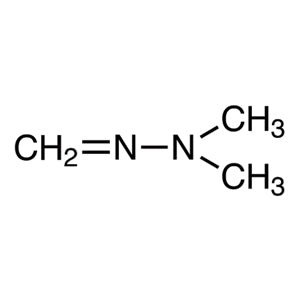
TCI F0713 Formaldehyde Dimethylhydrazone is a simple hydrazone formed from formaldehyde and dimethylhydrazine, and it is classified as a non-heterocyclic building block within the synthetic materials catalogue. Although the structure is small, this compound holds a distinctive role in the organic chemistry laboratory as a reagent that supplies a single carbon atom with an unusual pattern of reactivity. It is widely used by researchers working on hydrazone-based synthesis, carbon–carbon bond formation, and the assembly of nitrogen-containing intermediates that are subsequently converted into other functional groups.
The characteristic that makes this material valuable is the ability of the hydrazone framework to reverse the natural reactivity pattern of the carbonyl group. In an ordinary aldehyde, the carbonyl carbon is electrophilic, but through hydrazone chemistry that same carbon atom can be directed to behave nucleophilically, opening bond-forming routes that are difficult to reach with conventional carbonyl reagents. The dimethylamino group on nitrogen contributes electron-donating character that stabilises intermediates, while the carbon–nitrogen double bond can also act as an acceptor in addition reactions.
In Indonesian laboratories, this reagent is typically found in university research groups and institutional synthesis facilities where methodology development and the preparation of nitrogen-containing intermediates are routine. It suits benches that run small-scale exploratory reactions, where a single-carbon building block with reversed polarity allows a target to be reached in fewer steps. Researchers working on hydrazone chemistry and carbon–carbon bond construction keep it on hand as a specialised addition to their building-block inventory.
Related TCI products
- TCI F0323 1081-15-8 Formaldehyde 2,4-Dinitrophenylhydrazone
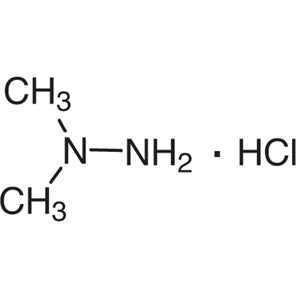
- TCI D0742 593-82-8 1,1-Dimethylhydrazine Hydrochloride
- TCI D0741 306-37-6 1,2-Dimethylhydrazine Dihydrochloride
- TCI M0341 302-15-8 Methylhydrazine Sulfate
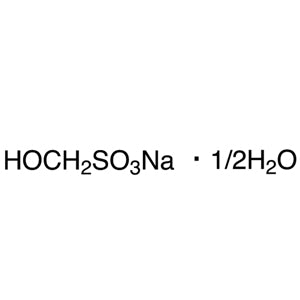
- TCI S0880 63148-74-3 Formaldehyde Sodium Bisulfite Hemihydrate
- TCI H0260 870-72-4 Formaldehyde Sodium Bisulfite
- Hydrazone-based synthesis — the compound is itself a preformed hydrazone, giving researchers a ready starting point for transformations that rely on the carbon–nitrogen double bond as the reactive centre.
- Carbon–carbon bond formation — the reversed polarity of the hydrazone carbon allows it to act as a nucleophilic single-carbon partner in couplings that conventional aldehyde reagents cannot achieve directly.
- Preparation of nitrogen-containing intermediates — the dimethylhydrazone unit introduces nitrogen into a growing framework, giving intermediates that are later elaborated into other functional groups.
- Umpolung methodology studies — laboratories investigating reactivity reversal use this material as a model substrate because its small structure isolates the polarity inversion effect from other influences.
- Addition reaction chemistry — the carbon–nitrogen double bond can function as an acceptor, letting researchers explore addition pathways across the hydrazone linkage under controlled laboratory conditions.
| Brand | TCI |
|---|---|
| CAS number | 2035-89-4 |
| Molecular formula | — |
| Purity | — |
| Category | Chemistry > Building Blocks > Non-Heterocyclic Building Blocks |
| Pack sizes | available in standard TCI research-scale catalogue packaging; please confirm the pack size when ordering. |
| Physical form | — |
| Storage | store according to the conditions stated on the manufacturer's label and safety data sheet. |
- Product code: F0713
Store the container tightly closed in a cool, dry, well-ventilated area away from heat, ignition sources, and direct sunlight, following the conditions given on the manufacturer's label and safety data sheet. Keep the material in its original supplier container, or in a chemically compatible tightly sealed vessel, and label it clearly. Handle the reagent inside a functioning fume hood while wearing safety glasses, gloves, and a laboratory coat. Avoid inhalation of vapour and contact with skin or eyes. Segregate it from incompatible materials, especially oxidising agents and strong acids, and close the container promptly after use to limit exposure to air and moisture. Dispose of residues and contaminated packaging through the laboratory's approved chemical waste procedure.
—
Produk Terkait
-
Formaldehyde2,4-Dinitrophenylhydrazone TCI F0323
Regular price From Rp 1.326.150,00Regular price -
1,1-DimethylhydrazineHydrochloride TCI D0742
Regular price Rp 4.638.900,00Regular price -
1,2-DimethylhydrazineDihydrochloride TCI D0741
Regular price Rp 7.473.900,00Regular price -
MethylhydrazineSulfate TCI M0341
Regular price From Rp 1.008.000,00Regular price -
FormaldehydeSodiumBisulfiteHemihydrate TCI S0880
Regular price From Rp 1.167.600,00Regular price -
FormaldehydeSodiumBisulfite TCI H0260
Regular price Rp 557.550,00Regular price -
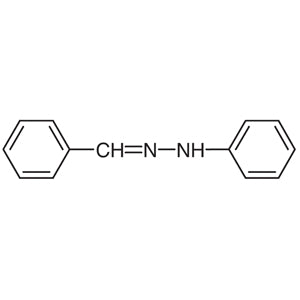
BenzaldehydePhenylhydrazone TCI B0014
Regular price Rp 3.551.100,00Regular price -
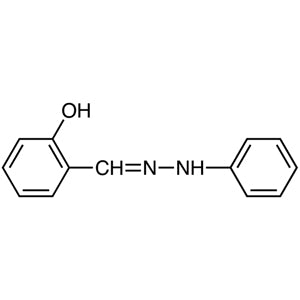
2-HydroxybenzaldehydePhenylhydrazone TCI H1478
Regular price From Rp 1.936.200,00Regular price