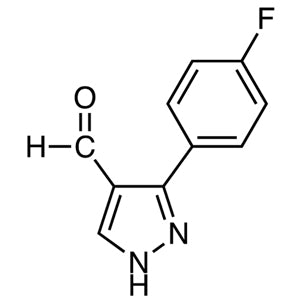
3-(4-Fluorophenyl)pyrazole-4-carboxaldehyde is a chemical compound widely used as a building block in the synthesis of complex molecules. It plays a crucial role in organic chemistry laboratories, where it serves as a versatile intermediate in various synthetic pathways. This compound is particularly valuable for its ability to participate in multiple reaction types, including condensation, substitution, and nucleophilic reactions. Its unique structure, featuring both a fluorinated aromatic ring and an aldehyde group, makes it a key component in the development of pharmaceuticals and advanced materials.
The compound’s reactivity and stability make it a preferred choice for researchers seeking precision in their synthetic processes. The presence of the fluorine atom enhances its reactivity and selectivity, allowing for controlled chemical transformations. Its aldehyde functionality adds versatility, enabling further functionalization and modification. These properties make it an essential tool for chemists working on drug discovery, material science, and other research areas requiring high chemical specificity and efficiency.
In Indonesian laboratories, 3-(4-Fluorophenyl)pyrazole-4-carboxaldehyde is commonly used in organic chemistry research, especially in pharmaceutical and material development projects. It supports the creation of new compounds with potential applications in medicine and industry. Its availability ensures that local scientists can conduct experiments with accuracy and efficiency, contributing to the advancement of scientific research in the region.
Related TCI products
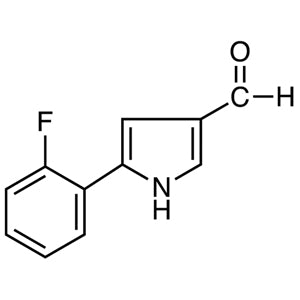
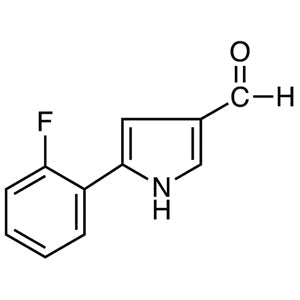
- TCI F1074 881674-56-2 5-(2-Fluorophenyl)pyrrole-3-carboxaldehyde
- TCI B5335 1030825-20-7 2-(5-Bromo-2-methylbenzyl)-5-(4-fluorophenyl)thiophene
- TCI B2764 27469-60-9 1-[Bis(4-fluorophenyl)methyl]piperazine
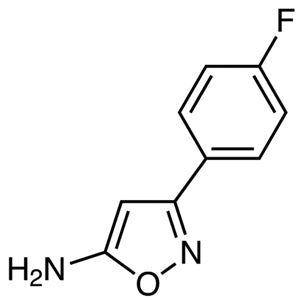
- TCI A2929 81465-82-9 5-Amino-3-(4-fluorophenyl)isoxazole
- TCI F1428 33282-24-5 5-(4-Fluorophenyl)isoxazole-3-carboxylic Acid
- TCI F1356 347-12-6 2-(4-Fluorophenyl)imidazo[1,2-a]pyridine
- Drug synthesis and development where fluorinated compounds are needed for enhanced biological activity and metabolic stability.
- Organic synthesis of complex molecules requiring precise functional group manipulation and reactivity control.
- Material science research involving the creation of fluorinated polymers and advanced composite materials.
- Analytical chemistry applications for the study of fluorinated compounds and their reactivity in different environments.
- Custom compound preparation for academic and industrial research requiring specialized building blocks.
| Brand | TCI |
|---|---|
| CAS number | 306936-57-2 |
| Molecular formula | — |
| Purity | — |
| Category | Chemistry > Building Blocks > Fluorinated Building Blocks |
| Pack sizes | Available in various quantities as per standard laboratory supply options |
| Physical form | Solid or liquid, depending on the specific formulation and supplier packaging |
| Storage | — |
This compound should be stored in a cool, dry, and well-ventilated area away from direct sunlight and sources of heat. It is recommended to use airtight containers made of glass or high-density polyethylene to prevent moisture absorption and contamination. Due to its chemical reactivity, it should be handled with appropriate personal protective equipment, including gloves and safety goggles. Avoid exposure to incompatible substances such as strong oxidizers or acids. Proper labeling and storage in a designated chemical storage cabinet are essential to ensure safety and compliance with laboratory protocols.
—
Produk Terkait
-
5-(2-Fluorophenyl)pyrrole-3-carboxaldehyde TCI F1074
Regular price Rp 2.147.250,00Regular price -
2-(5-Bromo-2-methylbenzyl)-5-(4-fluorophenyl)thiophene TCI B5335
Regular price From Rp 1.035.300,00Regular price -
1-[Bis(4-fluorophenyl)methyl]piperazine TCI B2764
Regular price From Rp 769.650,00Regular price -
5-Amino-3-(4-fluorophenyl)isoxazole TCI A2929
Regular price From Rp 1.510.950,00Regular price -
5-(4-Fluorophenyl)isoxazole-3-carboxylicAcid TCI F1428
Regular price From Rp 2.386.650,00Regular price -
2-(4-Fluorophenyl)imidazo[1,2-a]pyridine TCI F1356
Regular price Rp 2.969.400,00Regular price -
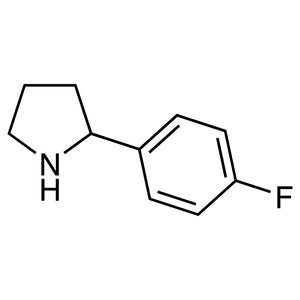
2-(4-Fluorophenyl)pyrrolidine TCI F1329
Regular price Rp 7.129.500,00Regular price -
1-Benzyl-3-(4-fluorophenyl)piperazine TCI F1303
Regular price From Rp 2.094.750,00Regular price

![27469-60-9 1-[Bis(4-fluorophenyl)methyl]piperazine - AMI Scientific](http://amiscientific.com/cdn/shop/files/TCI2510B2764.jpg?v=1768815392&width=533)

![2-(4-Fluorophenyl)imidazo[1,2-a]pyridine (CAS 347-12-6) - TCI F1356 - AMI Scientific](http://amiscientific.com/cdn/shop/files/TCI2510F1356.jpg?v=1768819019&width=533)