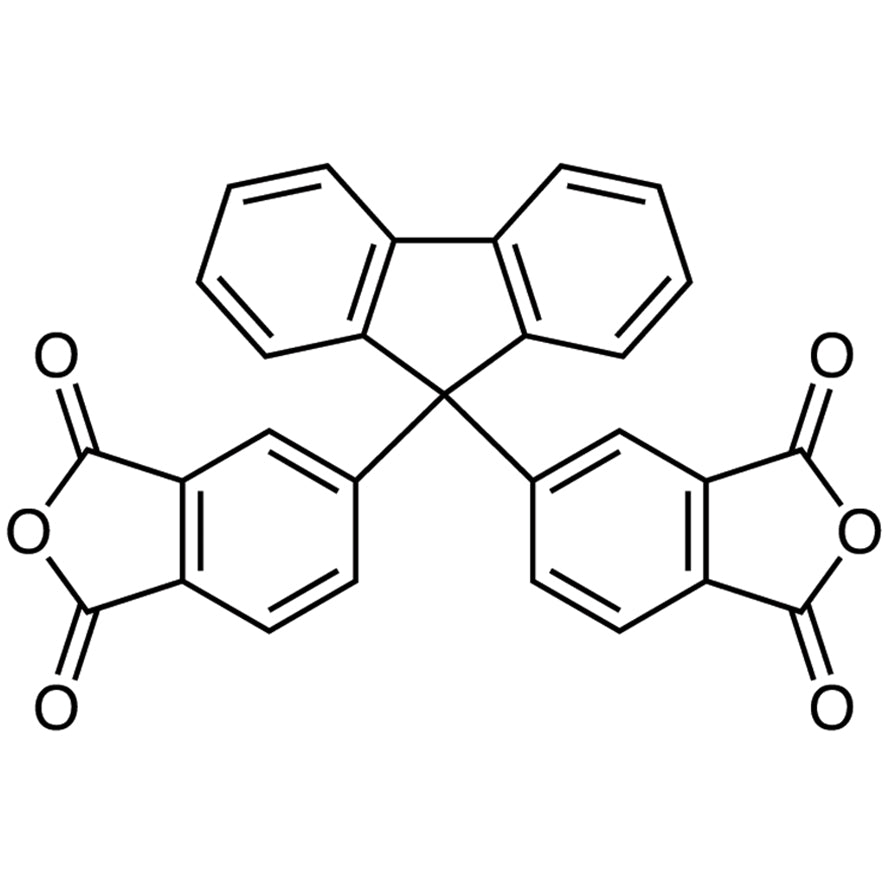
9,9-Bis(3,4-dicarboxyphenyl)fluorene Dianhydride is a specialized chemical compound used in the synthesis of polymers and macromolecules. This material plays a crucial role in laboratory settings where researchers are developing advanced materials with tailored properties. Its complex structure, featuring two anhydride groups on the fluorene core, enables it to act as a key monomer in the creation of thermoplastic polymers and composites. Due to its unique chemical composition, it is widely utilized in material science research to produce high-performance materials with enhanced mechanical and thermal characteristics.
The compound is favored for its chemical stability and reactivity, which can be precisely controlled during synthesis processes. Its ability to form strong, heat-resistant polymer networks makes it ideal for applications requiring durability and thermal resistance. The molecular structure allows for versatile bonding with various other monomers, enabling the development of a wide range of material properties. These characteristics make it a preferred choice for both academic and industrial research in material science.
In Indonesian laboratories, this compound is commonly used in research and development projects focused on advanced materials and chemical technologies. It is particularly valuable in studies related to polymer synthesis, composite materials, and thermal stability. Many research institutions and universities in Indonesia rely on this compound for experiments aimed at creating new materials with improved performance and functionality.
TCI brochures (PDF)
- Raw Materials for Polyimide Synthesis 2026-05-11 · p. 3
- Fluorenes and Fluorenones 2026-04-15 · p. 6
- Monomers 2025-05-28 · p. 38
Related TCI products
- TCI T2698 738-90-9 Tricyclo[6.4.0.0(2,7)]dodecane-1,8:2,7-tetracarboxylic Dianhydride
- TCI T2697 64198-16-9 1,2,3,4-Tetramethyl-1,2,3,4-cyclobutanetetracarboxylic Dianhydride
- TCI B4260 2421-28-5 3,3',4,4'-Benzophenonetetracarboxylic Dianhydride (purified by sublimation)
- TCI B1770 17309-39-6 meso-Butane-1,2,3,4-tetracarboxylic Dianhydride
- TCI B1317 1719-83-1 Bicyclo[2.2.2]oct-7-ene-2,3,5,6-tetracarboxylic Dianhydride
- TCI B0948 2421-28-5 3,3',4,4'-Benzophenonetetracarboxylic Dianhydride
- Polymer Synthesis: This compound is ideal for synthesizing high-performance thermoplastic polymers due to its ability to form stable, heat-resistant networks.
- Composite Material Development: Its chemical structure allows it to integrate seamlessly with various monomers, making it suitable for creating advanced composite materials.
- Thermal Stability Research: The compound's inherent thermal resistance makes it a key component in studies focused on materials that can withstand high temperatures.
- Mechanical Property Enhancement: Its ability to form strong molecular bonds contributes to the development of materials with improved mechanical strength and durability.
- Material Innovation Projects: Researchers use this compound to explore new material formulations with tailored properties for industrial and scientific applications.
| Brand | TCI |
|---|---|
| CAS number | 135876-30-1 |
| Molecular formula | — |
| Purity | — |
| Category | Materials Science > Polymer/Macromolecule Reagents > Monomers |
| Pack sizes | Available in various quantities as per supplier specifications |
| Physical form | Solid |
| Storage | Store in a cool, dry place away from moisture and direct sunlight |
This compound should be stored in a cool, dry environment to maintain its chemical stability and prevent degradation. It is recommended to keep it in a sealed container to minimize exposure to moisture and air. Due to its chemical nature, it should be handled with care, using appropriate personal protective equipment such as gloves and safety goggles. Storage should be in a well-ventilated area to avoid any potential hazards. The compound is not flammable but may react with certain substances, so it should be kept away from incompatible materials. Proper labeling and storage conditions are essential to ensure safe handling and long-term usability in laboratory settings.
—
Produk Terkait
-
Tricyclo[6.4.0.0(2,7)]dodecane-1,8:2,7-tetracarboxylicDianhydride TCI T2698
Regular price From Rp 6.704.250,00Regular priceRp 4.688.250,00Sale price From Rp 6.704.250,00 -
1,2,3,4-Tetramethyl-1,2,3,4-cyclobutanetetracarboxylicDianhydride TCI T2697
Regular price From Rp 3.048.150,00Regular priceRp 2.131.500,00Sale price From Rp 3.048.150,00 -
3,3',4,4'-BenzophenonetetracarboxylicDianhydride(purifiedbysublimation) TCI B4260
Regular price From Rp 2.121.000,00Regular priceRp 1.498.350,00Sale price From Rp 2.121.000,00 -
meso-Butane-1,2,3,4-tetracarboxylicDianhydride TCI B1770
Regular price From Rp 1.749.300,00Regular priceRp 1.239.000,00Sale price From Rp 1.749.300,00 -
Bicyclo[2.2.2]oct-7-ene-2,3,5,6-tetracarboxylicDianhydride TCI B1317
Regular price From Rp 1.140.300,00Regular priceRp 796.950,00Sale price From Rp 1.140.300,00 -
3,3',4,4'-BenzophenonetetracarboxylicDianhydride TCI B0948
Regular price From Rp 955.500,00Regular priceRp 683.550,00Sale price From Rp 955.500,00 -
PyromelliticDianhydride TCI B0040
Regular price From Rp 505.050,00Regular priceRp 352.800,00Sale price From Rp 505.050,00 -
PyromelliticDianhydride(purifiedbysublimation) TCI P2103
Regular price From Rp 2.704.800,00Regular priceRp 1.891.050,00Sale price From Rp 2.704.800,00
![738-90-9 Tricyclo[6.4.0.0(2,7)]dodecane-1,8:2,7-tetracarboxylic Dianhydride - AMI Scientific](http://amiscientific.com/cdn/shop/files/TCI2510T2698.jpg?v=1769143660&width=533)


![1719-83-1 Bicyclo[2.2.2]oct-7-ene-2,3,5,6-tetracarboxylic Dianhydride - AMI Scientific](http://amiscientific.com/cdn/shop/files/TCI2510B1317.jpg?v=1768815163&width=533)