


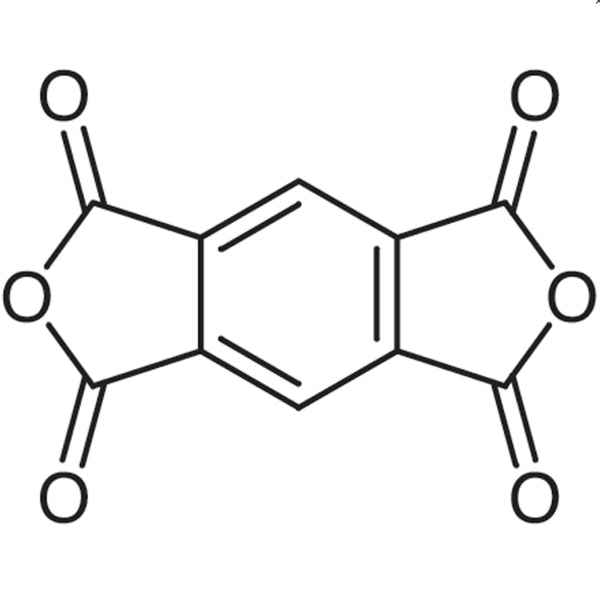
Pyromellitic Dianhydride (PDA), with CAS number 89-32-7, is a chemical compound widely used in materials science research. As a key component in the development of Covalent Organic Frameworks (COFs), PDA functions as a linker that connects molecular units to form complex porous structures. Its role in the laboratory is critical for creating advanced materials with tailored properties. PDA is valued for its ability to participate in chemical reactions under specific conditions, making it an essential tool for researchers working on innovative material development.
PDA is preferred due to its chemical stability and high reactivity. The molecular structure of PDA consists of four anhydride groups, which enable the formation of strong covalent bonds. This characteristic enhances the stability of the COFs it helps create, making it a reliable choice in demanding laboratory environments. Its reactivity also allows for precise control over the synthesis process, ensuring consistency and reproducibility in material development. These properties make PDA a highly sought-after compound in modern materials research.
In Indonesian laboratories, PDA is commonly used in the study of advanced materials, particularly in fields such as energy, gas storage, and sensor development. Researchers rely on PDA to create materials with unique optical, electronic, or catalytic properties. Its application is widespread in both academic and industrial research settings, supporting the growth of scientific innovation in Indonesia. The compound's reliability and versatility make it a staple in the laboratories of material scientists across the country.
TCI brochures (PDF)
- Raw Material for Polyimides and COFs Mellitic Trianhydride 2026-09-14 · p. 1
- Covalent Organic Framework (COF) Linkers 2026-05-18 · p. 6
- Raw Materials for Polyimide Synthesis 2026-05-11 · p. 2
- Monomers 2025-05-28 · p. 37
Related TCI products
- TCI P2103 89-32-7 Pyromellitic Dianhydride (purified by sublimation)
- TCI P0972 128-69-8 3,4,9,10-Perylenetetracarboxylic Dianhydride
- TCI N1128 3711-01-1 2,3,6,7-Naphthalenetetracarboxylic 2,3:6,7-Dianhydride
- TCI N0755 81-30-1 Naphthalene-1,4,5,8-tetracarboxylic Dianhydride (purified by sublimation)
- TCI N0369 81-30-1 Naphthalene-1,4,5,8-tetracarboxylic Dianhydride
- TCI M3617 4253-24-1 Mellitic Trianhydride
- Covalent Organic Frameworks (COFs) synthesis: PDA serves as a critical linker in the formation of porous, stable COFs, enabling precise structural control and enhanced material properties.
- Optical material development: Its chemical versatility allows for the creation of materials with tailored optical properties, useful in photonic and sensing applications.
- Catalytic material synthesis: PDA's reactivity supports the development of catalytic materials with high surface area and active sites for chemical reactions.
- Gas storage and separation: The porous structure of COFs built with PDA makes it suitable for gas adsorption and selective separation applications.
- Sensor development: PDA-based materials are used in the fabrication of sensors that detect environmental or chemical changes with high sensitivity and specificity.
| Brand | TCI |
|---|---|
| CAS number | 89-32-7 |
| Molecular formula | — |
| Purity | — |
| Category | Materials Science > Material Building Blocks > Covalent Organic Frameworks (COFs) Linkers |
| Pack sizes | Available in various quantities as per supplier specifications |
| Physical form | Solid |
| Storage | Store in a cool, dry place away from moisture and direct sunlight |
Pyromellitic Dianhydride should be stored in a cool, dry environment to maintain its chemical stability. It is recommended to use airtight containers to prevent exposure to moisture and air, which can affect its reactivity. In laboratory settings, PDA should be handled with appropriate personal protective equipment, including gloves and safety goggles, to ensure safety during handling. Due to its reactivity, it is important to avoid contact with incompatible substances such as strong acids or bases. Proper ventilation is also necessary when working with PDA to minimize inhalation risks. Storage conditions should be monitored to ensure the material remains in optimal condition for use in research applications.
—
Product Categories
- Material Building BlocksCovalent Organic Frameworks (COFs) LinkersCarboxylic Anhydride Linkers [Covalent Organic Frameworks (COFs) Linkers]
- Polymer/Macromolecule ReagentsCovalent Organic Frameworks (COFs) LinkersCarboxylic Anhydride Linkers [Covalent Organic Frameworks (COFs) Linkers]
- Polymer/Macromolecule ReagentsMonomersTetracarboxylic Dianhydride Monomers
- Polymer/Macromolecule ReagentsPolyimide Raw MaterialsTetracarboxylic Dianhydrides [Polyimide Raw Materials]
Produk Terkait
-
PyromelliticDianhydride(purifiedbysublimation) TCI P2103
Regular price From Rp 2.704.800,00Regular priceRp 1.891.050,00Sale price From Rp 2.704.800,00 -
3,4,9,10-PerylenetetracarboxylicDianhydride TCI P0972
Regular price From Rp 1.485.750,00Regular priceRp 1.038.450,00Sale price From Rp 1.485.750,00 -
2,3,6,7-Naphthalenetetracarboxylic2,3:6,7-Dianhydride TCI N1128
Regular price From Rp 4.161.150,00Regular priceRp 2.909.550,00Sale price From Rp 4.161.150,00 -
Naphthalene-1,4,5,8-tetracarboxylicDianhydride(purifiedbysublimation) TCI N0755
Regular price From Rp 2.227.050,00Regular priceRp 1.557.150,00Sale price From Rp 2.227.050,00 -
Naphthalene-1,4,5,8-tetracarboxylicDianhydride TCI N0369
Regular price From Rp 2.439.150,00Regular priceRp 1.705.200,00Sale price From Rp 2.439.150,00 -
MelliticTrianhydride TCI M3617
Regular price From Rp 1.988.700,00Regular priceRp 1.390.200,00Sale price From Rp 1.988.700,00 -
Tricyclo[6.4.0.0(2,7)]dodecane-1,8:2,7-tetracarboxylicDianhydride TCI T2698
Regular price From Rp 6.704.250,00Regular priceRp 4.688.250,00Sale price From Rp 6.704.250,00 -
1,2,3,4-Tetramethyl-1,2,3,4-cyclobutanetetracarboxylicDianhydride TCI T2697
Regular price From Rp 3.048.150,00Regular priceRp 2.131.500,00Sale price From Rp 3.048.150,00


