

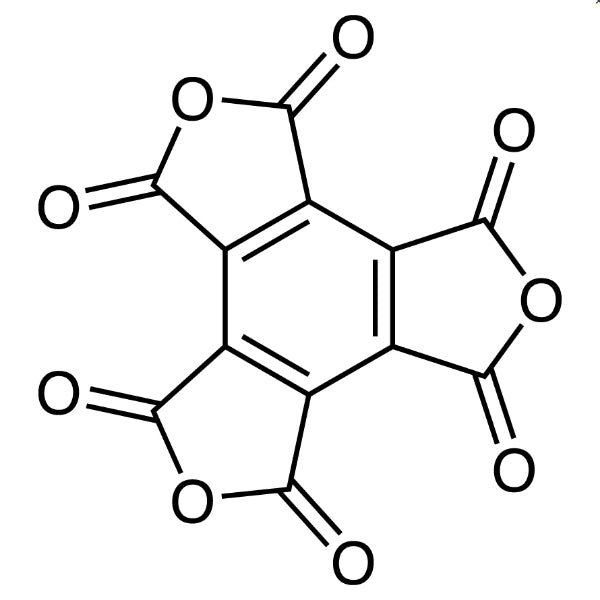
Mellitic trianhydride (MTA), with CAS number 4253-24-1, is a chemical compound widely used in the synthesis of covalent organic frameworks (COFs). As a key building block in materials science, MTA plays a crucial role in constructing porous structures with exceptional chemical stability. Its unique molecular structure enables it to act as a linker, connecting organic molecules to form robust and highly ordered frameworks. This makes it an essential component in the development of advanced materials with tailored properties for various applications. In the laboratory, MTA is valued for its versatility and reliability in creating complex molecular architectures.
MTA is preferred for its chemical stability and ability to form strong covalent bonds with a wide range of organic molecules. Its symmetric structure facilitates precise control over the synthesis process, allowing researchers to design COFs with specific pore sizes and functional groups. These properties make MTA ideal for applications requiring high structural integrity and resistance to harsh chemical environments. The compound's stability under various reaction conditions ensures consistent results, making it a trusted material in both academic and industrial research settings.
In Indonesian laboratories, MTA is commonly used in material science research, particularly in the development of porous materials and advanced catalysts. Its role in creating COFs with high surface area and tunable properties makes it a key ingredient in studies focused on gas storage, separation, and catalytic processes. Researchers in Indonesia rely on MTA to support innovation in chemical engineering and materials development, contributing to the growth of scientific research in the region.
Advantages (TCI brochure)
- Can synthesize tri-directionally branched polyimides and COFs by reacting with amine linkers
- Obtained polyimides and COFs reported to have highly active CO2-capture ability
- Obtained polyimides and COFs can be used for visible light redox catalysis (reported)
TCI brochures (PDF)
- Raw Material for Polyimides and COFs Mellitic Trianhydride 2026-09-14 · p. 1
- Covalent Organic Framework (COF) Linkers 2026-05-18 · p. 6
- Raw Materials for Polyimide Synthesis 2026-05-11 · p. 3
- Monomers 2025-05-28 · p. 38
Related TCI products
- TCI B0040 89-32-7 Pyromellitic Dianhydride
- TCI P2103 89-32-7 Pyromellitic Dianhydride (purified by sublimation)
- TCI P0972 128-69-8 3,4,9,10-Perylenetetracarboxylic Dianhydride
- TCI N1128 3711-01-1 2,3,6,7-Naphthalenetetracarboxylic 2,3:6,7-Dianhydride
- TCI N0755 81-30-1 Naphthalene-1,4,5,8-tetracarboxylic Dianhydride (purified by sublimation)
- TCI N0369 81-30-1 Naphthalene-1,4,5,8-tetracarboxylic Dianhydride
- Covalent Organic Frameworks (COFs) synthesis: MTA serves as a critical linker for constructing highly ordered and porous structures with tunable properties.
- Gas storage and separation applications: The porous nature of COFs built with MTA allows for efficient adsorption and separation of gases, making it suitable for energy and environmental research.
- Catalytic material development: MTA enables the creation of stable and functional catalysts with high surface area and active sites for chemical reactions.
- Advanced material characterization: Its well-defined structure allows for precise analysis using various analytical techniques, aiding in material design and optimization.
- Research in porous materials: MTA supports the development of materials with tailored porosity and chemical functionality for diverse industrial and scientific applications.
From the TCI brochure
- Synthesis of polyimides and COFs
- CO2 capture (reported for resulting polyimides and COFs)
- Visible light redox catalysis (reported)
| Brand | TCI |
|---|---|
| CAS number | 4253-24-1 |
| Molecular formula | — |
| Purity | — |
| Category | Materials Science > Material Building Blocks > Covalent Organic Frameworks (COFs) Linkers |
| Pack sizes | Available in standard laboratory quantities |
| Physical form | Solid, crystalline powder |
| Storage | — |
MTA should be stored in a cool, dry, and well-ventilated area away from moisture and direct sunlight. It is recommended to use airtight containers made of glass or high-density polyethylene to prevent contamination and maintain its chemical integrity. Due to its stability, MTA does not require refrigeration but should be protected from prolonged exposure to air. In laboratory settings, it is important to handle MTA with care, using appropriate personal protective equipment such as gloves and safety goggles. While it is generally non-hazardous, proper handling ensures the safety of both the researcher and the integrity of the material.
—
Product Categories
- Material Building BlocksCovalent Organic Frameworks (COFs) LinkersCarboxylic Anhydride Linkers [Covalent Organic Frameworks (COFs) Linkers]
- Polymer/Macromolecule ReagentsCovalent Organic Frameworks (COFs) LinkersCarboxylic Anhydride Linkers [Covalent Organic Frameworks (COFs) Linkers]
- Polymer/Macromolecule ReagentsMonomersTetracarboxylic Dianhydride Monomers
- Polymer/Macromolecule ReagentsPolyimide Raw MaterialsTetracarboxylic Dianhydrides [Polyimide Raw Materials]
Produk Terkait
-
PyromelliticDianhydride TCI B0040
Regular price From Rp 505.050,00Regular priceRp 352.800,00Sale price From Rp 505.050,00 -
PyromelliticDianhydride(purifiedbysublimation) TCI P2103
Regular price From Rp 2.704.800,00Regular priceRp 1.891.050,00Sale price From Rp 2.704.800,00 -
3,4,9,10-PerylenetetracarboxylicDianhydride TCI P0972
Regular price From Rp 1.485.750,00Regular priceRp 1.038.450,00Sale price From Rp 1.485.750,00 -
2,3,6,7-Naphthalenetetracarboxylic2,3:6,7-Dianhydride TCI N1128
Regular price From Rp 4.161.150,00Regular priceRp 2.909.550,00Sale price From Rp 4.161.150,00 -
Naphthalene-1,4,5,8-tetracarboxylicDianhydride(purifiedbysublimation) TCI N0755
Regular price From Rp 2.227.050,00Regular priceRp 1.557.150,00Sale price From Rp 2.227.050,00 -
Naphthalene-1,4,5,8-tetracarboxylicDianhydride TCI N0369
Regular price From Rp 2.439.150,00Regular priceRp 1.705.200,00Sale price From Rp 2.439.150,00 -
1H,3H-Anthra[2,3-c:6,7-c']difuran-1,3,7,9-tetraone TCI A3795
Regular price From Rp 4.531.800,00Regular priceRp 3.168.900,00Sale price From Rp 4.531.800,00 -
Naphtho[1,2-c:5,6-c']difuran-1,3,6,8-tetraone TCI N1247
Regular price Rp 4.638.900,00Regular priceRp 3.243.450,00Sale price Rp 4.638.900,00



![4430-56-2 1H,3H-Anthra[2,3-c:6,7-c']difuran-1,3,7,9-tetraone - AMI Scientific](http://amiscientific.com/cdn/shop/files/TCI_807c1d22-2757-4538-b8c3-4d4bf17eced3.png?v=1766991176&width=533)
![3711-03-3 Naphtho[1,2-c:5,6-c']difuran-1,3,6,8-tetraone - AMI Scientific](http://amiscientific.com/cdn/shop/files/TCI2510N1247.jpg?v=1768819277&width=533)