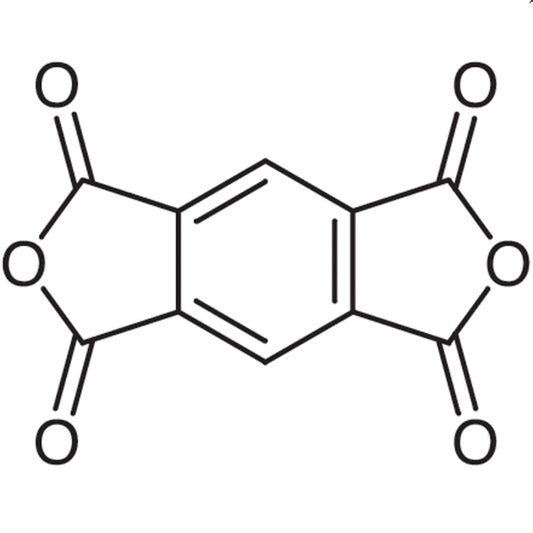
![3711-03-3 Naphtho[1,2-c:5,6-c']difuran-1,3,6,8-tetraone - AMI Scientific](http://amiscientific.com/cdn/shop/files/TCI2510N1247.jpg?v=1768819277&width=1946)
![3711-03-3 Naphtho[1,2-c:5,6-c']difuran-1,3,6,8-tetraone - AMI Scientific](http://amiscientific.com/cdn/shop/files/TCI2510N1247.jpg?v=1768819277&width=1445)
Naphtho[1,2-c:5,6-c']difuran-1,3,6,8-tetraone is a chemical compound widely used in materials science research, particularly in the development of covalent organic frameworks (COFs). As a linker, it plays a crucial role in connecting molecular units to form highly structured and stable materials. This compound is essential for creating materials with tailored optical, electronic, or catalytic properties. Its unique molecular architecture enables precise control over the assembly of COFs, making it a key component in advanced material synthesis.
The compound’s aromatic structure provides both stability and flexibility, allowing it to form strong, durable bonds between molecular components. Its chemical stability ensures it remains effective under various experimental conditions, making it a reliable choice for laboratory use. Additionally, its ability to participate in controlled chemical reactions enhances its utility in the synthesis of functional materials. These properties make it a preferred choice for researchers aiming to develop high-performance materials with specific characteristics.
In Indonesian laboratories, Naphtho[1,2-c:5,6-c']difuran-1,3,6,8-tetraone is commonly used in innovative material research, especially in the fields of renewable energy and chemical sensors. Local researchers often utilize this compound to develop new materials with potential applications in technology and environmental science. Its versatility and reliability make it an important tool for advancing material science in the region.
TCI brochures (PDF)
- Raw Materials for Polyimide Synthesis 2026-05-11 · p. 3
Related TCI products
- TCI A3795 4430-56-2 1H,3H-Anthra[2,3-c:6,7-c']difuran-1,3,7,9-tetraone
- TCI D5970 131891-42-4 Decahydro-1H,3H-4,10:5,9-dimethanonaphtho[2,3-c:6,7-c']difuran-1,3,6,8-tetraone
- TCI B0040 89-32-7 Pyromellitic Dianhydride
- TCI P2103 89-32-7 Pyromellitic Dianhydride (purified by sublimation)
- TCI P0972 128-69-8 3,4,9,10-Perylenetetracarboxylic Dianhydride
- TCI N1128 3711-01-1 2,3,6,7-Naphthalenetetracarboxylic 2,3:6,7-Dianhydride
- Renewable Energy Research: This compound is ideal for creating materials used in solar cells and energy storage devices due to its optical and electronic properties.
- Chemical Sensor Development: Its molecular structure allows for the design of sensitive and selective chemical sensors capable of detecting specific analytes.
- COF Synthesis: It serves as a critical linker in the construction of covalent organic frameworks, enabling the formation of highly ordered and porous materials.
- Catalytic Material Design: The compound's stability and reactivity make it suitable for the development of catalysts with enhanced performance in industrial processes.
- Environmental Material Innovation: It is used in the synthesis of materials that can be applied in pollution control and environmental remediation efforts.
| Brand | TCI |
|---|---|
| CAS number | 3711-03-3 |
| Molecular formula | — |
| Purity | — |
| Category | Materials Science > Material Building Blocks > Covalent Organic Frameworks (COFs) Linkers |
| Pack sizes | Available in standard laboratory quantities as per supplier specifications |
| Physical form | Solid, crystalline powder |
| Storage | Store in a cool, dry place away from direct light and moisture |
This compound should be stored in a cool, dry environment, away from direct sunlight and moisture to maintain its chemical stability. It is recommended to use airtight containers to prevent exposure to air and humidity, which could affect its performance. Due to its chemical nature, it should be handled with appropriate personal protective equipment, such as gloves and safety goggles, to ensure laboratory safety. Avoid contact with incompatible substances to prevent unwanted reactions. Proper labeling and storage conditions are essential to ensure the material remains effective for research applications. Always follow standard laboratory safety protocols when working with this compound.
—
Product Categories
- Material Building BlocksCovalent Organic Frameworks (COFs) LinkersCarboxylic Anhydride Linkers [Covalent Organic Frameworks (COFs) Linkers]
- Polymer/Macromolecule ReagentsCovalent Organic Frameworks (COFs) LinkersCarboxylic Anhydride Linkers [Covalent Organic Frameworks (COFs) Linkers]
- Polymer/Macromolecule ReagentsMonomersTetracarboxylic Dianhydride Monomers
- Polymer/Macromolecule ReagentsPolyimide Raw MaterialsTetracarboxylic Dianhydrides [Polyimide Raw Materials]
Produk Terkait
-
1H,3H-Anthra[2,3-c:6,7-c']difuran-1,3,7,9-tetraone TCI A3795
Regular price From Rp 4.531.800,00Regular price -
Decahydro-1H,3H-4,10:5,9-dimethanonaphtho[2,3-c:6,7-c']difuran-1,3,6,8-tetraone TCI D5970
Regular price Rp 5.062.050,00Regular price -
PyromelliticDianhydride TCI B0040
Regular price From Rp 505.050,00Regular price -
PyromelliticDianhydride(purifiedbysublimation) TCI P2103
Regular price From Rp 2.704.800,00Regular price -
3,4,9,10-PerylenetetracarboxylicDianhydride TCI P0972
Regular price From Rp 1.485.750,00Regular price -
2,3,6,7-Naphthalenetetracarboxylic2,3:6,7-Dianhydride TCI N1128
Regular price From Rp 4.161.150,00Regular price -
Naphthalene-1,4,5,8-tetracarboxylicDianhydride(purifiedbysublimation) TCI N0755
Regular price From Rp 2.227.050,00Regular price -
Naphthalene-1,4,5,8-tetracarboxylicDianhydride TCI N0369
Regular price From Rp 2.439.150,00Regular price
![4430-56-2 1H,3H-Anthra[2,3-c:6,7-c']difuran-1,3,7,9-tetraone - AMI Scientific](http://amiscientific.com/cdn/shop/files/TCI_807c1d22-2757-4538-b8c3-4d4bf17eced3.png?v=1766991176&width=533)
![Decahydro-1H,3H-4,10:5,9-dimethanonaphtho[2,3-c:6,7-c']difuran-1,3,6,8-tetraone (CAS 131891-42-4) - TCI D5970 - AMI Scientific](http://amiscientific.com/cdn/shop/files/TCI2510D5970.jpg?v=1767109510&width=533)