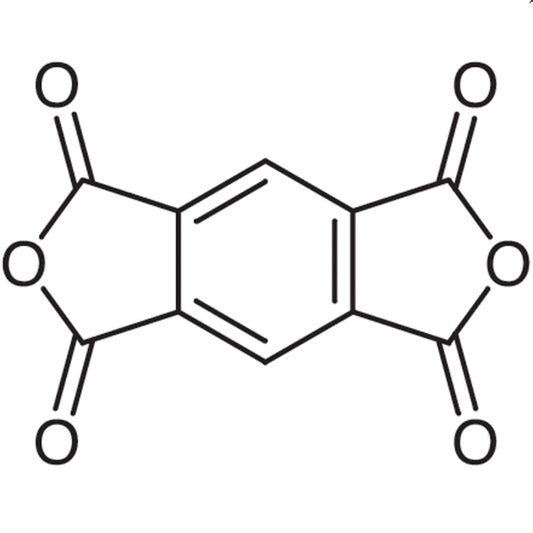
![4430-56-2 1H,3H-Anthra[2,3-c:6,7-c']difuran-1,3,7,9-tetraone - AMI Scientific](http://amiscientific.com/cdn/shop/files/TCI_807c1d22-2757-4538-b8c3-4d4bf17eced3.png?v=1766991176&width=1946)
![4430-56-2 1H,3H-Anthra[2,3-c:6,7-c']difuran-1,3,7,9-tetraone - AMI Scientific](http://amiscientific.com/cdn/shop/files/TCI_807c1d22-2757-4538-b8c3-4d4bf17eced3.png?v=1766991176&width=1445)
TCI A3795, with the CAS number 4430-56-2, is a specialized chemical compound known as 1H,3H-Anthra[2,3-c:6,7-c']difuran-1,3,7,9-tetraone. This compound plays a crucial role in materials science research, particularly in the development of covalent organic frameworks (COFs). It serves as a building block for constructing porous, crystalline structures with tunable pore sizes and functionalities. Its unique molecular architecture enables the formation of stable, highly ordered frameworks that are essential for advanced material synthesis.
The compound is prized for its chemical stability and controlled reactivity, making it ideal for precise chemical reactions. Its complex molecular structure allows for the formation of strong covalent bonds, which contribute to the mechanical strength and chemical resistance of the resulting COFs. These properties ensure that the material maintains its integrity under various experimental conditions, making it a reliable choice for researchers working with sensitive or high-precision applications.
In Indonesian laboratories, TCI A3795 is widely used in material and chemical research to develop new technologies. It is a key component in the synthesis of COFs, which are applied in fields such as gas storage, catalysis, and chemical sensing. Its versatility and performance make it a preferred material for academic and industrial research institutions across Indonesia.
Advantages (TCI brochure)
- Expected high heat resistance due to rigid structure
- Expected low thermal expansion coefficient
- Expected gas barrier properties due to rigid structure
TCI brochures (PDF)
- Raw Material for Synthesis of Polyimides and Acceptor Materials 2,3,6,7-ATCDA 2025-06-19 · p. 1
- Covalent Organic Framework (COF) Linkers 2026-05-18 · p. 6
- Raw Materials for Polyimide Synthesis 2026-05-11 · p. 3
Related TCI products
- TCI N1247 3711-03-3 Naphtho[1,2-c:5,6-c']difuran-1,3,6,8-tetraone
- TCI D5970 131891-42-4 Decahydro-1H,3H-4,10:5,9-dimethanonaphtho[2,3-c:6,7-c']difuran-1,3,6,8-tetraone
- TCI B0040 89-32-7 Pyromellitic Dianhydride
- TCI P2103 89-32-7 Pyromellitic Dianhydride (purified by sublimation)
- TCI P0972 128-69-8 3,4,9,10-Perylenetetracarboxylic Dianhydride
- TCI N1128 3711-01-1 2,3,6,7-Naphthalenetetracarboxylic 2,3:6,7-Dianhydride
- Covalent Organic Frameworks (COFs) synthesis: This compound is ideal for constructing porous, crystalline structures due to its ability to form stable and ordered frameworks with tunable porosity.
- Gas storage and separation applications: The porous structure of COFs made from this material enables efficient adsorption and separation of gases, making it useful in energy and environmental research.
- Catalytic reactions: Its controlled reactivity and stability make it suitable for use in catalytic processes where precise molecular interactions are required.
- Chemical sensing technologies: The material’s ability to form functionalized frameworks allows for the development of sensitive chemical sensors for detection and analysis.
- Advanced material development: Researchers use this compound to explore new material properties and applications in nanotechnology and functional materials.
From the TCI brochure
- Raw material for synthesis of polyimides
- Acceptor materials
- Chemical modification of the anthracene moiety after imidation (ref. 2)
| Brand | TCI |
|---|---|
| CAS number | 4430-56-2 |
| Molecular formula | — |
| Purity | — |
| Category | Materials Science > Material Building Blocks > Covalent Organic Frameworks (COFs) Linkers |
| Pack sizes | — |
| Physical form | — |
| Storage | Store in a cool, dry place away from light and moisture |
Data from the TCI brochure
| Glass transition temperature | exceeding 400°C (polyimides incorporating this product, as reported (ref. 1)) |
|---|---|
| Decomposition temperature | exceeding 580°C (polyimides incorporating this product, as reported (ref. 1)) |
Source: TCI brochure FF208 (2025-06-19)
This compound should be stored in a cool, dry environment, away from direct light and moisture to maintain its chemical stability. It is recommended to use airtight containers made of materials that are chemically inert, such as glass or high-density polyethylene, to prevent contamination and degradation. In laboratory settings, it is important to handle the compound with appropriate personal protective equipment, including gloves and safety goggles, to ensure safe handling. Proper labeling of storage containers is essential for identifying the material and preventing accidental exposure. Due to its chemical nature, it should be kept away from incompatible substances to avoid any potential reactions. Regular monitoring of storage conditions ensures the material remains in optimal condition for research applications.
—
Product Categories
- Material Building BlocksCovalent Organic Frameworks (COFs) LinkersCarboxylic Anhydride Linkers [Covalent Organic Frameworks (COFs) Linkers]
- Polymer/Macromolecule ReagentsCovalent Organic Frameworks (COFs) LinkersCarboxylic Anhydride Linkers [Covalent Organic Frameworks (COFs) Linkers]
- Polymer/Macromolecule ReagentsMonomersTetracarboxylic Dianhydride Monomers
- Polymer/Macromolecule ReagentsPolyimide Raw MaterialsTetracarboxylic Dianhydrides [Polyimide Raw Materials]
Produk Terkait
-
Naphtho[1,2-c:5,6-c']difuran-1,3,6,8-tetraone TCI N1247
Regular price Rp 4.638.900,00Regular priceRp 3.243.450,00Sale price Rp 4.638.900,00 -
Decahydro-1H,3H-4,10:5,9-dimethanonaphtho[2,3-c:6,7-c']difuran-1,3,6,8-tetraone TCI D5970
Regular price Rp 5.062.050,00Regular priceRp 3.539.550,00Sale price Rp 5.062.050,00 -
PyromelliticDianhydride TCI B0040
Regular price Rp 505.050,00Regular priceRp 352.800,00Sale price Rp 505.050,00 -
PyromelliticDianhydride(purifiedbysublimation) TCI P2103
Regular price Rp 2.704.800,00Regular priceRp 1.891.050,00Sale price Rp 2.704.800,00 -
3,4,9,10-PerylenetetracarboxylicDianhydride TCI P0972
Regular price Rp 1.485.750,00Regular priceRp 1.038.450,00Sale price Rp 1.485.750,00 -
2,3,6,7-Naphthalenetetracarboxylic2,3:6,7-Dianhydride TCI N1128
Regular price Rp 4.161.150,00Regular priceRp 2.909.550,00Sale price Rp 4.161.150,00 -
Naphthalene-1,4,5,8-tetracarboxylicDianhydride(purifiedbysublimation) TCI N0755
Regular price Rp 2.227.050,00Regular priceRp 1.557.150,00Sale price Rp 2.227.050,00 -
Naphthalene-1,4,5,8-tetracarboxylicDianhydride TCI N0369
Regular price Rp 2.439.150,00Regular priceRp 1.705.200,00Sale price Rp 2.439.150,00
![3711-03-3 Naphtho[1,2-c:5,6-c']difuran-1,3,6,8-tetraone - AMI Scientific](http://amiscientific.com/cdn/shop/files/TCI2510N1247.jpg?v=1768819277&width=533)
![Decahydro-1H,3H-4,10:5,9-dimethanonaphtho[2,3-c:6,7-c']difuran-1,3,6,8-tetraone (CAS 131891-42-4) - TCI D5970 - AMI Scientific](http://amiscientific.com/cdn/shop/files/TCI2510D5970.jpg?v=1767109510&width=533)