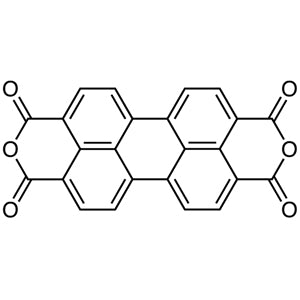
3,4,9,10-Perylenetetracarboxylic Dianhydride is a chemical compound widely used in laboratory settings for research and experimental purposes. It is a key reagent in organic chemistry due to its unique molecular structure, which consists of four carboxylic anhydride groups. This compound plays a critical role in the synthesis of various organic compounds, particularly in the development of pigments and dyes. Its chemical properties make it a versatile tool for chemists and researchers working on complex molecular structures.
The compound is known for its high reactivity and ability to form stable intermediates in chemical reactions. Its molecular structure allows it to react with a wide range of functional groups, making it suitable for a variety of synthetic pathways. Additionally, it exhibits good stability under controlled conditions, which enhances its usability in long-term research projects. These properties make it a preferred choice for scientists seeking reliable and effective chemical reagents.
In Indonesian laboratories, this compound is commonly used in chemical, pharmaceutical, and materials research. It is a valuable resource for institutions and universities engaged in the synthesis of complex compounds and the development of new chemical products. Its availability in the local market supports ongoing scientific activities and innovation in various research fields.
TCI brochures (PDF)
- Organic Transistor (OFET) Materials 2026-05-07 · p. 17
- Covalent Organic Framework (COF) Linkers 2026-05-18 · p. 6
- Raw Materials for Polyimide Synthesis 2026-05-11 · p. 3
- Solar Cell Materials 2026-04-21 · p. 10
- Monomers 2025-05-28 · p. 38
Related TCI products
- TCI P2102 128-69-8 3,4,9,10-Perylenetetracarboxylic Dianhydride (purified by sublimation)
- TCI N0755 81-30-1 Naphthalene-1,4,5,8-tetracarboxylic Dianhydride (purified by sublimation)
- TCI N0369 81-30-1 Naphthalene-1,4,5,8-tetracarboxylic Dianhydride
- TCI B0040 89-32-7 Pyromellitic Dianhydride
- TCI P2103 89-32-7 Pyromellitic Dianhydride (purified by sublimation)
- TCI N1128 3711-01-1 2,3,6,7-Naphthalenetetracarboxylic 2,3:6,7-Dianhydride
- Organic synthesis applications benefit from its reactivity and ability to form stable intermediates in complex reactions.
- Pigment development relies on its molecular structure for creating vibrant and durable color compounds.
- Dye research utilizes its chemical properties to synthesize new and specialized coloring agents.
- Pharmaceutical research employs it in the creation of advanced chemical compounds for drug development.
- Material science studies use it to develop new polymers and functional materials with enhanced properties.
| Brand | TCI |
|---|---|
| CAS number | 128-69-8 |
| Molecular formula | — |
| Purity | — |
| Category | Chemistry > Stains and Dyes (for Research and Experimental Use) > Pigments (for Research and Experimental Use) |
| Pack sizes | Available in standard laboratory quantities as per supplier specifications |
| Physical form | Solid, typically in powder or crystalline form |
| Storage | Store in a cool, dry place away from moisture and direct sunlight |
This compound should be stored in a cool, dry environment to maintain its chemical integrity. It is recommended to keep it in a tightly sealed container to prevent exposure to moisture and air. Due to its reactivity, it should be handled with care, using appropriate personal protective equipment such as gloves and safety goggles. Avoid contact with incompatible substances to ensure safety in the laboratory. Proper labeling of storage containers is essential for safe handling and easy identification. Regular inspection of storage conditions is advised to ensure optimal preservation of the compound.
—
Product Categories
- Electronic MaterialsOrganic Solar Cell (OPV) MaterialsAcceptor Materials [Organic Solar Cell (OPV) Materials]
- Electronic MaterialsOrganic Transistor (OFET) Materialsn-Type Organic Semiconductors [Organic Transistor (OFET) Materials]
- Material Building BlocksCovalent Organic Frameworks (COFs) LinkersCarboxylic Anhydride Linkers [Covalent Organic Frameworks (COFs) Linkers]
- Photonic Materials and Optical MaterialsPerylene Dyes
- Polymer/Macromolecule ReagentsCovalent Organic Frameworks (COFs) LinkersCarboxylic Anhydride Linkers [Covalent Organic Frameworks (COFs) Linkers]
- Polymer/Macromolecule ReagentsMonomersTetracarboxylic Dianhydride Monomers
- Polymer/Macromolecule ReagentsPolyimide Raw MaterialsTetracarboxylic Dianhydrides [Polyimide Raw Materials]
Produk Terkait
-
3,4,9,10-PerylenetetracarboxylicDianhydride(purifiedbysublimation) TCI P2102
Regular price Rp 3.021.900,00Regular priceRp 2.112.600,00Sale price Rp 3.021.900,00 -
Naphthalene-1,4,5,8-tetracarboxylicDianhydride(purifiedbysublimation) TCI N0755
Regular price From Rp 2.227.050,00Regular priceRp 1.557.150,00Sale price From Rp 2.227.050,00 -
Naphthalene-1,4,5,8-tetracarboxylicDianhydride TCI N0369
Regular price From Rp 2.439.150,00Regular priceRp 1.705.200,00Sale price From Rp 2.439.150,00 -
PyromelliticDianhydride TCI B0040
Regular price From Rp 505.050,00Regular priceRp 352.800,00Sale price From Rp 505.050,00 -
PyromelliticDianhydride(purifiedbysublimation) TCI P2103
Regular price From Rp 2.704.800,00Regular priceRp 1.891.050,00Sale price From Rp 2.704.800,00 -
2,3,6,7-Naphthalenetetracarboxylic2,3:6,7-Dianhydride TCI N1128
Regular price From Rp 4.161.150,00Regular priceRp 2.909.550,00Sale price From Rp 4.161.150,00 -
MelliticTrianhydride TCI M3617
Regular price From Rp 1.988.700,00Regular priceRp 1.390.200,00Sale price From Rp 1.988.700,00 -
N,N'-Dimethyl-3,4,9,10-perylenetetracarboxylicDiimide TCI D4429
Regular price From Rp 2.544.150,00Regular priceRp 1.794.450,00Sale price From Rp 2.544.150,00