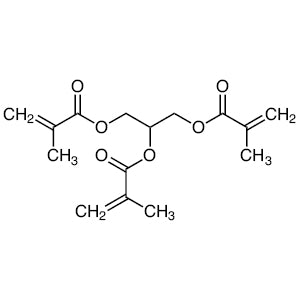
Glycerol Trimethacrylate (GTM) is a chemical compound widely used in materials science and polymer chemistry. It functions as a monomer with a complex chemical structure, consisting of glycerol linked to three methacrylate groups. In the laboratory, GTM serves as a fundamental building block for the synthesis of polymers, composites, and additives. Its versatility makes it a key component in developing materials with enhanced mechanical and chemical properties. GTM is commonly utilized in research settings to create coatings, adhesives, and other functional materials.
One of the key attributes that make GTM a preferred choice is its chemical stability and controlled reactivity. It is stabilized with MEHQ (methyl ether hydroquinone), which acts as an antioxidant to prevent oxidation. This stabilization ensures that GTM maintains its integrity over time, making it suitable for long-term storage and use. Additionally, GTM has a low viscosity, allowing it to mix easily with other substances during synthesis processes. These properties contribute to its widespread adoption in both academic and industrial research environments.
In Indonesian laboratories, GTM is frequently used by researchers in materials science, chemistry, and engineering. It plays a vital role in experiments aimed at developing new materials, such as durable coatings and composite structures. Its availability and stability make it an essential reagent for innovation in various scientific fields, supporting the advancement of polymer-based technologies and functional materials.
- Polymer synthesis applications benefit from GTM’s ability to form cross-linked networks, enhancing the mechanical strength and thermal stability of the final product.
- Coating formulations utilize GTM to improve adhesion, flexibility, and resistance to environmental factors, making it ideal for industrial and academic research.
- Composite material development relies on GTM’s compatibility with various matrices, allowing for the creation of lightweight and durable materials with tailored properties.
- Adhesive formulations leverage GTM’s reactivity and low viscosity to create strong, long-lasting bonds in both laboratory and industrial settings.
- Functional material research uses GTM as a building block for creating smart materials with responsive properties, such as stimuli-sensitive polymers.
| Brand | TCI |
|---|---|
| CAS number | 7401-88-9 |
| Molecular formula | — |
| Purity | — |
| Category | Materials Science > Polymer/Macromolecule Reagents > Monomers |
| Pack sizes | Available in various quantities as per supplier specifications |
| Physical form | Liquid |
| Storage | Store in a cool, dark place away from heat and direct sunlight |
Glycerol Trimethacrylate should be stored in a cool, dark location, away from heat and direct sunlight to maintain its stability. It is recommended to use airtight containers made of materials that are chemically inert, such as glass or high-density polyethylene, to prevent contamination and degradation. Due to its sensitivity to oxidation, it is important to minimize exposure to air and moisture during handling. In laboratory settings, GTM should be handled with appropriate personal protective equipment, including gloves and safety goggles, to ensure safe usage. Regular monitoring of storage conditions is advised to maintain the integrity of the material and ensure its effectiveness in research applications.
—
Produk Terkait
-
TrimethylolpropaneTrimethacrylate(stabilizedwithMEHQ) TCI T0912
Regular price From Rp 477.750,00Regular price -
GlycerolDimethacrylate(mixtureof1,2-and1,3-form)(stabilizedwithMEHQ) TCI B2938
Regular price From Rp 584.850,00Regular price -
PolyethyleneGlycolDimethacrylate(n=approx4)(stabilizedwithMEHQ) TCI T1352
Regular price From Rp 505.050,00Regular price -
PolyethyleneGlycolDimethacrylate(n=approx14)(stabilizedwithMEHQ) TCI P2760
Regular price From Rp 610.050,00Regular price -
PolyethyleneGlycolDimethacrylate(n=approx9)(stabilizedwithMEHQ) TCI P2709
Regular price From Rp 610.050,00Regular price -
NeopentylGlycolDimethacrylate(stabilizedwithMEHQ) TCI N0780
Regular price From Rp 717.150,00Regular price -
EthyleneGlycolDimethacrylate(stabilizedwithHQ) TCI E0102
Regular price From Rp 452.550,00Regular price -
TetramethyleneGlycolDimethacrylate(stabilizedwithMEHQ) TCI T3488
Regular price Rp 3.763.200,00Regular price