

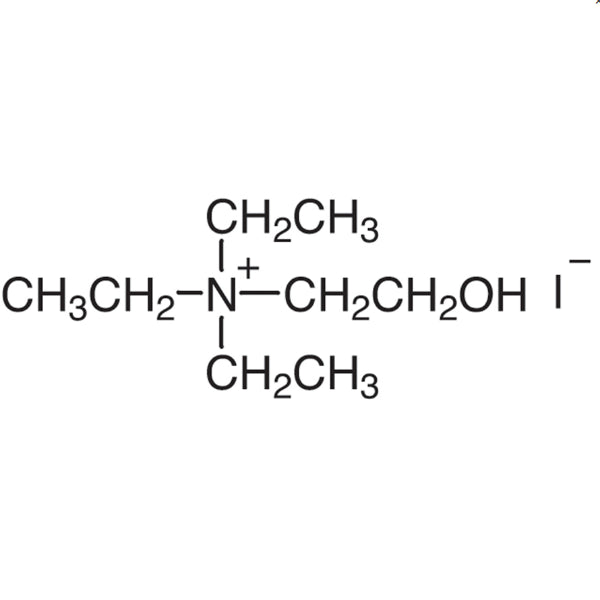
(2-Hydroxyethyl)triethylammonium iodide is a chemical compound widely used in laboratory settings for various synthetic reactions, particularly in the synthesis of organic compounds. This compound serves as a versatile reagent in chemical processes due to its ionic structure, which enhances its reactivity under different chemical conditions. It is commonly employed in nucleophilic substitution reactions and the formation of complex molecular structures. Its role as a building block in chemical synthesis makes it essential for researchers working in diverse fields such as pharmaceuticals, materials science, and industrial chemistry.
The compound's unique properties, including its ability to act as a source of iodide ions, make it a preferred choice in chemical reactions requiring iodide as a reagent or catalyst. The presence of hydroxyl groups in its molecular structure contributes to its polarity, enabling solubility in both organic solvents and water. This solubility characteristic is crucial for its application in various synthetic protocols. Additionally, its chemical stability under specific conditions ensures reliable performance in laboratory experiments.
In Indonesian laboratories, (2-Hydroxyethyl)triethylammonium iodide is frequently used in pure chemical research, drug development, and the production of industrial chemicals. Its availability and effectiveness make it a valuable tool for scientists and researchers aiming to develop new compounds with specific functional properties.
Related TCI products
- TCI T1679 3645-00-9 2-Hydroxyethyl Methyl Terephthalate
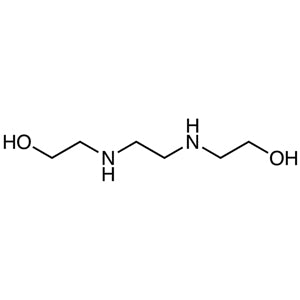
- TCI B3807 4439-20-7 N,N'-Bis(2-hydroxyethyl)ethylenediamine
- TCI B3429 959-26-2 Bis(2-hydroxyethyl) Terephthalate
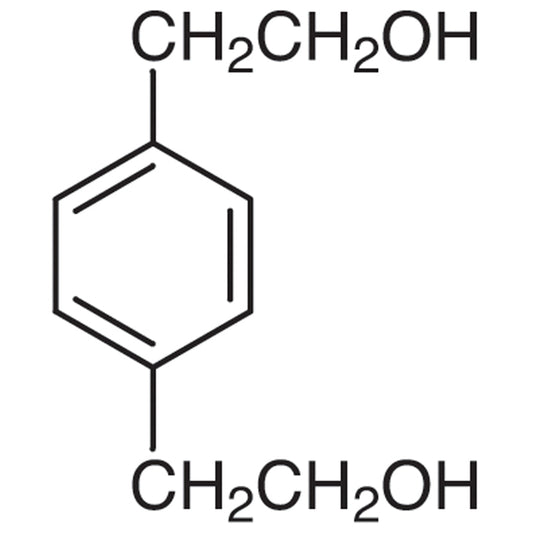
- TCI B2295 5140-03-4 1,4-Bis(2-hydroxyethyl)benzene
- TCI B2263 7146-67-0 N,N-Bis(2-hydroxyethyl)-p-toluenesulfonamide
- TCI B1158 1455-42-1 3,9-Bis(1,1-dimethyl-2-hydroxyethyl)-2,4,8,10-tetraoxaspiro[5.5]undecane
- Organic synthesis applications benefit from its reactivity and ability to act as a nucleophile in substitution reactions.
- Pharmaceutical research utilizes it for the development of new drugs due to its role in complex molecule formation.
- Material science experiments use it to create compounds with specific structural and functional properties.
- Industrial chemical production relies on its stability and solubility for efficient synthesis processes.
- Analytical chemistry applications take advantage of its ionic nature for ion exchange and separation techniques.
| Brand | TCI |
|---|---|
| CAS number | 5957-17-5 |
| Molecular formula | — |
| Purity | — |
| Category | Chemistry > Building Blocks > Non-Heterocyclic Building Blocks |
| Pack sizes | Available in various quantities as per standard laboratory supply |
| Physical form | Solid powder |
| Storage | Store in a cool, dry place away from light and moisture |
This compound should be stored in a cool, dry environment to maintain its chemical stability. It is recommended to keep it in a tightly sealed container to prevent exposure to moisture and air. Due to its ionic nature, it is advisable to use glass or plastic containers that are resistant to chemical degradation. Laboratory personnel should handle it with appropriate personal protective equipment to ensure safety. It is important to avoid contact with incompatible substances to prevent unwanted reactions. Proper storage conditions ensure the compound remains effective for its intended applications in chemical research and synthesis.
—
Produk Terkait
-
2-HydroxyethylMethylTerephthalate TCI T1679
Regular price From Rp 1.803.900,00Regular price -
N,N'-Bis(2-hydroxyethyl)ethylenediamine TCI B3807
Regular price Rp 3.498.600,00Regular price -
Bis(2-hydroxyethyl)Terephthalate TCI B3429
Regular price From Rp 928.200,00Regular price -
1,4-Bis(2-hydroxyethyl)benzene TCI B2295
Regular price Rp 10.865.400,00Regular price -
N,N-Bis(2-hydroxyethyl)-p-toluenesulfonamide TCI B2263
Regular price Rp 2.730.000,00Regular price -
3,9-Bis(1,1-dimethyl-2-hydroxyethyl)-2,4,8,10-tetraoxaspiro[5.5]undecane TCI B1158
Regular price From Rp 1.008.000,00Regular price -
2-HydroxyethylAcetate TCI A1059
Regular price From Rp 2.094.750,00Regular price -
(+/-)-4-(1-Hydroxyethyl)benzonitrile TCI H1955
Regular price From Rp 2.306.850,00Regular price




![1455-42-1 3,9-Bis(1,1-dimethyl-2-hydroxyethyl)-2,4,8,10-tetraoxaspiro[5.5]undecane - AMI Scientific](http://amiscientific.com/cdn/shop/files/TCI2510B1158_609993f6-3ef5-43f1-b023-4ccd96c49dd8.jpg?v=1767231560&width=533)

