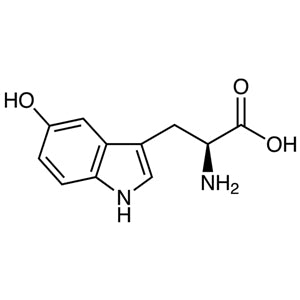
5-Hydroxy-L-tryptophan is a chemical compound widely used in various chemical and biochemical experiments. This compound is part of a group of substances related to the serotonin system in the human body. In the laboratory, it is frequently employed for research involving metabolism, neurobiology, and pharmacology. Due to its reactive nature, it serves as a key precursor in the synthesis of other bioactive compounds. Its molecular structure, featuring hydroxyl and amino groups, allows for diverse chemical reactions, making it a versatile reagent in synthetic chemistry.
The compound exhibits good solubility in organic solvents such as ethyl acetate and acetone, which enhances its utility in various experimental setups. Its chemical and physical properties make it an ideal choice for experiments requiring high reactivity and stability. The compound’s ability to participate in multiple reaction pathways also makes it a valuable tool for researchers aiming to explore biological activity and molecular interactions.
In Indonesian laboratories, 5-Hydroxy-L-tryptophan is commonly used in mental health research, biological therapy development, and pharmaceutical innovation. Its presence in chemical reagents supports ongoing scientific research in educational and research institutions across the country. The compound’s role in studying biological systems and drug development highlights its significance in advancing scientific knowledge and practical applications.
TCI brochures (PDF)
- Bio-Orthogonal Non-Canonical Amino Acid Tagging (BONCAT) Related Reagents 2025-12-23 · p. 2
- Non-Canonical Amino Acids for Protein Site-specific Modification by Genetic Code Expansion 2024-04-16 · p. 2
- Amino Acids and Peptide Synthesis Reagents 2025-08-14 · p. 5
- Neurobiology research benefits from 5-Hydroxy-L-tryptophan as it is involved in serotonin-related pathways, aiding in the study of neural functions and disorders.
- Pharmacological studies utilize this compound to investigate its potential in developing drugs targeting mental health conditions and neurological diseases.
- Metabolic research employs 5-Hydroxy-L-tryptophan to explore its role in biochemical pathways, contributing to understanding physiological processes.
- Biological therapy development incorporates this compound to study its effects on cellular and molecular mechanisms in therapeutic applications.
- Chemical synthesis experiments use 5-Hydroxy-L-tryptophan as a building block for creating bioactive compounds with pharmaceutical relevance.
| Brand | TCI |
|---|---|
| CAS number | 4350-09-8 |
| Molecular formula | — |
| Purity | — |
| Category | Chemistry > Chemical Biology > Peptide Chemistry |
| Pack sizes | — |
| Physical form | — |
| Storage | Store in a cool, dry place away from light and moisture |
5-Hydroxy-L-tryptophan should be stored in a cool, dry place, away from direct light and moisture to maintain its stability and prevent degradation. It is recommended to use airtight containers to minimize exposure to air and contaminants. Due to its reactive nature, it should be handled in a well-ventilated area, and appropriate personal protective equipment should be worn when working with the compound. Avoid contact with incompatible materials such as strong oxidizing agents. Proper labeling and storage conditions are essential to ensure safety and maintain the integrity of the compound during experimentation.
—
Product Categories
Produk Terkait
-
5-Methyl-L-tryptophan TCI M3682
Regular price Rp 8.560.650,00Regular price -
5-Methyl-DL-tryptophan TCI M0452
Regular price From Rp 2.466.450,00Regular price -
cis-4-Hydroxy-D-proline TCI H1358
Regular price From Rp 903.000,00Regular price -
cis-4-Hydroxy-L-proline TCI H1169
Regular price From Rp 530.250,00Regular price -
trans-4-Hydroxy-L-proline TCI H0296
Regular price From Rp 584.850,00Regular price -
5-Benzyloxy-DL-tryptophan TCI B0430
Regular price Rp 2.889.600,00Regular price -
H-L-Tyr(Propargyl)-OH TCI P3021
Regular price Rp 7.950.600,00Regular price -
Phenylthiohydantoin-tryptophan TCI P0378
Regular price From Rp 1.140.300,00Regular price