

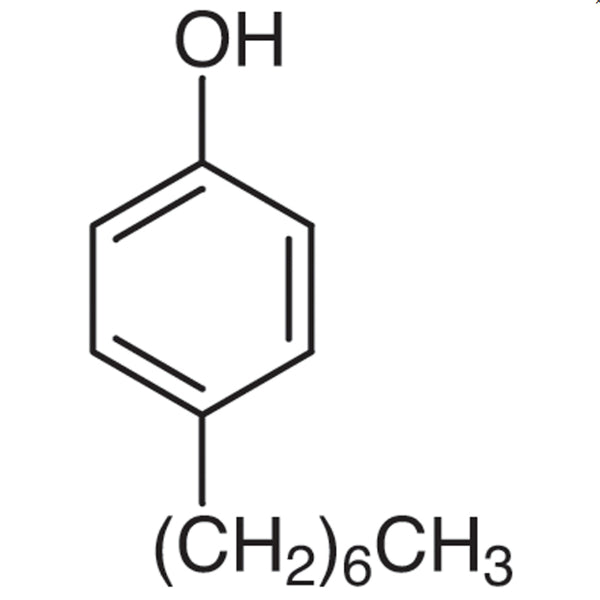
TCI H0615 4-Heptylphenol is an alkylphenol compound consisting of a straight heptyl chain attached at the para position of a phenol ring. The alkylphenol class plays an important role in the laboratory as a starting material for the preparation of nonionic surfactants, as the hydrophobic group in the design of amphiphilic molecules, and as a reference compound in environmental studies. The combination of a polar phenolic head with a long hydrocarbon tail makes this molecule a simple yet representative model for studying interfacial behaviour, solubility, and the interaction of molecules with biological systems as well as environmental matrices.
The properties that lead researchers to select this material are its clear amphiphilicity and its phenolic reactivity, which is readily carried forward in further processing. The hydroxyl group can be ethoxylated, esterified, or converted into an ether to produce derivatives with a tailored hydrophilic–lipophilic balance. The para alkyl chain provides good solubility in non-polar organic solvents while at the same time lowering solubility in water, a characteristic that is exploited in chromatography and in partition studies. Its relatively low melting point means the material may soften at tropical room temperature, so handling deserves attention.
In Indonesian laboratories this compound is typically encountered in synthetic chemistry groups preparing surfactant intermediates, in analytical laboratories that require a well-defined alkylphenol as a comparison compound, and in environmental research units examining alkylphenol residues in water and sediment matrices. Because ambient temperatures in Indonesia are consistently warm, laboratories here generally plan their weighing and transfer steps around the softening behaviour of the material rather than assuming it will remain a firm solid on the bench.
- Nonionic surfactant synthesis: the phenolic hydroxyl is readily ethoxylated, allowing researchers to build alkylphenol ethoxylate structures whose hydrophilic–lipophilic balance can be tuned by chain length.
- Amphiphile and molecular design studies: the straight heptyl tail serves as a well-defined hydrophobic group, giving a predictable building block when assembling amphiphilic molecules for self-assembly research.
- Environmental reference and residue work: as a defined alkylphenol, it functions as a comparison compound when investigating alkylphenol behaviour in water, sediment, and other environmental matrices.
- Chromatography and partition studies: the contrast between good non-polar solvent solubility and low water solubility makes it useful for examining retention, distribution, and partitioning behaviour between phases.
- Derivative preparation via phenolic chemistry: esterification and etherification of the hydroxyl group give access to a family of related derivatives for structure–property comparison in laboratory investigations.
| Brand | TCI |
|---|---|
| CAS number | 1987-50-4 |
| Molecular formula | — |
| Purity | — |
| Category | Chemistry > Building Blocks > Non-Heterocyclic Building Blocks |
| Pack sizes | available in the catalogue pack sizes offered by TCI for this product code |
| Physical form | — |
| Storage | keep tightly closed in a cool place; the material may soften at tropical room temperature |
- Product code: H0615
Store the container tightly closed in a cool, dry, well-ventilated place away from direct sunlight and heat sources, since the relatively low melting point means the material can soften under tropical ambient conditions. Original supplier packaging or tightly sealed glass containers with chemically resistant closures are suitable; avoid leaving the container open on the bench. Handle in a fume hood with gloves, safety glasses, and a laboratory coat, and avoid skin contact and inhalation of dust or vapour. Clean spatulas and weighing vessels after use, label all secondary containers clearly, and consult the manufacturer's safety data sheet before first use and before disposal.
—
Produk Terkait
-
Carvacrol TCI C0026
Regular price From Rp 980.700,00Regular price -
3-Chlorophenol TCI C0242
Regular price From Rp 1.246.350,00Regular price -
4-alpha-Cumylphenol TCI C0684
Regular price From Rp 477.750,00Regular price -
2-Cyclohexylphenol TCI C0732
Regular price From Rp 1.485.750,00Regular price -
4-Cyclohexylphenol TCI C0733
Regular price Rp 2.545.200,00Regular price -
2-Cyclohexyl-5-methylphenol TCI C1272
Regular price Rp 2.386.650,00Regular price -
2-Chloro-4-methoxyphenol TCI C1487
Regular price From Rp 1.193.850,00Regular price


