


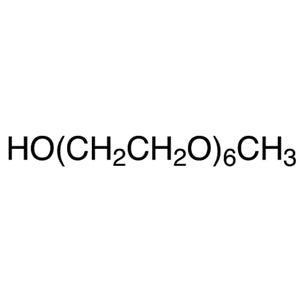
Hexaethylene Glycol Monomethyl Ether (CAS 23601-40-3) from TCI is a monodisperse polyethylene glycol built from exactly six ethylene oxide units, with one terminus capped as a methyl ether and the other left as a free hydroxyl group. Unlike conventional polymeric PEG, which is supplied as a mixture of chain lengths, this compound has a single defined chain length and therefore a precisely defined molecular mass. That characteristic is what makes it an important material for linker construction and for imparting hydrophilic character in bioconjugate chemistry, surface science, and the synthesis of functional molecules in the laboratory.
The reason researchers select this reagent is the combination of excellent water solubility, chain flexibility, and the protein-resistant, anti-fouling behaviour characteristic of oligoethylene glycol chains. The methyl ether terminus is chemically inert, so only one side of the molecule is reactive — an essential feature when a coupling reaction must proceed in a directed manner without forming double bridges between substrates. The free hydroxyl group is readily converted into a tosylate, mesylate, halide, azide, amine, or carboxylic acid, opening numerous routes toward fully functionalised linkers. Because the chain is monodisperse, mass spectrometric characterisation of the products is far cleaner.
In Indonesian laboratories, this material is typically handled in academic research groups, bioconjugate and materials chemistry laboratories, and synthesis facilities preparing custom linkers on a research scale. It is generally used as a starting building block that is activated at the hydroxyl terminus before being coupled to a molecule of interest, with the monodisperse chain length relied upon whenever the analytical result must be unambiguous. Work of this kind is usually performed on a small scale in a fume hood using standard organic synthesis glassware.
TCI brochures (PDF)
- PEGylation Reagents 2025-02-18 · p. 1
- Bioconjugation Reagents 2026-07-07 · p. 6
- Biomaterials Research Reagents 2025-02-19 · p. 7
- Reagents for Biological Research 2025-03-11 · p. 32
Related TCI products
- TCI T1372 23783-42-8 Tetraethylene Glycol Monomethyl Ether
- TCI P1159 23778-52-1 Pentaethylene Glycol Monomethyl Ether
- TCI O0296 25990-96-9 Octaethylene Glycol Monomethyl Ether
- TCI N0699 6048-68-6 Nonaethylene Glycol Monomethyl Ether
- TCI T0709 112-35-6 Triethylene Glycol Monomethyl Ether
- TCI D2904 2050595-03-2 Dodecaethylene Glycol Monomethyl Ether
- Bioconjugate linker synthesis — the single reactive hydroxyl terminus allows directed coupling to one substrate only, preventing the double-bridged by-products that complicate purification of conjugates.
- Hydrophilic spacer construction — the six ethylene oxide units confer excellent water solubility and chain flexibility, improving the aqueous behaviour of otherwise poorly soluble molecular constructs.
- Surface science and anti-fouling coatings — the protein-resistant character typical of oligoethylene glycol chains makes this compound useful when preparing surfaces intended to resist non-specific protein adsorption.
- Functionalised linker preparation — the free hydroxyl group is readily transformed into tosylate, mesylate, halide, azide, amine, or carboxylic acid functionality for onward synthetic routes.
- Analytical reference and mass spectrometric work — the monodisperse, single-chain-length structure gives a defined molecular mass and therefore substantially cleaner mass spectrometric characterisation than polymeric PEG.
| Brand | TCI |
|---|---|
| CAS number | 23601-40-3 |
| Molecular formula | — |
| Purity | — |
| Category | Chemistry > Building Blocks > Non-Heterocyclic Building Blocks |
| Pack sizes | available in the pack sizes listed on this product page |
| Physical form | — |
| Storage | store according to the conditions stated on the manufacturer's label and safety data sheet |
- Catalogue number: H0808
Store the container tightly closed in a cool, dry, well-ventilated place away from direct sunlight, heat sources, and incompatible materials, following the storage conditions stated on the manufacturer's label and safety data sheet. Keep the material in its original supplier container or in a chemically compatible, clearly labelled vessel, and close it promptly after each use, as polyethylene glycol derivatives readily take up atmospheric moisture that can affect subsequent activation and coupling chemistry. Handle the compound in a fume hood using standard laboratory personal protective equipment — safety glasses, gloves, and a laboratory coat. Transfer with clean, dry glassware to avoid contamination, and consult the safety data sheet before first use and before disposal.
—
Product Categories
- Building BlocksNon-Heterocyclic Building BlocksOxygen Compounds [Non-Heterocyclic Building Blocks]
- Chemical BiologyPEGylationPEG Oligomers
- Pharmaceutical Development and Drug Discovery Research ReagentsPEGylationPEG Oligomers
- Pharmaceutical Development and Drug Discovery Research ReagentsDrug Delivery Systems (DDS)PEGylation Reagents (for DDS)
Produk Terkait
-
TetraethyleneGlycolMonomethylEther TCI T1372
Regular price From Rp 1.881.600,00Regular priceRp 1.331.400,00Sale price From Rp 1.881.600,00 -
PentaethyleneGlycolMonomethylEther TCI P1159
Regular price From Rp 4.796.400,00Regular priceRp 3.369.450,00Sale price From Rp 4.796.400,00 -
OctaethyleneGlycolMonomethylEther TCI O0296
Regular price From Rp 5.300.400,00Regular priceRp 3.722.250,00Sale price From Rp 5.300.400,00 -
NonaethyleneGlycolMonomethylEther TCI N0699
Regular price From Rp 4.266.150,00Regular priceRp 2.998.800,00Sale price From Rp 4.266.150,00 -
TriethyleneGlycolMonomethylEther TCI T0709
Regular price From Rp 582.750,00Regular priceRp 423.150,00Sale price From Rp 582.750,00 -
DodecaethyleneGlycolMonomethylEther TCI D2904
Regular price From Rp 4.452.000,00Regular priceRp 3.129.000,00Sale price From Rp 4.452.000,00 -
DiethyleneGlycolMonomethylEther(stabilizedwithBHT) TCI M0537
Regular price From Rp 505.050,00Regular priceRp 352.800,00Sale price From Rp 505.050,00 -
HeptaethyleneGlycolMonomethylEther TCI H1046
Regular price From Rp 5.432.700,00Regular priceRp 3.814.650,00Sale price From Rp 5.432.700,00


