


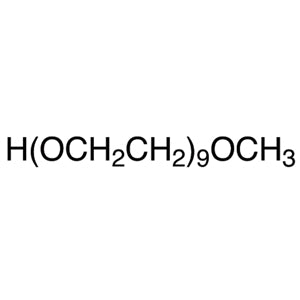
Nonaethylene Glycol Monomethyl Ether from TCI (product code N0699, CAS 6048-68-6) is an oligoethylene glycol made up of nine ethylene oxide units. A methoxy group caps one end of the chain, and the other end carries a free hydroxyl group. Because the chain has a single, well-defined length, this material is different from conventional polymeric PEG, which comes as a mixture of molecular weights. In the laboratory it serves as a building block for linkers, hydrophilic spacers, and monodisperse PEG derivatives whose structures can be controlled precisely.
Its main advantage is its monodisperse structure. Synthetic products built from it are easier to characterise by NMR and mass spectrometry, and results stay consistent from one batch to the next. Only one end of the molecule is reactive, so it can be functionalised selectively, for example by converting it into a tosylate, halide, amine, or carboxylic acid, with no risk of crosslinking. The ethylene oxide chain also makes target molecules more water-soluble and more flexible, two properties that are in high demand in medicinal chemistry and biotechnology.
In Indonesia, this material suits university research laboratories, pharmaceutical research centres, and research groups working in organic synthesis, medicinal chemistry, and bioconjugation. Researchers use it when they need a hydrophilic spacer of exact length, when they are building defined PEG-based linkers for new molecular designs, or when they need reproducible results for publications and development projects. As a TCI building block, it gives Indonesian laboratories a well-characterised starting material for multistep synthetic work.
TCI brochures (PDF)
- PEGylation Reagents 2025-02-18 · p. 1
- Bioconjugation Reagents 2026-07-07 · p. 6
- Biomaterials Research Reagents 2025-02-19 · p. 7
- Reagents for Biological Research 2025-03-11 · p. 32
Related TCI products
- TCI T1372 23783-42-8 Tetraethylene Glycol Monomethyl Ether
- TCI P1159 23778-52-1 Pentaethylene Glycol Monomethyl Ether
- TCI O0296 25990-96-9 Octaethylene Glycol Monomethyl Ether
- TCI T0709 112-35-6 Triethylene Glycol Monomethyl Ether
- TCI H0808 23601-40-3 Hexaethylene Glycol Monomethyl Ether
- TCI D2904 2050595-03-2 Dodecaethylene Glycol Monomethyl Ether
- Linker synthesis: the single reactive hydroxyl end allows stepwise attachment to other molecules, producing linkers of defined length without the crosslinking that difunctional glycols can cause.
- Hydrophilic spacer design: the nine-unit ethylene oxide chain adds water solubility and flexibility between functional groups, which helps in medicinal chemistry and biotechnology research.
- Preparation of monodisperse PEG derivatives: because the chain length is single and defined, the derivatives made from it have exact structures that are easier to purify and characterise than those made from polydisperse PEG.
- Selective end-group functionalisation: the free hydroxyl can be turned into a tosylate, halide, amine, or carboxylic acid, giving versatile intermediates for further coupling reactions.
- Analytical and reproducibility-focused synthesis: its monodisperse nature makes products easier to analyse by NMR and mass spectrometry, so results stay consistent from batch to batch.
| Brand | TCI (product code N0699) |
|---|---|
| CAS number | 6048-68-6 |
| Molecular formula | — |
| Purity | — |
| Category | Chemistry > Building Blocks > Non-Heterocyclic Building Blocks |
| Pack sizes | see the pack size options listed on the product page |
| Physical form | see the TCI product specification and certificate of analysis |
| Storage | follow the conditions stated on the TCI label and Safety Data Sheet |
Store Nonaethylene Glycol Monomethyl Ether in its original tightly closed container, in a cool, dry, well-ventilated place away from direct sunlight, heat sources, and strong oxidising agents. Glycol ethers can absorb moisture from the air, so keep the container sealed when not in use and reseal it promptly after dispensing. Always check the TCI label and Safety Data Sheet for the specific recommended storage conditions. Handle the material under good laboratory practice: wear safety glasses, chemical-resistant gloves, and a lab coat, and work in a fume hood or well-ventilated area. Avoid contact with skin and eyes, and avoid breathing vapours. Use clean, dry glassware and tools to prevent contamination, label secondary containers clearly, and dispose of waste according to institutional and local regulations.
—
Product Categories
- Building BlocksNon-Heterocyclic Building BlocksOxygen Compounds [Non-Heterocyclic Building Blocks]
- Chemical BiologyPEGylationPEG Oligomers
- Chemical BiologyPEGylationmPEG (Methyl Polyethylene Glycols)
- Pharmaceutical Development and Drug Discovery Research ReagentsPEGylationPEG Oligomers
- Pharmaceutical Development and Drug Discovery Research ReagentsPEGylationmPEG (Methyl Polyethylene Glycols)
- Pharmaceutical Development and Drug Discovery Research ReagentsDrug Delivery Systems (DDS)PEGylation Reagents (for DDS)
Produk Terkait
-
TetraethyleneGlycolMonomethylEther TCI T1372
Regular price From Rp 1.881.600,00Regular priceRp 1.331.400,00Sale price From Rp 1.881.600,00 -
PentaethyleneGlycolMonomethylEther TCI P1159
Regular price From Rp 4.796.400,00Regular priceRp 3.369.450,00Sale price From Rp 4.796.400,00 -
OctaethyleneGlycolMonomethylEther TCI O0296
Regular price From Rp 5.300.400,00Regular priceRp 3.722.250,00Sale price From Rp 5.300.400,00 -
TriethyleneGlycolMonomethylEther TCI T0709
Regular price From Rp 582.750,00Regular priceRp 423.150,00Sale price From Rp 582.750,00 -
HexaethyleneGlycolMonomethylEther TCI H0808
Regular price From Rp 2.782.500,00Regular priceRp 1.961.400,00Sale price From Rp 2.782.500,00 -
DodecaethyleneGlycolMonomethylEther TCI D2904
Regular price From Rp 4.452.000,00Regular priceRp 3.129.000,00Sale price From Rp 4.452.000,00 -
HeptaethyleneGlycolMonomethylEther TCI H1046
Regular price From Rp 5.432.700,00Regular priceRp 3.814.650,00Sale price From Rp 5.432.700,00 -
DiethyleneGlycolMonomethylEther(stabilizedwithBHT) TCI M0537
Regular price From Rp 505.050,00Regular priceRp 352.800,00Sale price From Rp 505.050,00


