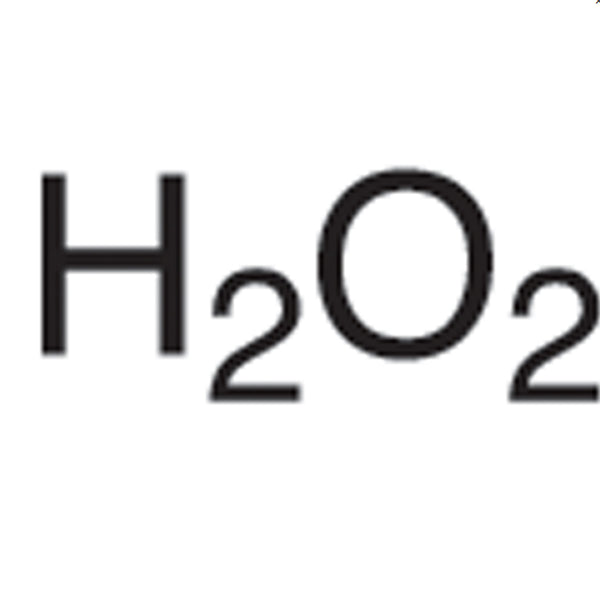
Hydrogen Peroxide (35% in Water) is a solution of hydrogen peroxide in water that has become the most widely used general-purpose oxidant in the modern laboratory. Its appeal rests on the fact that the only major by-product of its oxidation reactions is water, which makes the working process considerably cleaner than that of heavy-metal-based oxidants. At the bench, this reagent is used to oxidise sulfides to sulfoxides or sulfones, to form epoxides, to generate peroxy reagents in situ, and to clean glassware of stubborn organic residues.
The property that makes it a preferred choice is an oxidising strength that can be tuned through the choice of catalyst, the pH, and the reaction temperature. With transition metal catalysts, H₂O₂ can be directed toward epoxidation or hydroxylation; together with carboxylic acids it forms peracids; and under Fenton conditions it generates hydroxyl radicals for the breakdown of organic compounds. The 35% concentration is high enough for synthetic work while remaining far easier to handle than very concentrated preparations, giving chemists a practical balance between reactivity and manageability.
In Indonesian laboratories this grade sits comfortably in synthetic organic chemistry groups, university teaching and research benches, and industrial quality control units that need a dependable oxidant without the disposal burden of metal-based alternatives. The solution decomposes slowly into water and oxygen, particularly on exposure to heat, light, or metal contamination, so the packaging and the way it is stored between uses matter as much as the reagent grade itself for laboratories working in a warm tropical climate.
- Oxidation of sulfides to sulfoxides and sulfones — the tunable oxidising strength lets chemists stop cleanly at the sulfoxide stage or push through to the sulfone by adjusting catalyst, pH, and temperature.
- Epoxidation of alkenes — in combination with transition metal catalysts, hydrogen peroxide can be directed selectively toward epoxide formation while releasing only water as the significant by-product.
- In situ generation of peroxy reagents — reaction with carboxylic acids forms peracids on demand, avoiding the need to store and handle pre-formed peracid preparations in the laboratory.
- Fenton-type degradation of organic compounds — under Fenton conditions the reagent generates hydroxyl radicals capable of breaking down organic species in treatment and degradation studies.
- Cleaning of laboratory glassware — the oxidising action removes stubborn organic residues from glass surfaces that ordinary detergent washing and solvent rinsing leave behind.
| Brand | TCI |
|---|---|
| CAS number | 7722-84-1 |
| Molecular formula | — |
| Purity | — |
| Category | Chemistry > Synthetic Reagents > Oxidation [Synthetic Reagents] |
| Pack sizes | — |
| Physical form | aqueous solution |
| Storage | keep in the original vented packaging, away from heat, light, and metal contamination |
- Concentration: 35% in water
Store the solution in a cool, dark place, well away from heat sources and direct light, both of which accelerate its slow decomposition into water and oxygen. Keep it in the original supplier packaging, which is designed to accommodate the gas released during storage; never transfer it into a tightly sealed container that cannot vent. Avoid any contact with metals or metal residues, as contamination catalyses decomposition. Handle in a fume hood using appropriate gloves, eye protection, and a lab coat, keep the material separated from organic solvents and other combustible substances, and wipe up spills promptly with plenty of water.
—
Produk Terkait
-
TCI B5774 5,10-Bis(4,4,5,5-tetramethyl-1,3,2-dioxaborolan-2-yl)naphtho[1,2-c:5,6-c']bis([1,2,5]oxadiazole)
Regular price Rp 10.255.350,00Regular price -
Dihydroiodide TCI B6569
Regular price From Rp 1.936.200,00Regular price -
Trifluoromethanesulfonate TCI B7003
Regular price From Rp 1.936.200,00Regular price
![5,10-Bis(4,4,5,5-tetramethyl-1,3,2-dioxaborolan-2-yl)naphtho[1,2-c:5,6-c']bis([1,2,5]oxadiazole) - TCI B5774 - AMI Scientific](http://amiscientific.com/cdn/shop/files/TCI2510B5774.jpg?v=1769180228&width=533)