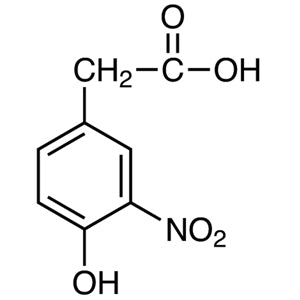
4-Hydroxy-3-nitrophenylacetic Acid is an aromatic compound that carries three distinct functional groups within a single molecule: a phenolic hydroxyl, a nitro group, and an acetic acid side chain. This combination makes it a highly versatile building block in organic synthesis laboratories, because each group can be reacted independently through a different route. The carboxyl group can be activated into an active ester or an amide, the nitro group can be reduced to an amine, and the phenolic hydroxyl can be etherified or acylated according to the design requirements of the target molecule a researcher is working on.
The property that makes this compound a preferred choice is its substitution pattern, which is already cleanly arranged from the outset, so researchers do not need to carry out additional nitration or hydroxylation steps that frequently produce isomer mixtures that are difficult to separate. The phenylacetate framework also places one carbon atom of spacing between the aromatic ring and the acid group, which reduces steric hindrance during amide bond formation. In immunology, the hydroxy-nitrophenyl framework is widely known as a structural component of haptens used in antibody response studies.
In Indonesian laboratories, this compound is typically handled in university research groups, government research institutes, and industrial R&D units engaged in organic synthesis and bioconjugate preparation. It is generally used at bench scale for building intermediates, where the defined substitution pattern shortens the synthetic route and reduces purification work. Laboratories that run immunology-related studies also draw on the hydroxy-nitrophenyl framework as a recognized starting point, and it is usually ordered in small pack quantities matched to each project.
Related TCI products
- Non-heterocyclic building block synthesis: the three independently addressable functional groups let chemists construct complex aromatic intermediates through selective, stepwise transformations without protecting-group gymnastics.
- Amide and peptide-type coupling work: the carboxyl group activates readily into active esters or amides, while the one-carbon spacer minimizes steric hindrance during bond formation.
- Aromatic amine precursor preparation: the nitro group can be reduced cleanly to an amine, giving access to aminophenol-type scaffolds without a separate nitration step that would generate isomers.
- Hapten framework preparation for immunology studies: the hydroxy-nitrophenyl motif is a widely recognized structural component in antibody response research and conjugate design.
- Phenolic derivatization and scaffold elaboration: the phenolic hydroxyl can be etherified or acylated on demand, allowing researchers to tune the molecule toward a specific target design.
| Brand | TCI |
|---|---|
| CAS number | 10463-20-4 |
| Molecular formula | — |
| Purity | — |
| Category | Chemistry > Building Blocks > Non-Heterocyclic Building Blocks |
| Pack sizes | available in standard TCI research pack sizes; please confirm the currently listed option when ordering |
| Physical form | — |
| Storage | store in a tightly closed container in a cool, dry, well-ventilated place away from light |
- Product code: H1362
Store the material in its original tightly closed container in a cool, dry, well-ventilated area, protected from direct sunlight and away from strong oxidizing agents and sources of ignition. Amber glass or the supplier's original packaging is suitable, and the container should be resealed promptly after each use to limit moisture uptake. Handle inside a fume hood using nitrile gloves, safety goggles, and a laboratory coat, and avoid generating dust when weighing the solid. Wash hands thoroughly after handling, clean up spills with dry methods, and follow the supplier safety data sheet together with local laboratory waste disposal procedures.
—
Produk Terkait
-
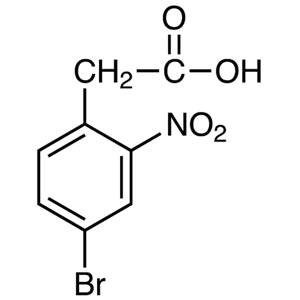
4-Bromo-2-nitrophenylaceticAcid TCI B5159
Regular price From Rp 1.193.850,00Regular price -
3-NitrophenylaceticAcid TCI N0442
Regular price From Rp 1.193.850,00Regular price -
2-NitrophenylaceticAcid TCI N0353
Regular price Rp 1.565.550,00Regular price -
4-NitrophenylaceticAcid TCI N0227
Regular price From Rp 664.650,00Regular price -
2-Methyl-3-nitrophenylaceticAcid TCI M1817
Regular price Rp 743.400,00Regular price -
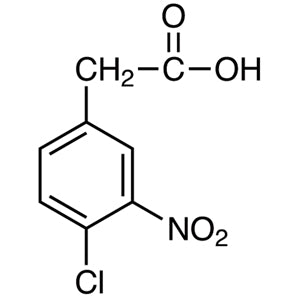
4-Chloro-3-nitrophenylaceticAcid TCI C3347
Regular price Rp 1.829.100,00Regular price -
N,N'-[(Perfluoropropane-2,2-diyl)bis(6-hydroxy-3,1-phenylene)]bis(1,3-dioxo-1,3-dihydroisobenzofuran-5-carboxamide) TCI T4007
Regular price From Rp 1.776.600,00Regular price -
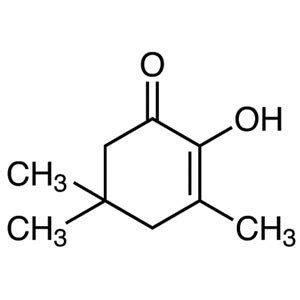
2-Hydroxy-3,5,5-trimethyl-2-cyclohexen-1-one TCI T2723
Regular price Rp 1.273.650,00Regular price


![223255-30-9 N,N'-[(Perfluoropropane-2,2-diyl)bis(6-hydroxy-3,1-phenylene)]bis(1,3-dioxo-1,3-dihydroisobenzofuran-5-carboxamide) - AMI Scientific](http://amiscientific.com/cdn/shop/files/TCI2510T4007.jpg?v=1767144592&width=533)