

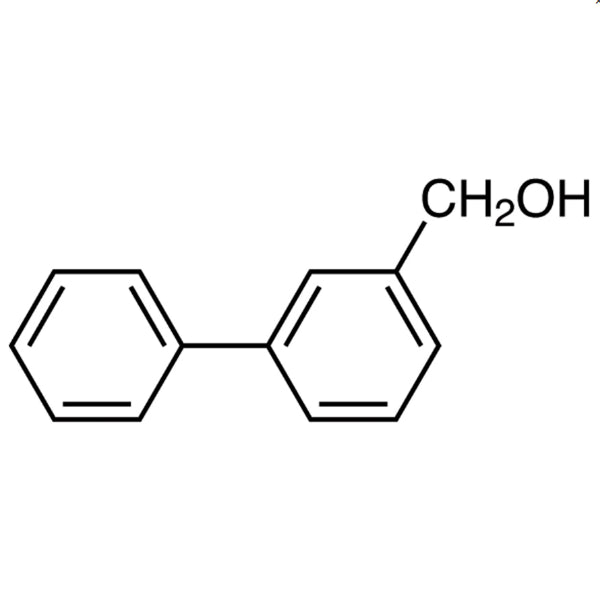
3-(Hydroxymethyl)biphenyl is a chemical compound widely used in synthetic reactions to construct complex molecular structures. As a building block in organic chemistry, it serves as a foundational material for the synthesis of various compounds with biphenyl frameworks substituted with hydroxymethyl groups. This compound plays a crucial role in laboratory settings by enabling the development of new chemical entities through controlled and precise synthetic pathways. Its presence in research labs supports the advancement of organic chemistry and related fields by offering a reliable starting point for molecular design.
The compound's unique properties make it a preferred choice for researchers. Its hydroxymethyl group provides high reactivity, allowing it to participate in a range of chemical reactions such as substitution, reduction, and oxidation. This reactivity, combined with its stable molecular structure, ensures consistent performance in laboratory experiments. The presence of the hydroxymethyl group also enhances its versatility, making it suitable for multiple synthetic applications where controlled chemical transformations are required.
In Indonesian laboratories, 3-(Hydroxymethyl)biphenyl is commonly used in organic chemistry research, particularly in academic institutions and research centers. Its availability in the local market and guaranteed quality make it a relevant choice for projects requiring high-quality chemical building blocks. Researchers rely on its reliability and performance to achieve accurate and reproducible results in their experiments.
Related TCI products
- TCI B4057 19184-65-7 2-(Bromomethyl)-2-(hydroxymethyl)-1,3-propanediol
- TCI B3399 5859-93-8 2,6-Bis(hydroxymethyl)naphthalene
- TCI B2682 2425-41-4 5,5-Bis(hydroxymethyl)-2-phenyl-1,3-dioxane
- TCI B2618 78840-04-7 2,6-Bis(hydroxymethyl)-1,4-dimethoxybenzene
- TCI B1904 34824-20-9 1,8-Bis(hydroxymethyl)anthracene
- TCI B1643 10038-40-1 2,2'-Bis(hydroxymethyl)diphenyl Ether
- Organic synthesis applications benefit from this compound's reactivity and structural versatility, enabling the creation of complex molecules with precise functional groups.
- It is ideal for substitution reactions due to its hydroxymethyl group, which can be modified under various reaction conditions to yield desired products.
- Reduction and oxidation reactions can be effectively carried out using this compound, making it a valuable reagent in synthetic pathways.
- It supports the development of biphenyl derivatives, which are essential in pharmaceutical and materials science research.
- Its stable molecular structure ensures consistent performance in controlled laboratory environments, enhancing the reliability of experimental outcomes.
| Brand | TCI |
|---|---|
| CAS number | 69605-90-9 |
| Molecular formula | — |
| Purity | — |
| Category | Chemistry > Building Blocks > Non-Heterocyclic Building Blocks |
| Pack sizes | Available in standard laboratory quantities |
| Physical form | Solid |
| Storage | Store in a cool, dry place away from light and moisture |
This compound should be stored in a cool, dry environment, away from direct light and moisture to maintain its stability and integrity. It is recommended to use airtight containers to prevent exposure to air and contaminants. Due to its chemical nature, it should be handled with appropriate personal protective equipment, such as gloves and safety goggles, to ensure laboratory safety. While it is not classified as highly hazardous, proper storage and handling practices are essential to prevent degradation and ensure consistent performance in experimental applications. Regular inspection of storage conditions is advised to maintain optimal quality and usability in research settings.
—
Produk Terkait
-
2-(Bromomethyl)-2-(hydroxymethyl)-1,3-propanediol TCI B4057
Regular price From Rp 1.644.300,00Regular price -
2,6-Bis(hydroxymethyl)naphthalene TCI B3399
Regular price From Rp 3.419.850,00Regular price -
5,5-Bis(hydroxymethyl)-2-phenyl-1,3-dioxane TCI B2682
Regular price Rp 6.943.650,00Regular price -
2,6-Bis(hydroxymethyl)-1,4-dimethoxybenzene TCI B2618
Regular price Rp 2.837.100,00Regular price -
1,8-Bis(hydroxymethyl)anthracene TCI B1904
Regular price Rp 9.673.650,00Regular price -
2,2'-Bis(hydroxymethyl)diphenylEther TCI B1643
Regular price From Rp 3.763.200,00Regular price -
2,3-Bis(hydroxymethyl)naphthalene TCI B1589
Regular price Rp 4.479.300,00Regular price -
Diethyl2,2-Bis(hydroxymethyl)malonate TCI B1492
Regular price From Rp 3.021.900,00Regular price


