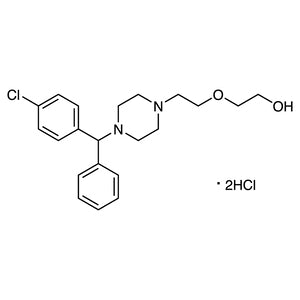
Hydroxyzine Dihydrochloride is the dihydrochloride salt of hydroxyzine, a piperazine-derived compound widely recognised as a histamine H1 receptor antagonist. In the laboratory setting, this material is supplied as a pharmacological research reagent for studying the role of histamine signalling in the central nervous system as well as in peripheral tissues. Its salt form makes the compound far easier to dissolve in aqueous media than the corresponding free base, so preparing stock solutions for receptor assays, cell culture work, and classical pharmacology experiments can be carried out more practically and more consistently.
The property that makes this compound a frequent choice is its pharmacological profile, which is already very well characterised in the scientific literature. Because of this, the compound is often used as a comparison compound or positive control in histamine receptor inhibition assays. The disubstituted piperazine framework, bearing a benzhydryl group and an ether alcohol side chain, provides high affinity for the H1 receptor together with activity at several other targets that are themselves of research interest. The dihydrochloride form yields a relatively stable solid that is easy to weigh out and shows favourable solubility behaviour.
In Indonesian laboratories, this reagent is typically used in university pharmacology and pharmacy departments, research institutes, and pharmaceutical research units where histamine receptor pharmacology is under investigation. It suits teaching and research work that requires a dependable reference antagonist for receptor binding studies, and its ready solubility and stable solid form make it convenient in facilities where stock solutions are prepared regularly and weighing conditions are not always ideal. It is intended for experimental use only.
- Histamine H1 receptor binding studies — the compound's high affinity for the H1 receptor and its thoroughly documented pharmacology make it a dependable reference antagonist for competitive binding experiments.
- Positive control in receptor inhibition assays — because its inhibitory behaviour at histamine receptors is already well characterised in the literature, it provides a trustworthy benchmark against which test compounds can be compared.
- Central nervous system signalling research — the compound is used to probe the contribution of histamine signalling in nervous tissue, where H1 antagonism helps clarify the pathways involved in experimental models.
- Peripheral tissue pharmacology experiments — researchers apply it to investigate histamine-mediated responses outside the central nervous system, taking advantage of its predictable and reproducible antagonist activity.
- Cell culture and stock solution preparation — the dihydrochloride salt dissolves readily in aqueous media, allowing consistent stock solutions to be made for cell-based assays and classical pharmacology protocols.
| Brand | TCI |
|---|---|
| CAS number | 2192-20-3 |
| Molecular formula | — |
| Purity | — |
| Category | Life Science > Biochemicals and Reagents > Pharmaceutical Research Reagents (for Experimental Use) |
| Pack sizes | available in the standard research pack sizes offered by the manufacturer; please confirm the required quantity when ordering |
| Physical form | solid |
| Storage | store according to the manufacturer's instructions on the product label |
- Product code: H1832
Store the container tightly closed in a cool, dry, well-ventilated place, away from moisture and direct sunlight, and follow the storage conditions stated on the manufacturer's label. Keep the material in its original container or in a chemically compatible, clearly labelled, tightly sealed vessel; because the dihydrochloride salt is a hygroscopically sensitive solid in practice, minimise exposure to humid air when weighing. Handle in a fume hood or a well-ventilated area, wearing a laboratory coat, safety glasses, and suitable gloves, and avoid generating or inhaling dust. As a pharmaceutical research reagent intended for experimental use only, it must not be used for human or veterinary purposes. Prepare aqueous stock solutions immediately before use where possible, and consult the manufacturer's safety data sheet before handling and for waste disposal guidance.
—
Produk Terkait
-
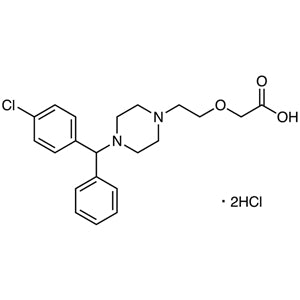
LevocetirizineDihydrochloride TCI L0264
Regular price From Rp 1.193.850,00Regular price -
CetirizineDihydrochloride TCI C2316
Regular price From Rp 2.995.650,00Regular price -
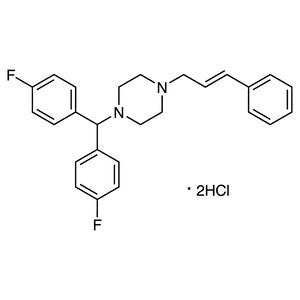
FlunarizineDihydrochloride TCI B6727
Regular price Rp 2.306.850,00Regular price -
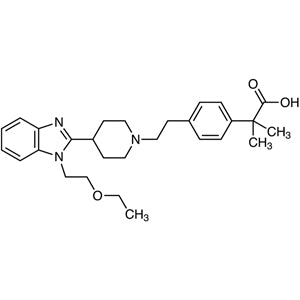
Bilastine TCI B5392
Regular price From Rp 6.758.850,00Regular price -
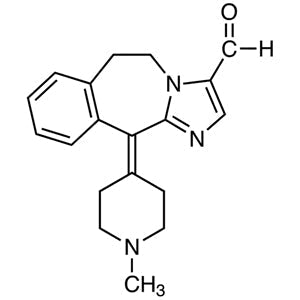
Alcaftadine TCI A3237
Regular price Rp 3.896.550,00Regular price -
AlimemazineTartrate TCI A2813
Regular price From Rp 1.724.100,00Regular price -
AzelastineHydrochloride TCI A2340
Regular price From Rp 1.353.450,00Regular price -
AntazolineHydrochloride TCI A2132
Regular price Rp 3.630.900,00Regular price