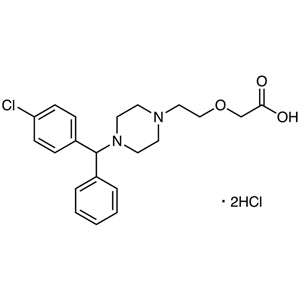
TCI L0264 Levocetirizine Dihydrochloride (CAS 130018-87-0) is the dihydrochloride salt of levocetirizine, the active enantiomer of cetirizine. Cetirizine belongs to the second-generation H1 receptor antagonist class of antihistamines. This product is supplied as a pharmaceutical research reagent for experimental use only and is not intended for therapeutic purposes. In the laboratory, levocetirizine dihydrochloride serves as a comparison compound in analytical method development, as a study material for drug chirality research, and as a pharmacological tool for investigating the role of histamine H1 receptors in cells and tissues. It is valuable to researchers who need a material with a clearly defined identity.
Researchers choose this compound mainly because it is a single-enantiomer form. That makes it especially useful in studies that distinguish activity and analytical behaviour between enantiomers, where a racemic mixture would give ambiguous results. The dihydrochloride salt form generally makes it easier to dissolve in aqueous media when preparing stock solutions. Its molecular structure contains aromatic groups, so it can be detected with UV detectors in liquid chromatography. These properties make it a practical choice for routine analytical work as well as exploratory pharmacological studies.
As a TCI product in the pharmaceutical research reagent category, this material supports work that depends on reproducibility, such as method validation and laboratory-scale dissolution testing. In Indonesian laboratories, it is typically used by pharmaceutical quality control and research and development teams, university pharmacy and chemistry departments, and research institutions working on chiral analysis or receptor pharmacology. Teams developing or verifying HPLC methods for antihistamine compounds, and academic groups running cell-based experiments involving histamine signalling, will find it a useful reagent with a well-documented identity.
TCI brochures (PDF)
- Immune System, Inflammation, Allergy Research Reagents 2025-05-26 · p. 4
- Pharmaceutical Ingredients for Research and Experimental Use 2026-03-09 · p. 35
- Analytical method development: it serves as a well-identified comparison compound when developing and optimising liquid chromatography methods, and its aromatic structure allows UV detection.
- Chiral separation and drug chirality studies: as a single enantiomer of cetirizine, it lets researchers study differences in activity and analytical behaviour between enantiomers.
- Method validation work: its defined identity as a TCI research reagent supports repeatable experiments when assessing parameters such as specificity, linearity, and reproducibility of an analytical procedure.
- Laboratory-scale dissolution testing: the dihydrochloride salt form generally dissolves readily in aqueous media, which is convenient for preparing solutions used in small-scale dissolution experiments.
- Histamine H1 receptor pharmacology: as an H1 receptor antagonist, it acts as a pharmacological tool for studying the role of histamine H1 receptors in cell and tissue models.
| Brand | TCI (product code L0264) |
|---|---|
| CAS number | 130018-87-0 |
| Molecular formula | — |
| Purity | — |
| Category | Life Science > Biochemicals and Reagents > Pharmaceutical Research Reagents (for Experimental Use) |
| Pack sizes | see the available options on the product listing or the TCI catalogue |
| Physical form | refer to the TCI specification sheet and Certificate of Analysis |
| Storage | follow the storage conditions stated on the product label and Safety Data Sheet (SDS) |
Store levocetirizine dihydrochloride in its original, tightly closed container in a cool, dry place away from direct light and moisture, following the conditions stated on the TCI label and Safety Data Sheet. Close the container promptly after each use to limit moisture uptake. Prepare stock solutions in clean, clearly labelled glassware or suitable laboratory vials, and record the preparation date. Wear standard laboratory protective equipment, including gloves, safety glasses, and a lab coat. Avoid creating or inhaling dust, and weigh the material in a well-ventilated area or under local exhaust. This product is for research and experimental use only and is not for human or veterinary therapeutic use. Dispose of waste according to local regulations and institutional procedures.
—
Product Categories
- Biochemicals and ReagentsPharmaceutical Research Reagents (for Experimental Use)Anti-allergic Ingredients (for Research and Experimental Use)
- Biochemicals and Reagents
- Cell BiologyImmune System, Inflammation, Allergy ResearchHistamine Receptor Antagonists
- Pharmaceutical Development and Drug Discovery ResearchPharmaceutical Research Reagents (for Experimental Use)Anti-allergic Ingredients (for Research and Experimental Use)
Produk Terkait
-
CetirizineDihydrochloride TCI C2316
Regular price From Rp 3.048.150,00Regular priceRp 2.147.250,00Sale price From Rp 3.048.150,00 -
HydroxyzineDihydrochloride TCI H1832
Regular price From Rp 955.500,00Regular priceRp 683.550,00Sale price From Rp 955.500,00 -
FlunarizineDihydrochloride TCI B6727
Regular price Rp 2.359.350,00Regular priceRp 1.665.300,00Sale price Rp 2.359.350,00 -
AzelastineHydrochloride TCI A2340
Regular price From Rp 1.405.950,00Regular priceRp 998.550,00Sale price From Rp 1.405.950,00 -
PromethazineHydrochloride TCI P2029
Regular price From Rp 1.563.450,00Regular priceRp 1.108.800,00Sale price From Rp 1.563.450,00 -
OlopatadineHydrochloride TCI O0361
Regular price Rp 10.758.300,00Regular priceRp 7.539.000,00Sale price Rp 10.758.300,00 -
Desloratadine TCI D3787
Regular price From Rp 1.351.350,00Regular priceRp 960.750,00Sale price From Rp 1.351.350,00 -
Chlorcyclizine TCI C3867
Regular price Rp 5.962.950,00Regular priceRp 4.185.300,00Sale price Rp 5.962.950,00