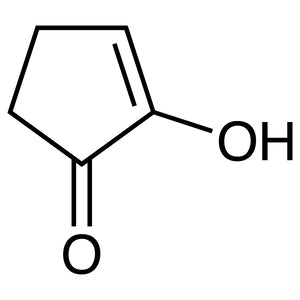
TCI H1874 is 2-Hydroxycyclopent-2-en-1-one, a five-membered cyclic building block that combines a ketone group and a hydroxyl group positioned on the ring double bond. This conjugated enol arrangement makes it a versatile synthon for organic chemists constructing cyclopentane frameworks as well as cyclopentenone derivatives, two motifs frequently encountered in natural product chemistry and in bioactive molecules. In the laboratory, the material serves as a reaction starting material, as an analytical reference compound, and as a model substrate for studying the behaviour of reactive conjugated enol systems.
The property that makes this compound attractive is the combination of the relatively high acidity of the enolic hydroxyl group with a conjugated carbonyl system. As a result, the molecule can act as a nucleophile once deprotonated, and equally as a Michael acceptor at the appropriate position. This dual-sided reactivity gives chemists a wide choice of synthetic routes starting from a single common precursor. The mildly strained five-membered ring framework also influences the selectivity of addition and condensation reactions, which is why the compound is often selected when a specific bond-forming position needs to be directed.
In Indonesian laboratories, TCI H1874 is typically found in synthetic organic chemistry groups at universities and research institutes, as well as in development laboratories working on fine chemical intermediates. It is generally handled at the bench scale for exploratory route development, method validation work, and student research projects where a well-characterised cyclic building block is required. Because it is supplied as a catalogued research chemical, it is normally ordered per experiment or per project rather than held as a bulk process raw material.
Related TCI products
- TCI H1664 17994-25-1 1-Hydroxycyclopropanecarboxylic Acid
- TCI M1991 6125-57-1 Methyl trans-4-Hydroxycyclohexanecarboxylate
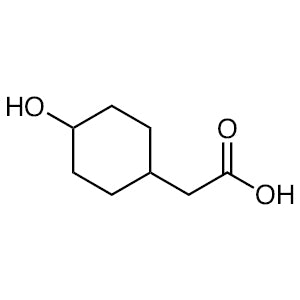
- TCI H1753 99799-09-4 2-(4-Hydroxycyclohexyl)acetic Acid (cis- and trans- mixture)
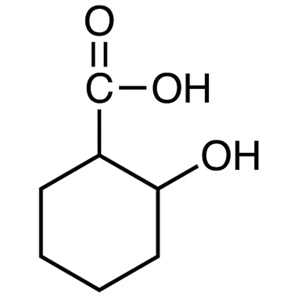
- TCI H1409 609-69-8 2-Hydroxycyclohexanecarboxylic Acid (cis- and trans- mixture)
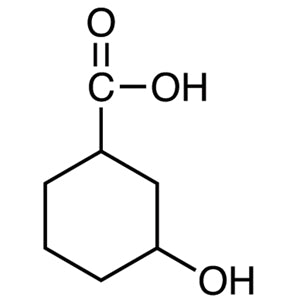
- TCI H1408 606488-94-2 3-Hydroxycyclohexanecarboxylic Acid (cis- and trans- mixture)
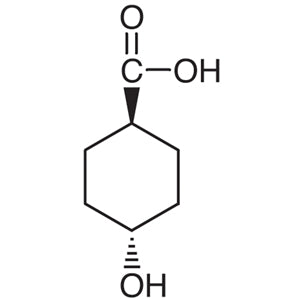
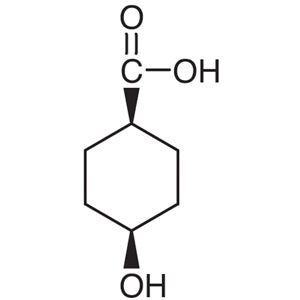
- TCI H1175 3685-26-5 trans-4-Hydroxycyclohexanecarboxylic Acid
- Cyclopentenone synthesis: the conjugated enol ring provides a direct entry point to cyclopentenone derivatives without the need to construct the strained five-membered carbocycle from acyclic precursors first.
- Natural product route development: cyclopentane and cyclopentenone motifs recur throughout natural product scaffolds, so this building block shortens exploratory syntheses targeting those structural families in research settings.
- Michael addition chemistry: the conjugated carbonyl system allows the molecule to function as a Michael acceptor, supporting carbon–carbon bond formation studies at a defined ring position.
- Nucleophilic alkylation after deprotonation: the acidic enolic hydroxyl is readily deprotonated, generating a nucleophilic species that can be alkylated or acylated in controlled bond-forming sequences.
- Analytical reference standard: the material serves as a comparison compound for chromatographic and spectroscopic identification work where an authentic cyclic enol reference is required for confirmation.
| Brand | TCI (Tokyo Chemical Industry) |
|---|---|
| CAS number | 10493-98-8 |
| Molecular formula | — |
| Purity | — |
| Category | Chemistry > Building Blocks > Non-Heterocyclic Building Blocks |
| Pack sizes | available in catalogue research-scale pack sizes; please confirm the currently listed packaging option when ordering |
| Physical form | — |
| Storage | keep in the closed original container under the conditions stated on the manufacturer label and safety data sheet |
- Chemical name: 2-Hydroxycyclopent-2-en-1-one
Store the container tightly closed in a cool, dry, well-ventilated area away from direct sunlight, heat sources, strong oxidising agents, and incompatible materials, following the storage conditions stated on the manufacturer label and safety data sheet. Keep the material in its original supplier container, or in a chemically compatible, clearly labelled and tightly sealed alternative if transfer is necessary. Handle in a fume hood using appropriate personal protective equipment including safety glasses, chemical-resistant gloves, and a laboratory coat. Avoid inhalation of vapour and direct contact with skin and eyes, minimise unnecessary exposure of the material to air and moisture during weighing, and review the full safety data sheet before first use. Dispose of residues and contaminated materials in accordance with applicable laboratory waste regulations.
—
Produk Terkait
-
1-HydroxycyclopropanecarboxylicAcid TCI H1664
Regular price From Rp 1.140.300,00Regular price -
Methyltrans-4-Hydroxycyclohexanecarboxylate TCI M1991
Regular price From Rp 717.150,00Regular price -
2-(4-Hydroxycyclohexyl)aceticAcid(cis-andtrans-mixture) TCI H1753
Regular price From Rp 1.060.500,00Regular price -
2-HydroxycyclohexanecarboxylicAcid(cis-andtrans-mixture) TCI H1409
Regular price From Rp 6.970.950,00Regular price -
3-HydroxycyclohexanecarboxylicAcid(cis-andtrans-mixture) TCI H1408
Regular price Rp 3.658.200,00Regular price -
trans-4-HydroxycyclohexanecarboxylicAcid TCI H1175
Regular price From Rp 3.949.050,00Regular price -
cis-4-HydroxycyclohexanecarboxylicAcid TCI H0980
Regular price From Rp 4.373.250,00Regular price -
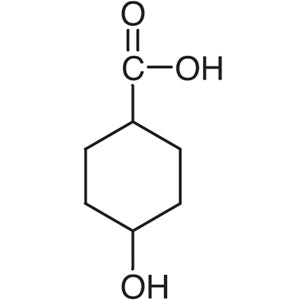
4-HydroxycyclohexanecarboxylicAcid(cis-andtrans-mixture) TCI H0960
Regular price From Rp 4.213.650,00Regular price