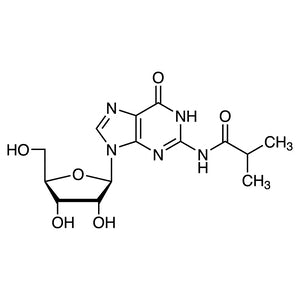
N2-Isobutyrylguanosine is a chemical compound widely used in the field of chemical biology, particularly in the study of nucleic acids. As a derivative of guanosine, it plays a crucial role in research related to RNA and DNA, serving as a key building block in the synthesis of biological compounds. This compound is essential for understanding the structural and functional aspects of nucleic acids, making it a valuable tool for scientists working in molecular biology and biochemistry. Its presence in laboratory settings supports the development of new therapeutic agents and the exploration of genetic mechanisms.
The compound is known for its complex chemical structure, which includes polar characteristics and high reactivity. These properties make it ideal for chemical reactions that require stability and the ability to interact with other molecules. Its reactivity allows it to participate in various biochemical processes, such as nucleotide modifications and the synthesis of nucleic acid analogs. The compound's unique chemical profile enables it to be used in a wide range of experimental applications, including drug development and genetic research.
In Indonesian laboratories, N2-Isobutyrylguanosine is commonly used by researchers in chemical biology, pharmacology, and genetics. It is an essential component in studies related to drug development, gene expression analysis, and molecular structure investigations. Its availability supports local scientific efforts, contributing to advancements in biotechnology and pharmaceutical research.
- Nucleotide Modification Studies – This compound is ideal for investigating the structural changes in nucleotides, which are critical for understanding genetic mutations and their impact on biological systems.
- Drug Development Research – Its chemical properties make it suitable for synthesizing nucleotide-based drugs, offering potential applications in the treatment of genetic disorders and viral infections.
- Genetic Expression Analysis – It supports experiments that aim to understand how gene expression is regulated, providing insights into cellular processes and disease mechanisms.
- Biochemical Reaction Studies – The high reactivity of N2-Isobutyrylguanosine allows it to be used in studying the mechanisms of biochemical reactions within biological systems.
- Molecular Structure Analysis – Its complex structure makes it a valuable tool in analyzing the molecular architecture of nucleic acids and their derivatives.
| Brand | — |
|---|---|
| CAS number | — |
| Molecular formula | — |
| Purity | — |
| Category | — |
| Pack sizes | — |
| Physical form | — |
| Storage | — |
- Brand – TCI
- CAS Number – 64350-24-9
- Category – Chemistry > Chemical Biology > Nucleic Acid Chemistry
- Pack Sizes – Available in various quantities as per standard laboratory requirements
- Physical Form – Solid powder
- Storage Note – Store in a cool, dry place away from direct sunlight
N2-Isobutyrylguanosine should be stored in a cool, dry environment to maintain its chemical integrity. It is recommended to keep the compound in a tightly sealed container to prevent moisture absorption and contamination. The substance is sensitive to light, so it should be stored away from direct sunlight and heat sources. When handling, it is important to use appropriate personal protective equipment, such as gloves and safety goggles, to ensure laboratory safety. Proper ventilation should be maintained in the workspace to minimize exposure to airborne particles. Regular monitoring of storage conditions ensures the compound remains stable and suitable for use in research applications.
—
Produk Terkait
-
TCI B5774 5,10-Bis(4,4,5,5-tetramethyl-1,3,2-dioxaborolan-2-yl)naphtho[1,2-c:5,6-c']bis([1,2,5]oxadiazole)
Regular price Rp 10.255.350,00Regular price -
Dihydroiodide TCI B6569
Regular price From Rp 1.936.200,00Regular price -
Trifluoromethanesulfonate TCI B7003
Regular price From Rp 1.936.200,00Regular price
![5,10-Bis(4,4,5,5-tetramethyl-1,3,2-dioxaborolan-2-yl)naphtho[1,2-c:5,6-c']bis([1,2,5]oxadiazole) - TCI B5774 - AMI Scientific](http://amiscientific.com/cdn/shop/files/TCI2510B5774.jpg?v=1769180228&width=533)