


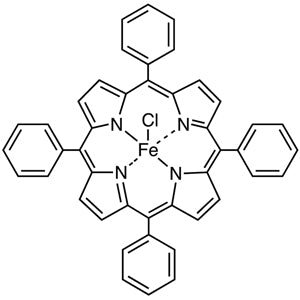
Iron(III) Tetraphenylporphyrin Chloride is a chemical compound widely utilized in laboratory settings for catalytic reactions and C-H activation studies. As a member of the porphyrin family, it possesses a complex molecular structure that enables it to act as a highly reactive catalyst. This compound is particularly valuable in organic and inorganic chemistry research due to its ability to facilitate a variety of chemical transformations. Its unique electronic properties make it a versatile tool for scientists aiming to explore new reaction pathways and mechanisms.
The compound’s reactivity, stability, and solubility in organic solvents make it a preferred choice for many researchers. Its ability to maintain structural integrity under various experimental conditions ensures consistent performance in laboratory applications. Additionally, its high purity and predictable behavior contribute to reliable results in chemical experiments. These properties position Iron(III) Tetraphenylporphyrin Chloride as a key reagent in modern chemical research, especially in catalytic processes that require precise control over reaction conditions.
In Indonesian laboratories, Iron(III) Tetraphenylporphyrin Chloride is commonly used in chemical research, particularly in catalysis and C-H activation studies. Its availability and performance make it a popular choice among researchers working on organic and inorganic chemistry projects. Its use is especially prevalent in academic and industrial research settings where efficient and reliable catalytic systems are required. The compound’s role in advancing chemical innovation is well recognized in the scientific community.
TCI brochures (PDF)
- Hydrosilane for Alkene Hydrogenation and Quaternary Carbon Construction through C–C Bond Formation 2025-09-30 · p. 1
- Magnetic Metal Complexes 2024-12-16 · p. 1
- C-H Bond Activation Reaction 2025-06-20 · p. 8
- Transition Metal Catalysts 2026-04-10 · p. 8
Related TCI products
- TCI M2621 32195-55-4 Manganese(III) Tetraphenylporphyrin Chloride
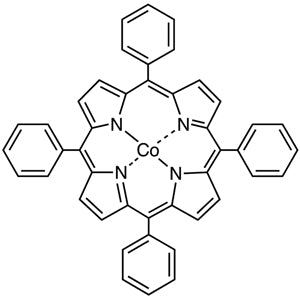
- TCI C3579 14172-90-8 Cobalt(II) Tetraphenylporphyrin
- TCI C2987 14172-91-9 Copper(II) Tetraphenylporphyrin
- TCI I0079 14024-18-1 Tris(2,4-pentanedionato)iron(III)
- TCI H0555 17786-67-3 Tris(hexafluoroacetylacetonato)iron(III)
- TCI D5886 2247605-87-2 Dichloro[8-(diisopropylphosphino)-5-fluoro-2-(2-pyridinyl)quinoline]iron(II)
- C-H Activation Studies: This compound is ideal for C-H activation due to its ability to facilitate the breaking and forming of carbon-hydrogen bonds, making it essential for exploring new catalytic mechanisms.
- Organic Synthesis Reactions: Its reactivity and stability make it a valuable catalyst in organic synthesis, particularly in substitution and oxidation reactions where precise control is required.
- Inorganic Chemistry Research: The compound’s unique electronic properties enable it to participate in various inorganic reactions, supporting studies in coordination chemistry and metal-based catalysis.
- Catalytic Oxidation Processes: Its ability to act as an efficient catalyst in oxidation reactions makes it suitable for applications in environmental and industrial chemistry.
- Reductive Reaction Systems: The compound’s versatility allows it to be used in reductive processes, where it can facilitate the reduction of various organic and inorganic compounds.
| Brand | TCI |
|---|---|
| CAS number | 16456-81-8 |
| Molecular formula | — |
| Purity | — |
| Category | Chemistry > Catalysis and Inorganic Chemistry > C-H Activation [Catalysis] |
| Pack sizes | Available in various quantities as per standard laboratory supply |
| Physical form | Solid powder |
| Storage | Store in a cool, dry place away from light and moisture |
Iron(III) Tetraphenylporphyrin Chloride should be stored in a cool, dry environment to maintain its stability and reactivity. It is recommended to keep the compound in a sealed container to prevent exposure to moisture and air, which could affect its performance. Due to its chemical nature, it should be handled with care, using appropriate personal protective equipment such as gloves and safety goggles. It is best stored in a well-ventilated area to minimize any potential risks associated with its use. Proper storage conditions help ensure the compound remains effective for use in laboratory experiments. Always follow standard laboratory safety protocols when handling this material.
References cited in the TCI brochure
- Xu-cheng Gan. Iron-Catalyzed Hydrobenzylation: Stereoselective Synthesis of (−)-Eugenial C Journal of the American Chemical Society, 2023. doi:10.1021/jacs.3c05428
- Nathan Dao. Metal-Hydride C–C Cross-Coupling of Alkenes Through a Double Outer-Sphere Mechanism The Journal of Organic Chemistry, 2024. doi:10.1021/acs.joc.4c00260
- Xu-cheng Gan. Carbon quaternization of redox active esters and olefins by decarboxylative coupling Science, 2024. doi:10.1126/science.adn5619
Product Categories
Produk Terkait
-
Manganese(III)TetraphenylporphyrinChloride TCI M2621
Regular price Rp 4.186.350,00Regular priceRp 2.943.150,00Sale price Rp 4.186.350,00 -
Cobalt(II)Tetraphenylporphyrin TCI C3579
Regular price Rp 2.702.700,00Regular priceRp 1.905.750,00Sale price Rp 2.702.700,00 -
Copper(II)Tetraphenylporphyrin TCI C2987
Regular price Rp 5.141.850,00Regular priceRp 3.610.950,00Sale price Rp 5.141.850,00 -
Tris(2,4-pentanedionato)iron(III) TCI I0079
Regular price From Rp 743.400,00Regular priceRp 519.750,00Sale price From Rp 743.400,00 -
Tris(hexafluoroacetylacetonato)iron(III) TCI H0555
Regular price Rp 6.413.400,00Regular priceRp 4.500.300,00Sale price Rp 6.413.400,00 -
Dichloro[8-(diisopropylphosphino)-5-fluoro-2-(2-pyridinyl)quinoline]iron(II) TCI D5886
Regular price Rp 7.207.200,00Regular priceRp 5.055.750,00Sale price Rp 7.207.200,00 -
Iron(II)Bromide TCI F1338
Regular price From Rp 1.936.200,00Regular priceRp 1.353.450,00Sale price From Rp 1.936.200,00 -
Zinc(II)Tetraphenylporphyrin TCI Z0036
Regular price From Rp 5.221.650,00Regular priceRp 3.666.600,00Sale price From Rp 5.221.650,00




![TCI D5886 2247605-87-2 Dichloro[8-(diisopropylphosphino)-5-fluoro-2-(2-pyridinyl)quinoline]iron(II)](http://amiscientific.com/cdn/shop/files/TCI2510D5886_65180c70-767e-4e81-bc01-b3314b0695e5.jpg?v=1792640211&width=533)
![Dichloro[8-(diisopropylphosphino)-5-fluoro-2-(2-pyridinyl)quinoline]iron(II) (CAS 2247605-87-2) - TCI D5886 - AMI Scientific](http://amiscientific.com/cdn/shop/files/TCI2510D5886.jpg?v=1767109391&width=533)


