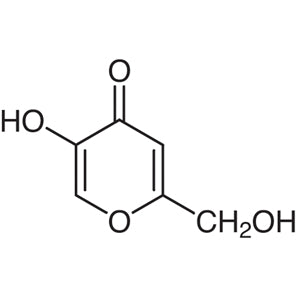
Kojic Acid (501-30-4) is a chemical compound widely used in laboratory settings, particularly in organic chemistry and the synthesis of heterocyclic compounds. It is a versatile building block that plays a crucial role in the development of complex molecular structures. Its unique molecular structure, composed of two acetic acid molecules linked covalently, gives it distinct chemical properties that make it valuable for various synthetic processes. This compound is commonly found in research laboratories where the synthesis of heterocyclic compounds is required, such as imidazoles and pyrimidines.
Kojic Acid is known for its chemical stability under certain conditions, although it is sensitive to ultraviolet light and oxidation. Its inert appearance and lack of odor make it easy to identify and handle in a laboratory environment. The high reactivity of this compound makes it an ideal choice for chemical reactions that require a readily reactive substrate. Its ability to participate in a wide range of chemical transformations makes it a preferred material for researchers aiming to accelerate the synthesis of new compounds.
In Indonesian laboratories, Kojic Acid is frequently used in scientific research across multiple disciplines, including organic chemistry, pharmaceuticals, and biochemistry. Its role in the development of new compounds and the study of molecular structures makes it an essential tool for researchers in these fields. Its availability and reliability make it a standard component in many laboratory workflows in Indonesia.
TCI brochures (PDF)
- Pharmaceutical Ingredients for Research and Experimental Use 2026-03-09 · p. 49
- Reagents for Biological Research 2025-03-11 · p. 50
- Organic synthesis applications benefit from Kojic Acid due to its unique molecular structure and reactivity, enabling the formation of complex heterocyclic compounds.
- Pharmaceutical research utilizes Kojic Acid for the development of new drugs, as it can serve as a building block in the synthesis of bioactive molecules.
- Biochemical studies often incorporate Kojic Acid to investigate its role in enzyme inhibition and its potential applications in metabolic pathways.
- Analytical chemistry uses Kojic Acid as a reference standard for spectroscopic and chromatographic analyses due to its stable chemical properties.
- Environmental research may employ Kojic Acid to study its behavior in different chemical environments and its potential for biodegradation.
| Brand | TCI |
|---|---|
| CAS number | 501-30-4 |
| Molecular formula | — |
| Purity | — |
| Category | Chemistry > Building Blocks > Heterocyclic Building Blocks |
| Pack sizes | Available in various quantities as per standard laboratory supply |
| Physical form | Solid, white crystalline powder |
| Storage | Store in a cool, dry place away from light and oxidizing agents |
Kojic Acid should be stored in a cool, dry place, away from direct sunlight and sources of heat. It is recommended to keep it in a sealed container to prevent exposure to moisture and air. Due to its sensitivity to ultraviolet light and oxidation, it is best stored in a dark, airtight container. In a laboratory setting, it is important to handle the compound with care, using appropriate personal protective equipment such as gloves and safety goggles. Avoid contact with skin and eyes, and ensure proper ventilation when working with the substance. Regular monitoring of storage conditions is essential to maintain its chemical integrity and ensure safe usage.
—
Product Categories
Produk Terkait
-
KojicAcidDipalmitate TCI K0050
Regular price From Rp 717.150,00Regular price -
Allantoin TCI A0211
Regular price Rp 743.400,00Regular price -
Pongamol TCI P2790
Regular price From Rp 2.730.000,00Regular price -
Arbutin TCI A0522
Regular price From Rp 452.550,00Regular price -
Triethylhexanoin TCI T4161
Regular price From Rp 743.400,00Regular price -
Avobenzone TCI B3382
Regular price From Rp 875.700,00Regular price -
alpha-Arbutin TCI A3284
Regular price From Rp 1.644.300,00Regular price -
AsiaticAcid TCI A2475
Regular price Rp 3.392.550,00Regular price