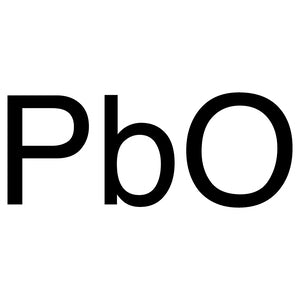
Lead(II) Oxide (PbO), with CAS number 1317-36-8, is a chemical compound widely used in laboratory experiments and industrial processes. It plays a crucial role in catalytic reactions and inorganic chemistry due to its unique chemical properties and stable crystalline structure. PbO is commonly employed as a reagent in the synthesis of other chemical compounds, particularly in the preparation of heavy metal compounds. Its versatility makes it an essential material for both basic and advanced chemical research.
PbO is valued for its chemical stability, high surface area, and ability to participate in redox reactions. These properties make it a preferred choice for applications requiring consistent performance and reliability. Its inertness to air exposure, combined with its high reactivity in controlled environments, ensures that it remains effective in various experimental setups. Additionally, its fine powder form allows for easy mixing with other reagents, enhancing its utility in laboratory settings.
In Indonesian laboratories, PbO is frequently used in both educational and research contexts. It is a key component in fundamental chemistry experiments and more complex industrial applications. Its role in testing chemical reactivity and in the synthesis of inorganic compounds makes it an indispensable material for chemists and researchers. The compound’s stability and consistent performance make it a reliable choice for long-term laboratory use.
TCI brochures (PDF)
- Metallic Salts 2025-11-06 · p. 6
- Redox Reaction Testing - PbO is ideal for studying oxidation-reduction processes due to its ability to act as an oxidizing agent in controlled environments.
- Inorganic Compound Synthesis - Its chemical stability and reactivity make it a valuable reagent in the preparation of heavy metal compounds and other inorganic materials.
- Catalyst Support in Industrial Processes - PbO’s crystalline structure and surface area make it suitable for use as a catalyst support in various chemical reactions.
- Precipitation Reactions - Its high reactivity with certain ions allows it to be used in precipitation experiments to form insoluble compounds.
- Educational Chemistry Demonstrations - PbO is commonly used in basic chemistry classes to illustrate chemical reactions and properties of inorganic compounds.
| Brand | TCI |
|---|---|
| CAS number | 1317-36-8 |
| Molecular formula | — |
| Purity | — |
| Category | Chemistry > Catalysis and Inorganic Chemistry > Main-group Elements |
| Pack sizes | Available in various quantities as per supplier specifications |
| Physical form | Fine powder |
| Storage | Store in a cool, dry place away from moisture and direct sunlight |
Lead(II) Oxide should be stored in a cool, dry environment to maintain its chemical stability and prevent degradation. It is recommended to use airtight containers to minimize exposure to moisture and air, which can affect its reactivity. Due to its toxic nature, proper personal protective equipment, such as gloves and safety goggles, should be worn during handling. It is important to ensure good ventilation in the laboratory when working with PbO to reduce inhalation risks. Avoid direct contact with skin and eyes, and always follow standard laboratory safety protocols when handling this compound.
—
Produk Terkait
-
Lead(II,IV)Oxide TCI L0412
Regular price From Rp 505.050,00Regular priceRp 352.800,00Sale price From Rp 505.050,00 -
Tin(IV)Oxide TCI T4006
Regular price From Rp 584.850,00Regular priceRp 408.450,00Sale price From Rp 584.850,00 -
Tellurium(IV)Oxide TCI T3254
Regular price Rp 875.700,00Regular priceRp 612.150,00Sale price Rp 875.700,00 -
Aluminum(III)Oxide,AEROXIDE(regR)AluC TCI A3546
Regular price Rp 1.220.100,00Regular priceRp 852.600,00Sale price Rp 1.220.100,00 -
LithiumOxide TCI L0403
Regular price From Rp 1.298.850,00Regular priceRp 908.250,00Sale price From Rp 1.298.850,00 -
Indium(III)Oxide TCI I1150
Regular price From Rp 2.306.850,00Regular priceRp 1.612.800,00Sale price From Rp 2.306.850,00 -
Germanium(IV)Oxide TCI G0607
Regular price From Rp 2.545.200,00Regular priceRp 1.779.750,00Sale price From Rp 2.545.200,00 -
Gallium(III)Oxide TCI G0603
Regular price From Rp 1.510.950,00Regular priceRp 1.056.300,00Sale price From Rp 1.510.950,00