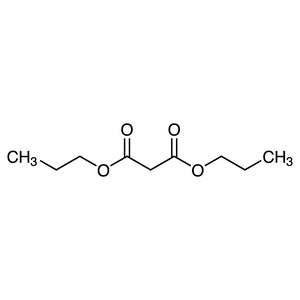
Dipropyl Malonate is a chemical compound widely used in organic laboratory reactions. It serves as a key building block in the synthesis of complex organic molecules. As an ester of malonic acid, it offers a simple yet versatile structure that is essential in the development of both heterocyclic and non-heterocyclic compounds. This compound is particularly valuable in synthetic chemistry due to its ability to participate in various reaction types, such as alkylation, acetylation, and halogen substitution. Its role in laboratory settings extends beyond mere reagent use, as it is integral to the creation of new chemical entities with specific functional groups.
The chemical properties of Dipropyl Malonate make it a preferred choice for researchers. It exhibits chemical stability and reactivity, allowing it to interact effectively with a wide range of reagents. Its relatively high boiling and melting points provide practical advantages during heating and cooling processes in the lab. These characteristics ensure that the compound remains stable under various experimental conditions, making it a reliable component in both academic and industrial research environments. Its solid form also simplifies handling and storage, contributing to its widespread use in laboratory settings.
In Indonesian laboratories, Dipropyl Malonate is commonly used in chemical research, particularly in the field of organic synthesis. It is frequently applied in higher education programs and industrial research projects. Its reliability and versatility make it a go-to compound for chemists working on the development of new materials and pharmaceutical compounds. Its presence in both academic and industrial laboratories underscores its importance in the chemical research landscape.
- Organic synthesis applications benefit from Dipropyl Malonate's role as a versatile building block, enabling the formation of complex molecular structures through various reaction mechanisms.
- In academic research settings, this compound is essential for teaching and demonstrating key organic chemistry reactions, such as alkylation and acetylation.
- Industrial research often utilizes Dipropyl Malonate for the development of new chemical products, leveraging its reactivity and stability in synthetic pathways.
- The compound's solid form and stable properties make it ideal for use in controlled laboratory environments where precision and consistency are required.
- Its ability to participate in halogen substitution reactions makes it a valuable tool in the synthesis of halogenated organic compounds for pharmaceutical and material science applications.
| Brand | TCI |
|---|---|
| CAS number | 1117-19-7 |
| Molecular formula | — |
| Purity | — |
| Category | Chemistry > Building Blocks > Non-Heterocyclic Building Blocks |
| Pack sizes | Available in standard laboratory quantities |
| Physical form | Solid |
| Storage | Store in a cool, dry place away from direct sunlight |
Dipropyl Malonate should be stored in a cool, dry environment to maintain its chemical stability. It is recommended to keep the compound in a sealed container to prevent exposure to moisture and air. Due to its solid form, it is easy to handle and measure in laboratory settings. Standard laboratory precautions should be followed, including the use of appropriate personal protective equipment when handling. The compound is generally non-hazardous under normal storage conditions but should be treated with care to avoid contamination. Proper storage ensures its effectiveness and safety in both academic and industrial research applications.
—
Produk Terkait
-
DipropylAdipate TCI A0931
Regular price Rp 1.008.000,00Regular price -
DipropylTetrachlorophthalate TCI T0595
Regular price Rp 2.359.350,00Regular price -
DipropylPhthalate TCI P0306
Regular price From Rp 1.590.750,00Regular price -
tert-ButylEthylMalonate TCI B3720
Regular price From Rp 928.200,00Regular price -
tert-ButylMethylMalonate TCI B2747
Regular price From Rp 1.670.550,00Regular price -
Diethyl(5-Bromopentyl)malonate TCI B2083
Regular price From Rp 2.254.350,00Regular price -
Diethyl2,2-Bis(hydroxymethyl)malonate TCI B1492
Regular price From Rp 3.021.900,00Regular price -
MonoethylMalonate TCI M2700
Regular price From Rp 1.246.350,00Regular price