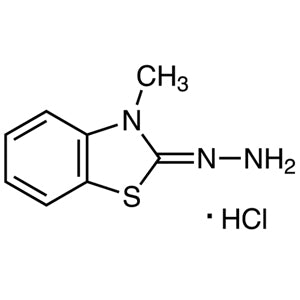
3-Methyl-2-benzothiazolinonehydrazone Hydrochloride is a versatile organic compound widely used in laboratory settings for its reactivity and utility in chemical synthesis. As a hydrazone, it plays a key role in the formation of heterocyclic compounds, which are essential in pharmaceutical and industrial applications. This compound is commonly used as a building block in the development of complex molecules, making it an important reagent in organic chemistry. Its ability to participate in various reactions such as hydrolysis, reduction, and condensation allows chemists to manipulate molecular structures with precision.
The compound is valued for its chemical stability and compatibility with a wide range of functional groups, making it a reliable choice for synthetic reactions. Its hydrazone functionality enables it to react with ketones, aldehydes, and other electrophilic species, facilitating the synthesis of diverse compounds. Additionally, its solubility in polar solvents enhances its usability in different reaction conditions. These properties make it a preferred reagent for researchers aiming to create new chemical entities with specific structural features.
In Indonesian laboratories, 3-Methyl-2-benzothiazolinonehydrazone Hydrochloride is frequently used in organic chemistry research, particularly in the development of pharmaceuticals, industrial chemicals, and analytical compounds. Local researchers rely on its predictable behavior and reactivity to advance their studies on heterocyclic structures. It is also employed in the modification of molecular frameworks, contributing to the expansion of knowledge in chemical synthesis and drug discovery.
Related TCI products
- TCI M2155 4338-98-1 3-Methyl-2-benzothiazolinonehydrazone Hydrochloride [for Biochemical Research]
- TCI A3264 29926-41-8 2-Acetyl-2-thiazoline
- TCI M1262 19975-56-5 2-(Methylthio)-2-thiazoline
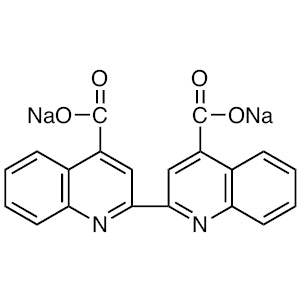
- TCI B4509 979-88-4 Bicinchoninic Acid Disodium Salt
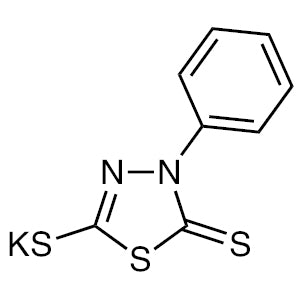
- TCI B1124 6336-51-2 Bismuthiol II
- TCI B1077 63451-34-3 2,2'-Bicinchoninic Acid Dipotassium Salt [for Determination of Cu]
- Synthesis of Heterocyclic Compounds: This compound is ideal for creating complex ring structures, which are common in pharmaceuticals and bioactive molecules.
- Hydrolysis Reactions: Its stability and reactivity make it suitable for generating intermediate compounds through hydrolysis processes.
- Modification of Molecular Structures: The hydrazone functionality allows for precise structural changes, aiding in the design of new chemical entities.
- Drug Development Research: It is frequently used in the synthesis of compounds with potential therapeutic applications, supporting medicinal chemistry studies.
- Analytical Chemistry Applications: Its chemical stability and reactivity make it useful in the preparation of reference standards and analytical reagents.
| Brand | TCI |
|---|---|
| CAS number | 4338-98-1 |
| Molecular formula | — |
| Purity | — |
| Category | Chemistry > Building Blocks > Heterocyclic Building Blocks |
| Pack sizes | As per supplier specifications |
| Physical form | Solid (as per standard product description) |
| Storage | Store in a cool, dry place away from moisture and light |
This compound should be stored in a cool, dry environment to maintain its chemical stability. It is recommended to keep it in a sealed container to prevent exposure to moisture and air. Due to its hydrazone nature, it may react with certain reagents, so it should be handled with care in laboratory settings. Appropriate personal protective equipment, such as gloves and safety goggles, should be worn when handling the compound. It is important to ensure that the storage area is well-ventilated to minimize any potential risks associated with its use. Proper labeling of containers is also essential for safe handling and storage.
—
Produk Terkait
-
3-Methyl-2-benzothiazolinonehydrazoneHydrochloride[forBiochemicalResearch] TCI M2155
Regular price From Rp 689.850,00Regular price -
2-Acetyl-2-thiazoline TCI A3264
Regular price From Rp 1.829.100,00Regular price -
2-(Methylthio)-2-thiazoline TCI M1262
Regular price From Rp 2.359.350,00Regular price -
BicinchoninicAcidDisodiumSalt TCI B4509
Regular price From Rp 955.500,00Regular price -
BismuthiolII TCI B1124
Regular price From Rp 955.500,00Regular price -
2,2'-BicinchoninicAcidDipotassiumSalt[forDeterminationofCu] TCI B1077
Regular price From Rp 1.565.550,00Regular price -
4-Amino-3-hydrazino-5-mercapto-1,2,4-triazole[forDeterminationofAldehydes] TCI A0956
Regular price From Rp 1.670.550,00Regular price -
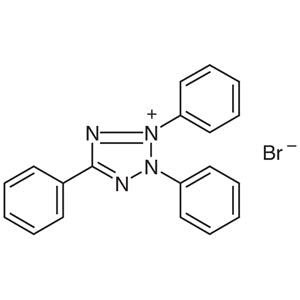
2,3,5-TriphenyltetrazoliumBromide TCI T0814
Regular price Rp 477.750,00Regular price
![4338-98-1 3-Methyl-2-benzothiazolinonehydrazone Hydrochloride [for Biochemical Research] - AMI Scientific](http://amiscientific.com/cdn/shop/files/TCI2510M2155.jpg?v=1767126165&width=533)


![63451-34-3 2,2'-Bicinchoninic Acid Dipotassium Salt [for Determination of Cu] - AMI Scientific](http://amiscientific.com/cdn/shop/files/TCI2510B1077_501acb84-bbbd-4643-86c9-ab685c4638df.jpg?v=1767231122&width=533)
![1750-12-5 4-Amino-3-hydrazino-5-mercapto-1,2,4-triazole [for Determination of Aldehydes] - AMI Scientific](http://amiscientific.com/cdn/shop/files/TCI2510A0956.jpg?v=1767080402&width=533)