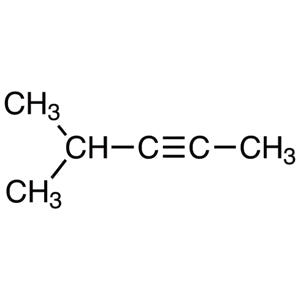
4-Methyl-2-pentyne (TCI M0270) is a branched internal alkyne hydrocarbon in which the carbon–carbon triple bond sits within the chain rather than at its end, flanked by a methyl group on one side and an isopropyl group on the other. Unlike terminal alkynes, this compound has no acetylenic hydrogen, so it cannot form acetylides and does not participate in Sonogashira coupling or click chemistry. That limitation is precisely what makes it valuable in the laboratory: it serves as an alkyne substrate whose reactivity is confined to the pi bond, making it especially useful for clean addition and cycloaddition studies where terminal-alkyne side reactions would otherwise complicate interpretation.
The property that drives its selection is the asymmetry of its substituents. A small methyl group at one end of the triple bond and a bulkier isopropyl group at the other create a genuine difference in steric environment between the two alkyne carbons. This makes the compound a highly informative regioselectivity probe in hydrometalation, carbometalation, hydration, and cycloaddition reactions, because researchers can read a catalyst's intrinsic preference directly from the ratio of the regioisomeric products formed. Its internal triple bond is also more resistant to oxidation than that of a terminal alkyne, which simplifies handling during comparative studies.
Physically, the material is a volatile and flammable liquid. In Indonesian laboratories it is generally used in synthetic organic chemistry research groups and in catalysis development work, where small quantities are drawn for mechanistic experiments, method development, and screening of new catalyst systems. Because it is volatile, it is typically dispensed in a fume hood and handled with syringe or cannula technique on small scales, consistent with normal practice for low-boiling hydrocarbon reagents.
- Regioselectivity studies in hydrometalation — the sterically differentiated methyl and isopropyl ends allow the catalyst's facial and positional preference to be read directly from the product ratio.
- Carbometalation method development — its unsymmetrical internal triple bond provides two distinguishable insertion outcomes, making it an efficient benchmark substrate when optimizing new organometallic reagent systems.
- Alkyne hydration investigations — the absence of an acetylenic hydrogen keeps the reaction confined to the pi bond, yielding clean ketone regiochemistry data for mechanistic interpretation.
- Cycloaddition chemistry — as an internal alkyne it acts as a two-carbon component in cycloaddition studies without the competing acetylide or terminal coupling pathways that complicate terminal alkynes.
- Catalyst screening and mechanistic probing — its resistance to oxidation relative to terminal alkynes makes it a stable, reproducible test substrate for comparing candidate catalysts under identical conditions.
| Brand | TCI (Tokyo Chemical Industry) |
|---|---|
| CAS number | 21020-27-9 |
| Molecular formula | — |
| Purity | — |
| Category | Chemistry > Building Blocks > Non-Heterocyclic Building Blocks |
| Pack sizes | available in standard TCI research-scale packaging; please confirm the currently listed pack options when ordering |
| Physical form | volatile, flammable liquid |
| Storage | keep tightly closed in a cool, well-ventilated place away from ignition sources |
Store the container tightly sealed in a cool, well-ventilated area, clearly separated from oxidizing agents, open flames, sparks, and other ignition sources. Keep the material in its original tightly closed supplier bottle, or in a compatible sealed glass container with a chemically resistant cap; because the liquid is volatile, avoid leaving containers open on the bench. Dispense and transfer inside a functioning fume hood, and use syringe or cannula technique for small volumes to minimize vapour release. Ground and bond containers when transferring larger volumes to control static discharge. Operators should wear safety glasses, chemically resistant gloves, and a laboratory coat, and should consult the manufacturer's safety data sheet before first use. Dispose of residues and contaminated materials as flammable organic waste according to institutional procedures.
—
Produk Terkait
-
2-Pentyne TCI P0628
Regular price From Rp 1.087.800,00Regular price -
1-Pentyne TCI P0068
Regular price From Rp 769.650,00Regular price -
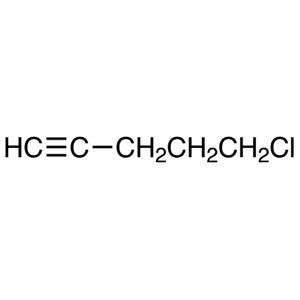
5-Chloro-1-pentyne TCI C1522
Regular price From Rp 1.273.650,00Regular price -
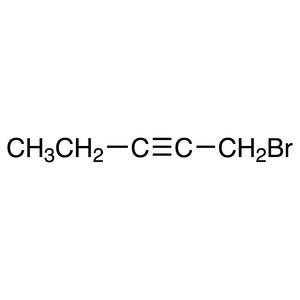
1-Bromo-2-pentyne TCI B6456
Regular price From Rp 3.605.700,00Regular price -
1,3,5-Triethynylbenzene TCI T2760
Regular price From Rp 3.578.400,00Regular price -
1-Butyl-4-ethynylbenzene TCI B2301
Regular price From Rp 980.700,00Regular price -
3,3-Dimethyl-1-butyne TCI B1114
Regular price From Rp 3.446.100,00Regular price -
2-Butyne TCI B0951
Regular price Rp 1.405.950,00Regular price