

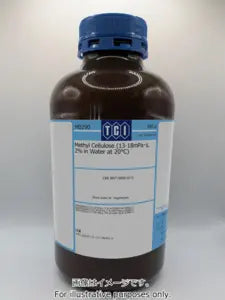
TCI M0290 is Methyl Cellulose specified at a viscosity of 13–18 mPa·s measured as a 2% solution in water at 20 degrees Celsius. It is a semisynthetic polysaccharide produced by the etherification of natural cellulose, and it belongs to the glycoscience group of materials. In the laboratory it functions as a thickener, a film former, a colloid stabiliser, and a gel-forming agent. Because it can modify the rheological behaviour of aqueous solutions with only a small addition, it appears very frequently in experimental formulations across a wide range of research fields.
The most distinctive characteristic of methyl cellulose is its thermal gelation behaviour, which runs opposite to that of most hydrocolloids. Its solutions thicken or form a gel when heated and return to a fluid state on cooling, a property that is deliberately exploited in many experimental designs. The 13–18 mPa·s designation on this product places it in the low-viscosity class, meaning the resulting solutions are relatively thin and easy to handle. This suits researchers who need fine control over consistency without immediately producing a solution that is too thick to work with. The material is also nonionic, which makes it comparatively tolerant in mixed systems.
In Indonesian laboratories, this grade of methyl cellulose is commonly kept as a general-purpose formulation aid on the bench. Research groups in chemistry, chemical biology, and glycoscience use it when a solution needs a controlled increase in viscosity, when a thin film must be cast, or when a dispersion needs to be held stable during an experiment. The low-viscosity class is particularly convenient for teaching and method-development work, where solutions are prepared repeatedly and must remain easy to pipette and mix.
TCI brochures (PDF)
- Polysaccharides 2025-02-13 · p. 2
- Drug Delivery System (DDS) Research Reagents 2025-01-29 · p. 1
- Reagents for Glyco Chemistry & Biology 5th Edition · p. 118
- Biomaterials Research Reagents 2025-02-19 · p. 5
Related TCI products
- TCI M0295 9004-67-5 Methyl Cellulose (7000-10000mPa.s, 2% in Water at 20deg C)
- TCI M0294 9004-67-5 Methyl Cellulose (1000-1800mPa.s, 2% in Water at 20deg C)
- TCI M0293 9004-67-5 Methyl Cellulose (350-550mPa.s, 2% in Water at 20deg C)
- TCI M0292 9004-67-5 Methyl Cellulose (80-120mPa.s, 2% in Water at 20deg C)
- TCI M0291 9004-67-5 Methyl Cellulose (20-30mPa.s, 2% in Water at 20deg C)
- TCI M0185 9004-67-5 Methyl Cellulose (3500-5600mPa.s, 2% in Water at 20deg C)
- Viscosity adjustment of aqueous systems: the low-viscosity 13–18 mPa·s class allows the consistency of a solution to be raised gradually and controllably rather than in a single thick step.
- Colloid and dispersion stabilisation: as a colloid stabiliser it helps keep suspended material evenly distributed, which reduces settling during preparation and over the course of an experiment.
- Film formation: the polymer's film-forming ability makes it suitable for casting thin, even layers from aqueous solution, a routine requirement in coating and surface-preparation work.
- Thermally reversible gel systems: because its solutions gel on heating and liquefy again on cooling, it supports experimental designs that need a gel state only at elevated temperature.
- Glycoscience and carbohydrate research: as a semisynthetic cellulose ether it serves as a working polysaccharide for studies of cellulose derivatives and their solution behaviour.
| Brand | TCI |
|---|---|
| CAS number | 9004-67-5 |
| Molecular formula | — |
| Purity | — |
| Category | Chemistry > Chemical Biology > Glycoscience |
| Pack sizes | available in the pack sizes listed by TCI for this catalogue item; please confirm the size required when ordering |
| Physical form | — |
| Storage | keep in the tightly closed original container, protected from moisture |
- Product identity: Methyl Cellulose, 13–18 mPa·s (2% in water at 20 °C)
Store the container tightly closed in a dry, well-ventilated place away from moisture, since cellulose ethers readily take up water from humid air and this affects both dissolution behaviour and the reliability of solution preparation. The original supplier container is the most suitable primary packaging; if transfer is necessary, use a clean, dry, sealable container that is clearly labelled with the product name and CAS number. Handle the dry powder in a way that limits dust generation, and follow the laboratory's standard practice for personal protective equipment, including a lab coat, gloves, and eye protection. Consult the manufacturer's safety data sheet before first use and keep it accessible in the work area.
—
Product Categories
- GlycoscienceApplications Using Glyco-materialsGlyco-engeneering [Applications Using Glyco-materials]
- GlycoscienceFunctional OligosaccharidesPolysaccharides [Functional Oligosaccharides]
- GlycosciencePolysaccharides [Glycoscience]
- Biochemicals and ReagentsCarbohydrates
- Pharmaceutical Development and Drug Discovery ResearchDrug Delivery Systems (DDS)Natural Polymers (for DDS)
Produk Terkait
-
MethylCellulose(7000-10000mPa.s,2%inWaterat20degC) TCI M0295
Regular price From Rp 582.750,00Regular priceRp 423.150,00Sale price From Rp 582.750,00 -
MethylCellulose(1000-1800mPa.s,2%inWaterat20degC) TCI M0294
Regular price From Rp 582.750,00Regular priceRp 423.150,00Sale price From Rp 582.750,00 -
MethylCellulose(350-550mPa.s,2%inWaterat20degC) TCI M0293
Regular price From Rp 582.750,00Regular priceRp 423.150,00Sale price From Rp 582.750,00 -
MethylCellulose(80-120mPa.s,2%inWaterat20degC) TCI M0292
Regular price From Rp 530.250,00Regular priceRp 370.650,00Sale price From Rp 530.250,00 -
MethylCellulose(20-30mPa.s,2%inWaterat20degC) TCI M0291
Regular price From Rp 582.750,00Regular priceRp 423.150,00Sale price From Rp 582.750,00 -
MethylCellulose(3500-5600mPa.s,2%inWaterat20degC) TCI M0185
Regular price From Rp 582.750,00Regular priceRp 423.150,00Sale price From Rp 582.750,00 -
HydroxypropylCellulose(1000-4000mPa.s,2%inWaterat20degC) TCI H0475
Regular price From Rp 664.650,00Regular priceRp 464.100,00Sale price From Rp 664.650,00 -
HydroxypropylCellulose(6-10mPa.s,2%inWaterat20degC) TCI H0474
Regular price From Rp 717.150,00Regular priceRp 516.600,00Sale price From Rp 717.150,00


