

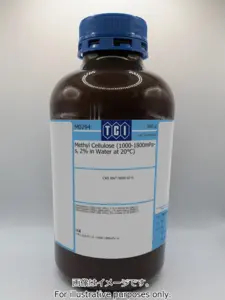
TCI M0294 Methyl Cellulose with a viscosity of 1000–1800 mPa·s (2% solution in water at 20 °C) is a high-viscosity, water-soluble nonionic cellulose ether. It is chosen when a laboratory needs substantial thickening from only a small amount of polymer, so the medium stays simple in composition yet remains viscous enough to suspend particles, cells, or bubbles. As a modified polysaccharide, it also serves as a subject of study in glycoscience and biopolymer materials research, alongside its broad role as a thickener, colloid stabilizer, film former, and semisolid matrix in formulation work.
The principal advantage of this grade lies in its thickening efficiency. Even at low concentrations, solutions are already highly viscous and display pseudoplastic behaviour: viscosity falls under applied shear, so the material can still be poured or pumped, then recovers its thickness once the shear is removed. The reversible thermal gelation characteristic of methyl cellulose is retained — solutions thicken or form a gel on heating and liquefy again on cooling, a property exploited in casting and structure-forming experiments. The nonionic character keeps viscosity comparatively resistant to variation in the surrounding ionic environment.
In Indonesian laboratories this material is typically used in formulation development, biopolymer and glycoscience research, and routine preparation of viscous media for suspension and coating work. University laboratories, pharmaceutical and cosmetic formulation groups, and food-science and materials research units use it wherever a reliable, single-component thickener is needed. Its supply as a TCI catalogue item makes it convenient for laboratories that require a consistent reference-grade cellulose ether across repeated experimental batches.
TCI brochures (PDF)
- Polysaccharides 2025-02-13 · p. 2
- Drug Delivery System (DDS) Research Reagents 2025-01-29 · p. 1
- Reagents for Glyco Chemistry & Biology 5th Edition · p. 119
- Biomaterials Research Reagents 2025-02-19 · p. 5
Related TCI products
- TCI M0295 9004-67-5 Methyl Cellulose (7000-10000mPa.s, 2% in Water at 20deg C)
- TCI M0293 9004-67-5 Methyl Cellulose (350-550mPa.s, 2% in Water at 20deg C)
- TCI M0292 9004-67-5 Methyl Cellulose (80-120mPa.s, 2% in Water at 20deg C)
- TCI M0291 9004-67-5 Methyl Cellulose (20-30mPa.s, 2% in Water at 20deg C)
- TCI M0290 9004-67-5 Methyl Cellulose (13-18mPas, 2% in Water at 20deg C)
- TCI M0185 9004-67-5 Methyl Cellulose (3500-5600mPa.s, 2% in Water at 20deg C)
- Viscous suspension media preparation — the high thickening efficiency holds particles, cells, or bubbles in stable suspension without the need for multiple additional formulation components.
- Semisolid formulation research — it forms gels, ointment-like bases, and viscous matrices used in pharmaceutical and cosmetic formulation studies where a controllable consistency is required.
- Film formation studies — as a film former, the polymer produces continuous coatings and cast films used in packaging, coating, and biopolymer material characterisation work.
- Thermal gelation experiments — the reversible heat-induced gelation allows casting and structure-forming trials in which gelation is triggered by heating and reversed by cooling.
- Glycoscience and biopolymer research — as a chemically modified polysaccharide, it serves as a model substrate for studies of cellulose derivatives and polysaccharide material behaviour.
| Brand | TCI |
|---|---|
| CAS number | 9004-67-5 |
| Molecular formula | — |
| Purity | — |
| Category | Chemistry > Chemical Biology > Glycoscience |
| Pack sizes | available in standard TCI catalogue pack sizes; please confirm the required size when ordering |
| Physical form | — |
| Storage | keep in a tightly closed container in a cool, dry place away from moisture |
- Viscosity: 1000–1800 mPa·s (2% in water at 20 °C)
Store the container tightly closed in a cool, dry, and well-ventilated area, protected from moisture, since cellulose ethers are hygroscopic and absorbed water can affect dissolution behaviour and solution viscosity. Keep the material in its original container or in a clean, dry, tightly sealed glass or chemically resistant plastic container, clearly labelled with the product name and CAS number. Handle the powder in a way that limits dust generation, and use standard laboratory personal protective equipment including a laboratory coat, safety goggles, and gloves. Prepare solutions using established laboratory dispersion practice and keep containers closed when not in use. Always consult the manufacturer's safety data sheet before handling.
—
Product Categories
- GlycoscienceApplications Using Glyco-materialsGlyco-engeneering [Applications Using Glyco-materials]
- GlycoscienceFunctional OligosaccharidesPolysaccharides [Functional Oligosaccharides]
- GlycosciencePolysaccharides [Glycoscience]
- Biochemicals and ReagentsCarbohydrates
- Pharmaceutical Development and Drug Discovery ResearchDrug Delivery Systems (DDS)Natural Polymers (for DDS)
Produk Terkait
-
MethylCellulose(7000-10000mPa.s,2%inWaterat20degC) TCI M0295
Regular price From Rp 582.750,00Regular priceRp 423.150,00Sale price From Rp 582.750,00 -
MethylCellulose(350-550mPa.s,2%inWaterat20degC) TCI M0293
Regular price From Rp 582.750,00Regular priceRp 423.150,00Sale price From Rp 582.750,00 -
MethylCellulose(80-120mPa.s,2%inWaterat20degC) TCI M0292
Regular price From Rp 530.250,00Regular priceRp 370.650,00Sale price From Rp 530.250,00 -
MethylCellulose(20-30mPa.s,2%inWaterat20degC) TCI M0291
Regular price From Rp 582.750,00Regular priceRp 423.150,00Sale price From Rp 582.750,00 -
MethylCellulose(13-18mPas,2%inWaterat20degC) TCI M0290
Regular price From Rp 582.750,00Regular priceRp 423.150,00Sale price From Rp 582.750,00 -
MethylCellulose(3500-5600mPa.s,2%inWaterat20degC) TCI M0185
Regular price From Rp 582.750,00Regular priceRp 423.150,00Sale price From Rp 582.750,00 -
HydroxypropylCellulose(1000-4000mPa.s,2%inWaterat20degC) TCI H0475
Regular price From Rp 664.650,00Regular priceRp 464.100,00Sale price From Rp 664.650,00 -
HydroxypropylCellulose(6-10mPa.s,2%inWaterat20degC) TCI H0474
Regular price From Rp 717.150,00Regular priceRp 516.600,00Sale price From Rp 717.150,00


