

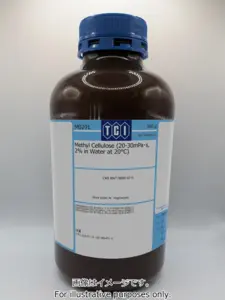
TCI M0291 Methyl Cellulose with a viscosity of 20–30 mPa.s (2% solution in water at 20 °C) is a cellulose ether derivative produced by partial methylation of the hydroxyl groups along the cellulose backbone. The material holds an important position in the laboratory as a thickener, film former, colloid stabiliser, and water-soluble formulation aid. Within glycoscience it serves as a model polysaccharide for studying the behaviour of carbohydrate ethers, while in biological and pharmaceutical laboratories it functions as a medium component, a suspending agent for test preparations, and a protective matrix for cells and enzymes during handling.
This grade represents the lowest viscosity level in the TCI methyl cellulose series, and that is precisely where its advantage lies. Solutions remain easy to pour, easy to filter, and easy to pipette even when prepared at a relatively high polymer concentration, allowing researchers to raise the solids content without confronting a solution too viscous to handle. As with methyl cellulose generally, the material dissolves in cold water and exhibits thermal gelation: it thickens or forms a gel on heating and returns to a fluid state on cooling. This reversible behaviour, combined with the low intrinsic viscosity of the grade, makes concentration and temperature two independent handles for tuning the rheology of a preparation.
In Indonesian laboratories, methyl cellulose of this type is routinely encountered in university chemistry and biology departments, pharmaceutical formulation units, food and materials testing laboratories, and research institutes working on polysaccharides. It is typically prepared as a stock solution in cold water and drawn on as needed for viscosity adjustment, suspension work, or cell handling. The low viscosity grade is often the practical choice where solutions must pass through filters, syringes, or automated liquid handlers without clogging.
TCI brochures (PDF)
- Polysaccharides 2025-02-13 · p. 2
- Drug Delivery System (DDS) Research Reagents 2025-01-29 · p. 1
- Reagents for Glyco Chemistry & Biology 5th Edition · p. 118
- Biomaterials Research Reagents 2025-02-19 · p. 5
Related TCI products
- TCI M0295 9004-67-5 Methyl Cellulose (7000-10000mPa.s, 2% in Water at 20deg C)
- TCI M0294 9004-67-5 Methyl Cellulose (1000-1800mPa.s, 2% in Water at 20deg C)
- TCI M0293 9004-67-5 Methyl Cellulose (350-550mPa.s, 2% in Water at 20deg C)
- TCI M0292 9004-67-5 Methyl Cellulose (80-120mPa.s, 2% in Water at 20deg C)
- TCI M0290 9004-67-5 Methyl Cellulose (13-18mPas, 2% in Water at 20deg C)
- TCI M0185 9004-67-5 Methyl Cellulose (3500-5600mPa.s, 2% in Water at 20deg C)
- Viscosity adjustment of aqueous preparations — the 20–30 mPa.s grade allows a laboratory to raise the polymer concentration substantially while keeping the resulting solution pourable and workable at the bench.
- Suspending agent for test preparations — methyl cellulose holds poorly soluble particles in a uniform dispersion, and the low viscosity of this grade keeps the suspension easy to pipette and dose accurately.
- Cell and enzyme handling — the polymer forms a protective matrix around cells and enzymes during manipulation, reducing mechanical stress while remaining fluid enough for routine transfer and washing steps.
- Glycoscience model polysaccharide — as a defined cellulose ether, it serves as a reference substrate for investigating how methylation of carbohydrate hydroxyl groups alters solubility, gelation, and solution behaviour.
- Film formation and colloid stabilisation — the material dries to a coherent film and stabilises colloidal systems, supporting coating experiments and formulation studies that require a water-soluble, non-ionic stabiliser.
| Brand | TCI (Tokyo Chemical Industry) |
|---|---|
| CAS number | 9004-67-5 |
| Molecular formula | — |
| Purity | — |
| Category | Chemistry > Chemical Biology > Glycoscience |
| Pack sizes | — |
| Physical form | — |
| Storage | store in a tightly closed container in a cool, dry place away from moisture |
- Product code: M0291
- Viscosity: 20–30 mPa.s (2% solution in water at 20 °C)
Store the material in its original tightly closed container in a cool, dry area, protected from moisture and direct sunlight, since cellulose ethers readily take up atmospheric water and may form lumps or lose free-flowing character. Use clean, dry glass or inert plastic containers with secure closures for both the powder and any prepared stock solutions. Handle the fine powder in a well-ventilated area or fume hood to limit dust generation, and wear a laboratory coat, gloves, and eye protection as routine practice. Dissolve in cold water with steady agitation to avoid clumping, and keep prepared solutions refrigerated and clearly labelled with the preparation date, as aqueous polysaccharide solutions are susceptible to microbial growth over time.
—
Product Categories
- GlycoscienceApplications Using Glyco-materialsGlyco-engeneering [Applications Using Glyco-materials]
- GlycoscienceFunctional OligosaccharidesPolysaccharides [Functional Oligosaccharides]
- GlycosciencePolysaccharides [Glycoscience]
- Biochemicals and ReagentsCarbohydrates
- Pharmaceutical Development and Drug Discovery ResearchDrug Delivery Systems (DDS)Natural Polymers (for DDS)
Produk Terkait
-
MethylCellulose(7000-10000mPa.s,2%inWaterat20degC) TCI M0295
Regular price From Rp 582.750,00Regular priceRp 423.150,00Sale price From Rp 582.750,00 -
MethylCellulose(1000-1800mPa.s,2%inWaterat20degC) TCI M0294
Regular price From Rp 582.750,00Regular priceRp 423.150,00Sale price From Rp 582.750,00 -
MethylCellulose(350-550mPa.s,2%inWaterat20degC) TCI M0293
Regular price From Rp 582.750,00Regular priceRp 423.150,00Sale price From Rp 582.750,00 -
MethylCellulose(80-120mPa.s,2%inWaterat20degC) TCI M0292
Regular price From Rp 530.250,00Regular priceRp 370.650,00Sale price From Rp 530.250,00 -
MethylCellulose(13-18mPas,2%inWaterat20degC) TCI M0290
Regular price From Rp 582.750,00Regular priceRp 423.150,00Sale price From Rp 582.750,00 -
MethylCellulose(3500-5600mPa.s,2%inWaterat20degC) TCI M0185
Regular price From Rp 582.750,00Regular priceRp 423.150,00Sale price From Rp 582.750,00 -
HydroxypropylCellulose(1000-4000mPa.s,2%inWaterat20degC) TCI H0475
Regular price From Rp 664.650,00Regular priceRp 464.100,00Sale price From Rp 664.650,00 -
HydroxypropylCellulose(6-10mPa.s,2%inWaterat20degC) TCI H0474
Regular price From Rp 717.150,00Regular priceRp 516.600,00Sale price From Rp 717.150,00


