

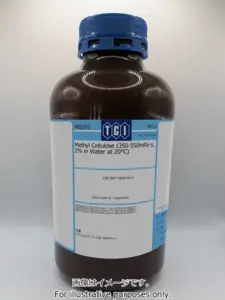
Methyl Cellulose (MC) is a versatile chemical compound widely used in laboratory settings, particularly in chemistry and biological research. It is a derivative of cellulose, synthesized through the methylation of cellulose chains, and is known for its thickening properties. MC can form stable aqueous solutions, making it an essential component in various chemical reactions and experimental procedures. Its ability to control viscosity and enhance solution structure makes it a valuable tool for researchers seeking to manipulate fluid properties in controlled environments.
The unique properties of MC, such as its high stability in aqueous environments and resistance to degradation, make it a preferred choice for many laboratory applications. It is non-toxic and exhibits good thermal stability, reducing the risk of unwanted chemical reactions. The viscosity of MC can be adjusted according to specific experimental needs, offering flexibility in its use. These characteristics ensure that MC remains a reliable and safe material for a wide range of scientific investigations.
In Indonesian laboratories, MC is commonly used in scientific research across various disciplines. It plays a crucial role in the preparation of gels, suspensions, and as a viscosity control agent in solution formulations. Its stability and non-toxic nature make it particularly suitable for experiments that require long-term storage or repeated use. MC is also used in educational settings to demonstrate chemical behavior and solution properties, supporting both research and teaching activities.
TCI brochures (PDF)
- Polysaccharides 2025-02-13 · p. 2
- Drug Delivery System (DDS) Research Reagents 2025-01-29 · p. 1
- Reagents for Glyco Chemistry & Biology 5th Edition · p. 119
- Biomaterials Research Reagents 2025-02-19 · p. 6
Related TCI products
- TCI M0295 9004-67-5 Methyl Cellulose (7000-10000mPa.s, 2% in Water at 20deg C)
- TCI M0294 9004-67-5 Methyl Cellulose (1000-1800mPa.s, 2% in Water at 20deg C)
- TCI M0292 9004-67-5 Methyl Cellulose (80-120mPa.s, 2% in Water at 20deg C)
- TCI M0291 9004-67-5 Methyl Cellulose (20-30mPa.s, 2% in Water at 20deg C)
- TCI M0290 9004-67-5 Methyl Cellulose (13-18mPas, 2% in Water at 20deg C)
- TCI M0185 9004-67-5 Methyl Cellulose (3500-5600mPa.s, 2% in Water at 20deg C)
- Methyl Cellulose is ideal for preparing stable aqueous gels and suspensions due to its thickening properties and ability to form viscous solutions.
- It is widely used in biochemical experiments to control solution viscosity and enhance structural integrity, supporting enzyme activity studies.
- MC serves as a viscosity modifier in pharmaceutical formulations, helping to adjust the consistency of drug delivery systems.
- It is commonly applied in polymer science research to study the behavior of hydrophilic polymers in aqueous environments.
- MC is used in educational laboratories to demonstrate the effects of viscosity and solution structure in basic chemistry experiments.
| Brand | TCI |
|---|---|
| CAS number | 9004-67-5 |
| Molecular formula | — |
| Purity | — |
| Category | Chemistry > Chemical Biology > Glycoscience |
| Pack sizes | As listed in product details |
| Physical form | Powder |
| Storage | Store in a cool, dry place away from moisture and direct sunlight |
Methyl Cellulose should be stored in a cool, dry environment to maintain its stability and prevent degradation. It is recommended to keep it in a sealed container to avoid moisture exposure, which can affect its physical properties. The material is non-hazardous but should be handled with care to prevent contamination. In laboratory settings, it is advisable to use appropriate personal protective equipment when handling large quantities. Proper labeling of containers is essential to ensure safe handling and prevent accidental misuse. Regular inspection of storage conditions is recommended to maintain the integrity of the product over time.
—
Product Categories
- GlycoscienceApplications Using Glyco-materialsGlyco-engeneering [Applications Using Glyco-materials]
- GlycoscienceFunctional OligosaccharidesPolysaccharides [Functional Oligosaccharides]
- GlycosciencePolysaccharides [Glycoscience]
- Biochemicals and ReagentsCarbohydrates
- Pharmaceutical Development and Drug Discovery ResearchDrug Delivery Systems (DDS)Natural Polymers (for DDS)
Produk Terkait
-
MethylCellulose(7000-10000mPa.s,2%inWaterat20degC) TCI M0295
Regular price From Rp 582.750,00Regular priceRp 423.150,00Sale price From Rp 582.750,00 -
MethylCellulose(1000-1800mPa.s,2%inWaterat20degC) TCI M0294
Regular price From Rp 582.750,00Regular priceRp 423.150,00Sale price From Rp 582.750,00 -
MethylCellulose(80-120mPa.s,2%inWaterat20degC) TCI M0292
Regular price From Rp 530.250,00Regular priceRp 370.650,00Sale price From Rp 530.250,00 -
MethylCellulose(20-30mPa.s,2%inWaterat20degC) TCI M0291
Regular price From Rp 582.750,00Regular priceRp 423.150,00Sale price From Rp 582.750,00 -
MethylCellulose(13-18mPas,2%inWaterat20degC) TCI M0290
Regular price From Rp 582.750,00Regular priceRp 423.150,00Sale price From Rp 582.750,00 -
MethylCellulose(3500-5600mPa.s,2%inWaterat20degC) TCI M0185
Regular price From Rp 582.750,00Regular priceRp 423.150,00Sale price From Rp 582.750,00 -
HydroxypropylCellulose(1000-4000mPa.s,2%inWaterat20degC) TCI H0475
Regular price From Rp 664.650,00Regular priceRp 464.100,00Sale price From Rp 664.650,00 -
HydroxypropylCellulose(6-10mPa.s,2%inWaterat20degC) TCI H0474
Regular price From Rp 717.150,00Regular priceRp 516.600,00Sale price From Rp 717.150,00


