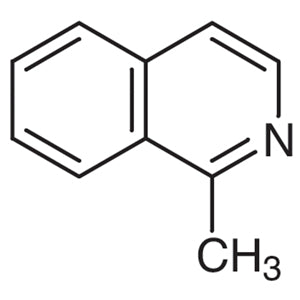
TCI M0298 1-Methylisoquinoline (CAS 1721-93-3) is a nitrogen-containing aromatic heterocyclic compound consisting of an isoquinoline framework bearing a methyl group at the one position, directly adjacent to the nitrogen atom. The compound is classified as a heterocyclic building block, a class of starting materials that forms the backbone of syntheses targeting bioactive compounds, coordination ligands, and organic materials. The isoquinoline skeleton itself is widely encountered in natural alkaloids, which makes this compound a frequent entry point for natural product chemistry and medicinal chemistry research in synthesis laboratories.
The properties that make it a preferred choice are the combination of a weakly basic nitrogen atom capable of coordinating to metals with a methyl group situated at an activated position. The nitrogen atom makes this compound a useful donor ligand in coordination chemistry and catalysis, including in the formation of cyclometalated complexes. Meanwhile, the methyl group adjacent to the nitrogen is relatively easy to deprotonate, so it can be reacted further through condensation or alkylation to extend the side chain. The fused aromatic ring system gives the molecule structural rigidity along with light absorption characteristics of interest to photophysical study.
In Indonesian laboratories, this material is typically handled in university and institutional synthesis groups, medicinal chemistry programmes, and organometallic research units that need a defined isoquinoline scaffold rather than preparing one in house. It is generally used at the bench scale for exploratory route development, ligand preparation, and the assembly of more elaborate heterocyclic targets, where a reliable commercial building block shortens a synthetic sequence considerably.
Related TCI products
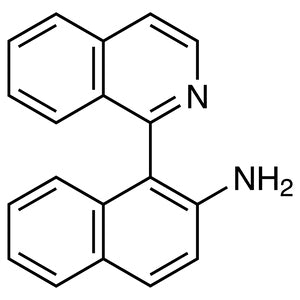
- TCI A2221 664302-70-9 1-(2-Amino-1-naphthyl)isoquinoline
- TCI I1246 6624-49-3 Isoquinoline-3-carboxylic Acid
- TCI I0942 80278-67-7 Isoquinoline-5-carboxaldehyde
- TCI I0671 486-73-7 Isoquinoline-1-carboxylic Acid
- TCI I0540 1532-72-5 Isoquinoline N-Oxide
- TCI I0509 203626-75-9 Isoquinoline-3-carboxylic Acid Monohydrate
- Heterocyclic scaffold synthesis: the isoquinoline core serves as a ready-made framework for building more elaborate nitrogen heterocycles without constructing the fused ring system from simpler precursors.
- Medicinal chemistry exploration: because the isoquinoline skeleton recurs throughout natural alkaloids, this compound gives research groups a direct entry point into analogue preparation and structure activity investigations.
- Coordination chemistry and ligand preparation: the weakly basic nitrogen atom acts as a donor site toward metal centres, making the compound suitable for assembling defined coordination complexes in the laboratory.
- Cyclometalation and catalyst studies: the arrangement of nitrogen donor and adjacent aromatic positions supports the formation of cyclometalated complexes used in organometallic catalysis and related mechanistic work.
- Side chain elaboration through condensation or alkylation: the methyl group next to nitrogen is comparatively easy to deprotonate, allowing chemists to extend the substituent and diversify the molecular framework.
| Brand | TCI |
|---|---|
| CAS number | 1721-93-3 |
| Molecular formula | — |
| Purity | — |
| Category | Chemistry > Building Blocks > Heterocyclic Building Blocks |
| Pack sizes | available in the standard catalogue pack sizes offered for this product code |
| Physical form | — |
| Storage | keep in a tightly closed original container under the conditions stated on the manufacturer label |
- Product code: M0298
Store the container tightly closed in a cool, dry, well ventilated area away from direct sunlight, heat sources, and incompatible materials, following the conditions stated on the manufacturer label and safety data sheet. Keep the material in its original supplier container or in a chemically compatible sealed vessel, and reseal promptly after each use to limit exposure to air and moisture. Handle in a fume hood using appropriate personal protective equipment, including gloves, safety glasses, and a laboratory coat. Avoid inhalation of vapour and contact with skin and eyes, and dispose of residues in accordance with institutional chemical waste procedures.
—
Produk Terkait
-
1-(2-Amino-1-naphthyl)isoquinoline TCI A2221
Regular price Rp 7.446.600,00Regular price -
Isoquinoline-3-carboxylicAcid TCI I1246
Regular price From Rp 2.809.800,00Regular price -
Isoquinoline-5-carboxaldehyde TCI I0942
Regular price From Rp 3.790.500,00Regular price -
Isoquinoline-1-carboxylicAcid TCI I0671
Regular price From Rp 1.590.750,00Regular price -
IsoquinolineN-Oxide TCI I0540
Regular price Rp 2.650.200,00Regular price -
Isoquinoline-3-carboxylicAcidMonohydrate TCI I0509
Regular price From Rp 2.068.500,00Regular price -
Isoquinoline-5-sulfonicAcid TCI I0470
Regular price From Rp 2.094.750,00Regular price -
Isoquinoline TCI I0182
Regular price From Rp 477.750,00Regular price