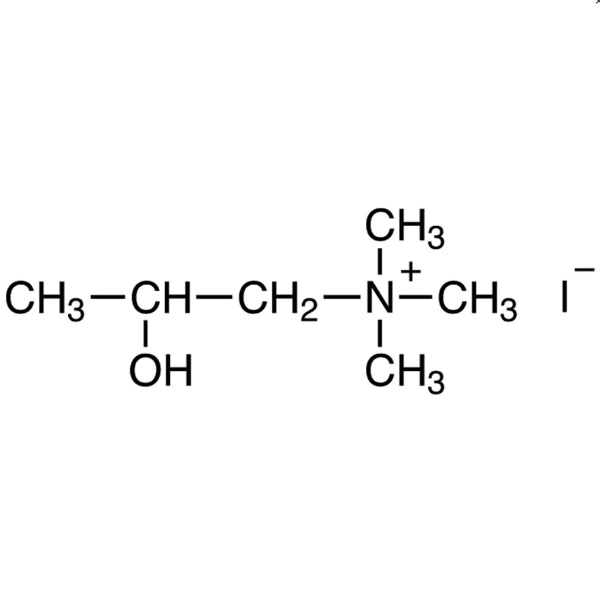
Beta-Methylcholine Iodide is a chemical compound widely used in laboratory settings for its versatility and reactivity in synthetic processes. As a building block in chemical synthesis, it plays a crucial role in the development of complex molecules across various scientific disciplines. Its simple yet essential structure makes it a fundamental component in the creation of compounds with applications in pharmaceuticals, biochemistry, and materials science. This compound is particularly valued for its ability to participate in a range of chemical reactions, making it a reliable choice for researchers aiming for precise and reproducible results.
The compound’s chemical properties, including its solubility in organic solvents and controlled reactivity, contribute to its popularity among scientists. Its stability under normal laboratory conditions ensures that it remains effective throughout experimental procedures. Additionally, its ability to form bonds with various functional groups enhances its utility in synthetic pathways. These characteristics make Beta-Methylcholine Iodide a preferred reagent for those requiring consistent performance and reliability in their experiments.
In Indonesian laboratories, Beta-Methylcholine Iodide is commonly used in research and development activities. It is often found in academic and industrial settings where the synthesis of new compounds is required. Its availability and compatibility with standard laboratory practices make it a go-to choice for chemists working on diverse projects. The compound’s predictable behavior and ease of handling further support its widespread use in both teaching and applied research environments.
- Pharmaceutical research for the synthesis of choline derivatives and related compounds due to its reactivity and compatibility with organic synthesis protocols.
- Biochemical experiments involving the modification of choline-based molecules for functional studies and drug development.
- Material science applications in the creation of functionalized polymers and coatings through controlled chemical reactions.
- Organic chemistry teaching labs for demonstrating basic synthetic techniques and reaction mechanisms.
- Industrial chemical production processes requiring stable and reactive intermediates for large-scale synthesis.
| Brand | TCI |
|---|---|
| CAS number | 26112-50-5 |
| Molecular formula | — |
| Purity | — |
| Category | Chemistry > Building Blocks > Non-Heterocyclic Building Blocks |
| Pack sizes | 50g |
| Physical form | White crystalline powder |
| Storage | Store in a cool, dry place away from light and moisture |
Beta-Methylcholine Iodide should be stored in a cool, dry place, away from direct light and moisture to maintain its chemical integrity. It is recommended to use airtight containers to prevent exposure to humidity and contaminants. Due to its chemical nature, it should be handled with appropriate personal protective equipment, such as gloves and safety goggles, to ensure laboratory safety. Avoid contact with incompatible materials, and ensure proper ventilation when working with this compound. Regular monitoring of storage conditions is advised to maintain its stability and effectiveness for experimental use.
—
Produk Terkait
-
beta-MethylcholineChloride TCI M1293
Regular price Rp 4.028.850,00Regular price -
(2-Hydroxyethyl)triethylammoniumIodide TCI H0407
Regular price Rp 3.870.300,00Regular price -
CholineIodide TCI C2573
Regular price Rp 2.411.850,00Regular price -
AcetylIodide TCI A0095
Regular price From Rp 6.386.100,00Regular price -
1-PentynylIodide TCI P1055
Regular price Rp 4.743.900,00Regular price -
AllylIodide(stabilizedwithCopperchip) TCI I0070
Regular price From Rp 1.856.400,00Regular price -
N,N-DimethylmethyleneammoniumIodide TCI D1646
Regular price From Rp 1.538.250,00Regular price -
Zinc(II)Iodide TCI Z0055
Regular price From Rp 795.900,00Regular price