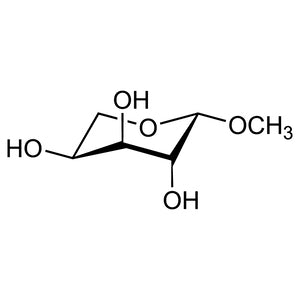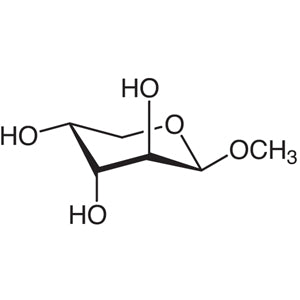
TCI M1019 Methyl beta-D-Arabinopyranoside is a methyl glycoside of arabinose presented in the pyranose ring form with the beta anomeric configuration, and it belongs to the glycoscience area of chemical biology. The compound is a simple carbohydrate whose anomeric position has been locked as a methyl ether, so it no longer undergoes the mutarotation characteristic of free reducing sugars. In the laboratory, its role is that of a reference material and a well-defined starting material in carbohydrate chemistry, particularly for research requiring a sugar unit with unambiguous stereochemistry and an anomeric centre that remains stable throughout a sequence of functional group manipulations.
The characteristics that make this material valuable are the stability of its anomeric configuration together with the availability of free hydroxyl groups at the remaining positions, whose reactivity can be differentiated from one another. With the anomeric centre protected, researchers can carry out selective protection, acylation, alkylation, or oxidation at a chosen hydroxyl without concern that the ring form will change during the reaction. The arabinopyranoside framework also serves as an important model for studying the conformational behaviour of a six-membered ring on a pentose sugar, whose behaviour differs from that of the corresponding furanose form. The stereochemical purity that is maintained in this defined structure is what allows results obtained with it to be interpreted with confidence.
In Indonesian laboratories, this compound is typically encountered in university and institutional research groups working on carbohydrate chemistry and chemical biology, where a defined glycoside is needed either as a synthetic building block or as a stereochemical reference point. It is generally ordered in small research quantities appropriate to synthetic and analytical work rather than in bulk, and it is handled alongside other fine chemicals within a standard organic or bioorganic synthesis workflow.
TCI brochures (PDF)
Related TCI products
- TCI M3832 1825-00-9 Methyl beta-L-Arabinopyranoside
- TCI D4594 97614-43-2 2-Deoxy-2-fluoro-1,3,5-tri-O-benzoyl-alpha-D-arabinofuranose
- TCI M2102 Methyl 2,3,4,6-Tetra-O-pivaloyl-D-mannopyranoside
- TCI M0368 617-04-9 Methyl alpha-D-Mannopyranoside
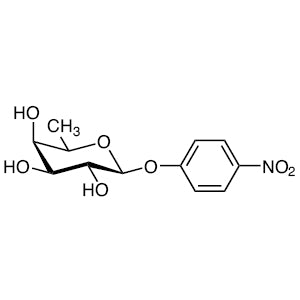
- TCI N0774 1226-39-7 4-Nitrophenyl beta-D-Fucopyranoside
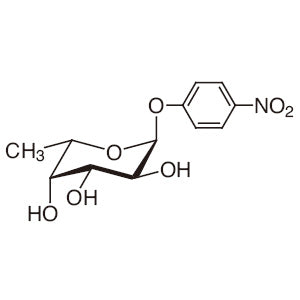
- TCI N0392 10231-84-2 4-Nitrophenyl alpha-L-Fucopyranoside
- Carbohydrate synthesis building block: the locked beta anomeric centre allows multi-step functional group manipulation of the remaining hydroxyls without the ring form or anomeric configuration shifting during the sequence.
- Selective hydroxyl protection studies: with the anomeric position already blocked as a methyl ether, the differentiated reactivity of the free hydroxyls can be exploited for regioselective protection, acylation, or alkylation experiments.
- Conformational analysis of pentose pyranosides: the six-membered ring framework of this arabinopyranoside serves as a model system for studying ring conformation behaviour that differs from the corresponding furanose form.
- Stereochemical reference material: the defined beta configuration and absence of mutarotation make this compound a dependable comparison standard when confirming the stereochemistry of synthesised glycoside products.
- Glycoscience and chemical biology research: as a simple, well-characterised glycoside it supports investigations where a carbohydrate unit of unambiguous structure is required for reliable interpretation of results.
| Brand | TCI |
|---|---|
| CAS number | 5328-63-2 |
| Molecular formula | — |
| Purity | — |
| Category | Chemistry > Chemical Biology > Glycoscience |
| Pack sizes | available in research-scale packaging; please confirm the currently offered size when ordering. |
| Physical form | — |
| Storage | store according to the manufacturer's stated conditions on the product label and accompanying documentation. |
- Product Code: M1019
Store the container tightly closed in a cool, dry place away from direct sunlight, moisture, and incompatible materials, following the storage conditions stated by the manufacturer on the product label and safety data sheet. Keep the material in its original supplier container, or transfer it only to a clean, dry, chemically compatible and clearly labelled vessel. Handle the compound in a well-ventilated area or fume hood using standard laboratory personal protective equipment, including a laboratory coat, safety glasses, and suitable gloves. Avoid raising dust, close the container promptly after use to limit moisture uptake, and consult the safety data sheet before first use and before disposal.
—
Product Categories
Produk Terkait
-
Methylbeta-L-Arabinopyranoside TCI M3832
Regular price From Rp 1.035.300,00Regular price -
2-Deoxy-2-fluoro-1,3,5-tri-O-benzoyl-alpha-D-arabinofuranose TCI D4594
Regular price From Rp 1.405.950,00Regular price -
Methyl2,3,4,6-Tetra-O-pivaloyl-D-mannopyranoside TCI M2102
Regular price Rp 5.300.400,00Regular price -
Methylalpha-D-Mannopyranoside TCI M0368
Regular price From Rp 1.326.150,00Regular price -
4-Nitrophenylbeta-D-Fucopyranoside TCI N0774
Regular price Rp 4.743.900,00Regular price -
4-Nitrophenylalpha-L-Fucopyranoside TCI N0392
Regular price From Rp 1.565.550,00Regular price -
Methyl-beta-D-xylopyranoside TCI M1253
Regular price From Rp 2.227.050,00Regular price -
Methylalpha-L-Fucopyranoside TCI M1051
Regular price Rp 3.870.300,00Regular price