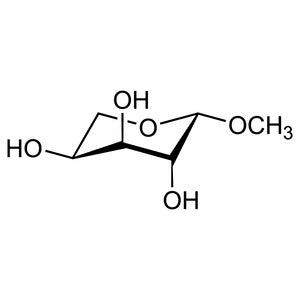
TCI M3832 is Methyl beta-L-Arabinopyranoside, a methyl glycoside of the sugar L-arabinose locked in the pyranose ring form with the beta anomeric configuration. The compound is important in glycoscience laboratories because the methyl group at the anomeric position protects the acetal centre, so the sugar no longer undergoes mutarotation and no longer opens its ring into the free aldehyde form. Researchers therefore obtain a stereochemically defined sugar substrate that can be processed further at its free hydroxyl groups, without the complication of anomeric mixtures that normally makes carbohydrate chemistry difficult.
The characteristics that make this material a preferred choice are its stereochemical purity together with the availability of three free hydroxyl groups of differing reactivity, which allows selective protection, alkylation, acylation, benzylidenation, and directed oxidation. The L configuration, less common than that of the D-series sugars, makes the compound a valuable building block for constructing rare oligosaccharide structures, bacterial antigens, and nucleoside analogues that are difficult to obtain from natural sources. As a crystalline solid it is easy to weigh out accurately, stable under appropriate storage, and dissolves well for onward reaction work.
In Indonesian laboratories this material is typically handled in university and institutional research groups working on carbohydrate synthesis, natural product chemistry, and chemical biology, as well as in laboratories that prepare glycoside standards and intermediates. It is normally weighed in small portions on an analytical balance, dissolved for reaction or analysis, and stored back in a controlled cabinet between uses. The crystalline form suits the ambient conditions of tropical laboratories, provided the container is kept closed and dry.
Related TCI products
- TCI M1019 5328-63-2 Methyl beta-D-Arabinopyranoside
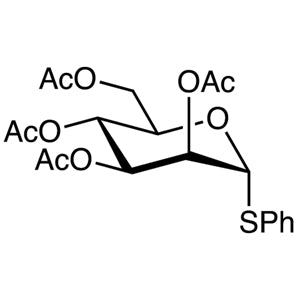
- TCI P2521 108032-93-5 Phenyl 2,3,4,6-Tetra-O-acetyl-1-thio-alpha-D-mannopyranoside
- TCI M2102 Methyl 2,3,4,6-Tetra-O-pivaloyl-D-mannopyranoside
- TCI M0368 617-04-9 Methyl alpha-D-Mannopyranoside
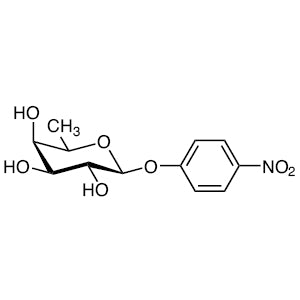
- TCI N0774 1226-39-7 4-Nitrophenyl beta-D-Fucopyranoside
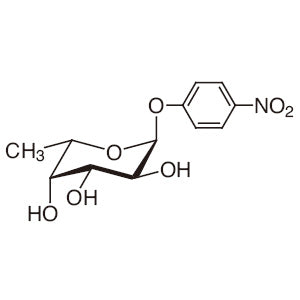
- TCI N0392 10231-84-2 4-Nitrophenyl alpha-L-Fucopyranoside
- Oligosaccharide synthesis — the three free hydroxyl groups have distinguishable reactivity, allowing selective protection and stepwise chain extension toward rare oligosaccharide sequences built on an L-arabinose unit.
- Bacterial antigen construction — the uncommon L configuration corresponds to sugar units found in bacterial glycan structures, making this compound a direct building block for antigen fragment assembly work.
- Nucleoside analogue preparation — the stereochemically defined pyranose core serves as a starting scaffold for analogues that cannot readily be isolated from natural sources in the required configuration.
- Selective protecting-group chemistry — benzylidenation, alkylation, and acylation studies rely on the differentiated hydroxyl positions, so this glycoside is a convenient model for developing and comparing protection strategies.
- Glycoscience reference and method work — because the anomeric centre is fixed and free of mutarotation, the compound gives a stable, single-species substrate for chromatographic and spectroscopic method development.
| Brand | TCI |
|---|---|
| CAS number | 1825-00-9 |
| Molecular formula | — |
| Purity | — |
| Category | Chemistry > Chemical Biology > Glycoscience |
| Pack sizes | available in the catalogue pack sizes listed for this item |
| Physical form | crystalline solid |
| Storage | keep in a tightly closed container under the storage conditions stated on the manufacturer's label |
Store the container tightly closed in a cool, dry place away from direct sunlight and sources of moisture, following the conditions given on the manufacturer's label. Original supplier packaging or a clean, well-sealed glass or amber container with an inert closure is suitable; avoid transferring the solid into containers that cannot be sealed properly. Weigh portions promptly and close the container again to limit exposure to humid laboratory air, which is a practical concern in tropical conditions. Handle the material in a ventilated area using gloves, safety glasses, and a laboratory coat, and use clean, dry spatulas to prevent contamination of the stock. Label any prepared solutions clearly with the compound name and preparation date, and consult the manufacturer's safety data sheet before first use.
—
Product Categories
Produk Terkait
-
Methylbeta-D-Arabinopyranoside TCI M1019
Regular price Rp 1.538.250,00Regular price -
Phenyl2,3,4,6-Tetra-O-acetyl-1-thio-alpha-D-mannopyranoside TCI P2521
Regular price Rp 5.803.350,00Regular price -
Methyl2,3,4,6-Tetra-O-pivaloyl-D-mannopyranoside TCI M2102
Regular price Rp 5.300.400,00Regular price -
Methylalpha-D-Mannopyranoside TCI M0368
Regular price From Rp 1.326.150,00Regular price -
4-Nitrophenylbeta-D-Fucopyranoside TCI N0774
Regular price Rp 4.743.900,00Regular price -
4-Nitrophenylalpha-L-Fucopyranoside TCI N0392
Regular price From Rp 1.565.550,00Regular price -
Methyl-beta-D-xylopyranoside TCI M1253
Regular price From Rp 2.227.050,00Regular price -
Methylalpha-L-Fucopyranoside TCI M1051
Regular price Rp 3.870.300,00Regular price