


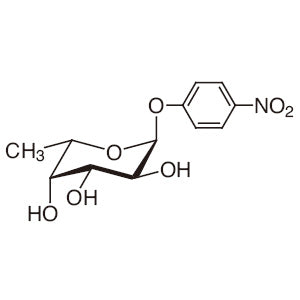
4-Nitrophenyl beta-D-Fucopyranoside is a chemical compound widely used in laboratory research related to glycoscience, particularly in the study of carbohydrate structure and function. This compound serves as a substrate in enzymatic reactions, enabling the identification of enzyme activities such as beta-D-fucosidase. Its role is critical in analyzing glycans and understanding molecular interactions involving carbohydrates, making it an essential tool for biochemical investigations. In Indonesian laboratories, it is frequently utilized in biomedical, pharmacological, and biotechnological research to explore enzymatic mechanisms and the development of carbohydrate-related drug therapies.
The compound’s chemical properties make it a preferred choice for various experimental applications. It exhibits stability and solubility in organic solvents such as ethyl acetate or acetone, which facilitates its use in diverse laboratory settings. The presence of a nitro group on the phenyl ring enhances its solubility in polar solvents and supports more efficient chemical reactions. These characteristics contribute to its effectiveness in experiments requiring high reactivity and precision, making it a reliable reagent for researchers working in glycoscience and related fields.
In the context of Indonesian laboratories, 4-Nitrophenyl beta-D-Fucopyranoside is commonly used in research focused on enzyme activity testing, particularly for beta-D-fucosidase. Its application extends to studies involving carbohydrate metabolism and the development of new therapeutic agents. Researchers in Indonesia rely on this compound to advance their understanding of enzymatic processes and their implications in biological systems.
TCI brochures (PDF)
Related TCI products
- TCI N0392 10231-84-2 4-Nitrophenyl alpha-L-Fucopyranoside
- TCI M1051 14687-15-1 Methyl alpha-L-Fucopyranoside
- TCI N0493 3767-28-0 4-Nitrophenyl alpha-D-Glucopyranoside [Substrate for alpha-D-Glucosidase]
- TCI N0235 2492-87-7 4-Nitrophenyl beta-D-Glucopyranoside Monohydrate [Substrate for beta-D-Glucosidase]
- TCI N0620 2001-96-9 4-Nitrophenyl beta-D-Xylopyranoside [Substrate for beta-Xylosidase]
- TCI N0619 10357-27-4 4-Nitrophenyl alpha-D-Mannopyranoside [Substrate for alpha-Mannosidase]
- Enzyme Activity Testing: This compound is ideal for assessing the activity of beta-D-fucosidase, a key enzyme in carbohydrate metabolism, allowing researchers to evaluate enzymatic efficiency and substrate specificity.
- Glycan Analysis: It is used in the structural analysis of glycans, aiding in the identification of carbohydrate-based biomolecules and their functional roles in biological systems.
- Molecular Interaction Studies: Its reactivity and solubility make it suitable for investigating molecular interactions involving carbohydrates, supporting research in biochemistry and biotechnology.
- Biomedical Research: The compound is employed in studies related to disease mechanisms, particularly those involving carbohydrate metabolism and enzyme-related disorders.
- Drug Development: It plays a role in the development of new therapeutic agents by helping to understand enzymatic pathways and their impact on metabolic processes.
| Brand | TCI |
|---|---|
| CAS number | 1226-39-7 |
| Molecular formula | — |
| Purity | — |
| Category | Chemistry > Chemical Biology > Glycoscience |
| Pack sizes | Available in various quantities as per supplier specifications |
| Physical form | Solid powder |
| Storage | Store in a cool, dry place away from light and moisture |
This compound should be stored in a cool, dry environment, away from direct light and moisture to maintain its chemical stability. It is recommended to use airtight containers to prevent exposure to air and humidity, which could affect its solubility and reactivity. Due to its potential for chemical interactions, it should be handled with appropriate personal protective equipment, including gloves and safety goggles. In laboratory settings, it should be stored separately from incompatible substances to ensure safety. Regular monitoring of storage conditions is advised to maintain the integrity of the compound for research applications.
—
Product Categories
Produk Terkait
-
4-Nitrophenylalpha-L-Fucopyranoside TCI N0392
Regular price From Rp 1.565.550,00Regular price -
Methylalpha-L-Fucopyranoside TCI M1051
Regular price Rp 3.870.300,00Regular price -
4-Nitrophenylalpha-D-Glucopyranoside[Substrateforalpha-D-Glucosidase] TCI N0493
Regular price From Rp 2.147.250,00Regular price -
4-Nitrophenylbeta-D-GlucopyranosideMonohydrate[Substrateforbeta-D-Glucosidase] TCI N0235
Regular price From Rp 2.359.350,00Regular price -
4-Nitrophenylbeta-D-Xylopyranoside[Substrateforbeta-Xylosidase] TCI N0620
Regular price Rp 2.041.200,00Regular price -
4-Nitrophenylalpha-D-Mannopyranoside[Substrateforalpha-Mannosidase] TCI N0619
Regular price Rp 4.902.450,00Regular price -
4-Nitrophenylbeta-D-Glucuronide[Substrateforbeta-Glucuronidase] TCI N0618
Regular price Rp 1.776.600,00Regular price -
4-Nitrophenylbeta-D-Galactopyranoside[Substrateforbeta-Galactosidase] TCI N0616
Regular price From Rp 1.961.400,00Regular price

![3767-28-0 4-Nitrophenyl alpha-D-Glucopyranoside [Substrate for alpha-D-Glucosidase] - AMI Scientific](http://amiscientific.com/cdn/shop/files/TCI2510N0493.jpg?v=1767129938&width=533)
![2492-87-7 4-Nitrophenyl beta-D-Glucopyranoside Monohydrate [Substrate for beta-D-Glucosidase] - AMI Scientific](http://amiscientific.com/cdn/shop/files/TCI2510N0235.jpg?v=1767129472&width=533)
![2001-96-9 4-Nitrophenyl beta-D-Xylopyranoside [Substrate for beta-Xylosidase] - AMI Scientific](http://amiscientific.com/cdn/shop/files/TCI2510N0620.jpg?v=1767130146&width=533)
![10357-27-4 4-Nitrophenyl alpha-D-Mannopyranoside [Substrate for alpha-Mannosidase] - AMI Scientific](http://amiscientific.com/cdn/shop/files/TCI2510N0619.jpg?v=1767130142&width=533)
![10344-94-2 4-Nitrophenyl beta-D-Glucuronide [Substrate for beta-Glucuronidase] - AMI Scientific](http://amiscientific.com/cdn/shop/files/TCI2510N0618.jpg?v=1767130139&width=533)
![3150-24-1 4-Nitrophenyl beta-D-Galactopyranoside [Substrate for beta-Galactosidase] - AMI Scientific](http://amiscientific.com/cdn/shop/files/TCI2510N0616.jpg?v=1767130131&width=533)