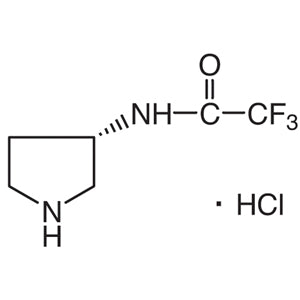
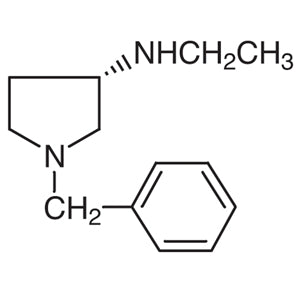
TCI M1107 (3R)-(+)-3-(Methylamino)pyrrolidine is a chiral building block consisting of a pyrrolidine ring bearing a methylamino group at the 3-position in a defined R configuration. The compound belongs to the family of cyclic diamines that are highly sought after in medicinal chemistry, because it provides two nitrogen centres of differing reactivity together with a stereogenic centre that determines the three-dimensional shape of the final molecule. In the synthesis of bioactive compounds, the absolute configuration at this position is frequently the factor that decides whether a molecule binds optimally to its biological target.
The characteristic that makes this material a preferred choice is its defined chiral purity from the very beginning of the synthetic route. By starting from a single-enantiomer material, researchers avoid the complexity of resolving a racemate at a late stage, a process that normally consumes time and cost while sacrificing half of the material. The ring nitrogen, a secondary amine, is strongly nucleophilic and is commonly used in nucleophilic aromatic substitution as well as metal-catalysed cross-coupling, while the methylamino group on the side chain offers a second point of functionalisation. The strong basicity of both nitrogen atoms also facilitates salt formation and purification handling.
In Indonesian laboratories, this building block is typically used in academic and industrial research groups working on asymmetric synthesis, medicinal chemistry, and the preparation of pharmaceutical intermediates. It is generally ordered in small quantities appropriate to exploratory route development, where a stereochemically defined starting material shortens the path to a target scaffold. University research laboratories, pharmaceutical R&D units, and contract synthesis facilities are the usual settings in which this reagent is applied.
TCI brochures (PDF)
- Chiral Building Blocks 2025-04-14 · p. 2
Related TCI products
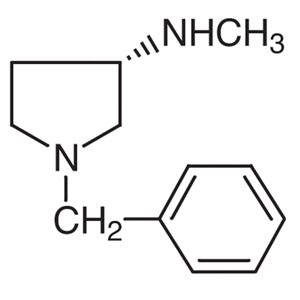
- TCI B1583 169749-99-9 (3S)-(+)-1-Benzyl-3-(methylamino)pyrrolidine
- TCI M1108 139015-32-0 (3S)-(-)-3-(Methylamino)pyrrolidine
- TCI M2157 116539-55-0 (S)-3-(Methylamino)-1-(2-thienyl)-1-propanol
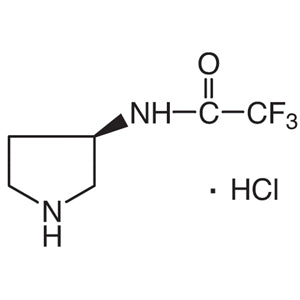
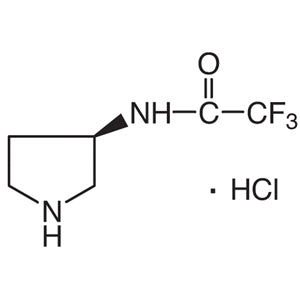
- TCI T1369 141043-16-5 (3R)-(+)-3-(Trifluoroacetamido)pyrrolidine Hydrochloride
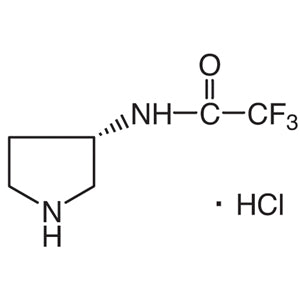
- TCI T1366 132883-43-3 (3S)-(-)-3-(Trifluoroacetamido)pyrrolidine Hydrochloride
- TCI B3662 61478-26-0 (2S,4R)-1-(tert-Butoxycarbonyl)-4-hydroxy-2-(hydroxymethyl)pyrrolidine
- Asymmetric synthesis route development — the defined R configuration is fixed at the outset, so the stereochemical outcome of the target molecule is controlled without any later resolution step.
- Medicinal chemistry scaffold construction — the cyclic diamine framework gives two nitrogen handles with different reactivity, allowing sequential and selective elaboration of a drug-like core structure.
- Nucleophilic aromatic substitution reactions — the strongly nucleophilic secondary ring nitrogen readily displaces suitable leaving groups on activated aromatic systems to build nitrogen-linked architectures.
- Metal-catalysed cross-coupling chemistry — the ring nitrogen serves as a coupling partner in catalytic amination chemistry, introducing the chiral pyrrolidine unit directly onto an aryl framework.
- Pharmaceutical intermediate preparation — starting from a single-enantiomer building block avoids racemate separation at the final stage, saving time and cost and preserving material that would otherwise be discarded.
| Brand | TCI |
|---|---|
| CAS number | 139015-33-1 |
| Molecular formula | — |
| Purity | — |
| Category | Chemistry > Asymmetric Synthesis > Chiral Building Blocks |
| Pack sizes | available in the standard research-scale pack sizes supplied by TCI; please confirm the available option when ordering |
| Physical form | — |
| Storage | store according to the conditions stated on the manufacturer's label and safety data sheet |
- Chemical class: cyclic diamine / chiral pyrrolidine building block
Store the container tightly closed in a cool, dry, well-ventilated place, following the storage conditions stated on the manufacturer's label and safety data sheet. Amine compounds of this type are generally kept in their original tightly sealed container, protected from moisture and from prolonged exposure to air, and away from acids and other incompatible materials. Handle inside a fume hood using appropriate personal protective equipment, including safety glasses, chemical-resistant gloves, and a laboratory coat. Both nitrogen centres are strongly basic, so avoid contact with skin and eyes and prevent the generation of vapours. Return the container promptly to its designated storage location after use, and consult the safety data sheet before any handling, transfer, or disposal operation.
—
Produk Terkait
-
(3S)-(+)-1-Benzyl-3-(methylamino)pyrrolidine TCI B1583
Regular price From Rp 955.500,00Regular price -
(3S)-(-)-3-(Methylamino)pyrrolidine TCI M1108
Regular price From Rp 4.559.100,00Regular price -
(S)-3-(Methylamino)-1-(2-thienyl)-1-propanol TCI M2157
Regular price From Rp 1.696.800,00Regular price -
(3R)-(+)-3-(Trifluoroacetamido)pyrrolidineHydrochloride TCI T1369
Regular price From Rp 2.386.650,00Regular price -
(3S)-(-)-3-(Trifluoroacetamido)pyrrolidineHydrochloride TCI T1366
Regular price From Rp 1.298.850,00Regular price -
(2S,4R)-1-(tert-Butoxycarbonyl)-4-hydroxy-2-(hydroxymethyl)pyrrolidine TCI B3662
Regular price From Rp 1.273.650,00Regular price -
(3R)-(+)-1-Benzyl-3-(tert-butoxycarbonylamino)pyrrolidine TCI B1932
Regular price Rp 2.068.500,00Regular price -
(3S)-(+)-1-Benzyl-3-(ethylamino)pyrrolidine TCI B1581
Regular price From Rp 2.199.750,00Regular price