


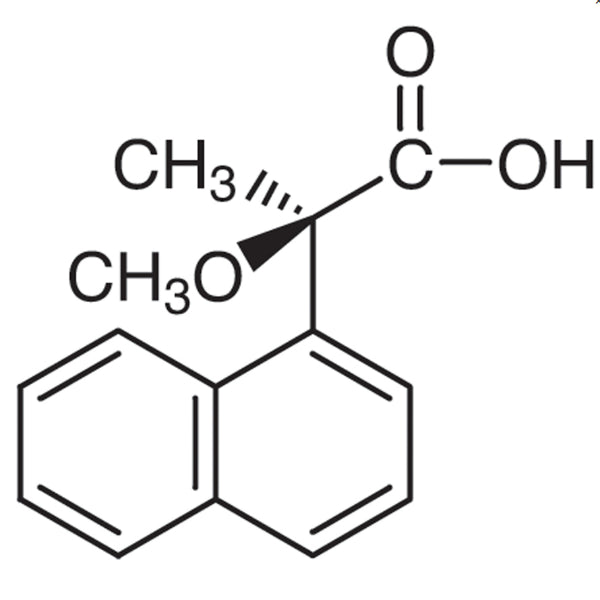
(R)-(-)-2-Methoxy-2-(1-naphthyl)propionic Acid is a chemical compound widely used in analytical chemistry and scientific research. It serves as a key reagent in spectroscopy applications, aiding in the detection and identification of specific compounds. This compound is commonly found in laboratory settings where precise analytical methods are required. Its role extends beyond mere detection, as it is also utilized as a building block for the synthesis of other compounds. Due to its optical activity, it plays a crucial role in quantitative and qualitative analysis. Its unique molecular structure makes it an essential tool for researchers aiming for accuracy and reliability in their experiments.
The compound's optical activity and high purity make it a preferred choice for analytical applications. Its ability to interact with various analytical techniques, such as HPLC and UV-Vis spectroscopy, ensures reliable and reproducible results. The compound is known for its stability and consistent performance under controlled laboratory conditions. These properties make it suitable for use in both research and industrial settings. Its high purity level ensures that it does not introduce unwanted variables into experimental results, making it a trusted material for scientific investigations.
In Indonesian laboratories, this compound is commonly used in pharmaceutical, analytical chemistry, and environmental research. It is a standard reagent in many research institutions and universities, supporting the development of new products and the advancement of scientific knowledge. Its availability in the local market makes it a practical choice for researchers who require high-quality reagents for their work. Its versatility and reliability have made it an essential component in various analytical processes.
Related TCI products
- TCI M1367 102691-93-0 (S)-(+)-2-Methoxy-2-(1-naphthyl)propionic Acid
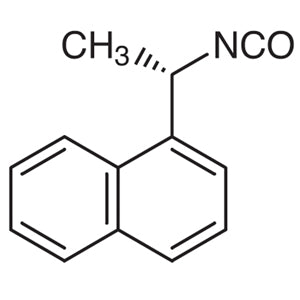
- TCI I0398 73671-79-1 (S)-(+)-1-(1-Naphthyl)ethyl Isocyanate
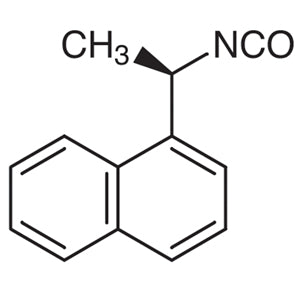
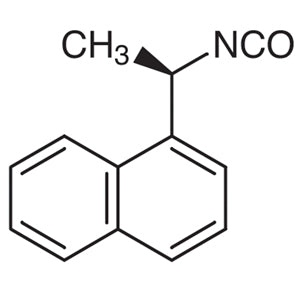
- TCI I0336 42340-98-7 (R)-(-)-1-(1-Naphthyl)ethyl Isocyanate
- TCI M1104 39637-99-5 (R)-(-)-alpha-Methoxy-alpha-(trifluoromethyl)phenylacetyl Chloride [for Determination of the optical purity of Alcohols and Amines]
- TCI M1103 20445-33-4 (S)-(+)-alpha-Methoxy-alpha-(trifluoromethyl)phenylacetyl Chloride [for Determination of the optical purity of Alcohols and Amines]
- TCI M0832 17257-71-5 (S)-(-)-alpha-Methoxy-alpha-(trifluoromethyl)phenylacetic Acid [Optical Resolving]
- Used in pharmaceutical research for the synthesis of active pharmaceutical ingredients due to its structural similarity to many drug molecules.
- Applied in environmental analysis for the detection of organic pollutants in water and soil samples due to its reactivity and specificity.
- Utilized in analytical chemistry for the calibration of analytical instruments and as a reference standard for accurate measurements.
- Employed in spectroscopy studies for the identification of complex organic compounds through UV-Vis and HPLC techniques.
- Incorporated in academic research for the development of new analytical methods and the study of molecular interactions.
| Brand | TCI |
|---|---|
| CAS number | 63628-26-2 |
| Molecular formula | — |
| Purity | — |
| Category | Analytical Chemistry > Analytical Reagents > Spectroscopy Reagents |
| Pack sizes | Available in various quantities as per standard reagent packaging |
| Physical form | Solid powder |
| Storage | Store in a cool, dry place away from light and moisture |
This compound should be stored in a cool, dry place, away from direct light and moisture to maintain its stability and purity. It is recommended to use airtight containers to prevent exposure to air and humidity. Due to its optical activity, it is important to handle it with care to avoid contamination or degradation. Laboratory personnel should wear appropriate personal protective equipment when handling the compound. Proper labeling of containers is essential to ensure safe handling and prevent accidental use. The compound should not be stored near incompatible substances to avoid any chemical interactions. Regular inspection of storage conditions is advised to ensure the material remains suitable for use in analytical applications.
—
Produk Terkait
-
(S)-(+)-2-Methoxy-2-(1-naphthyl)propionicAcid TCI M1367
Regular price Rp 6.308.400,00Regular price -
(S)-(+)-1-(1-Naphthyl)ethylIsocyanate TCI I0398
Regular price From Rp 4.188.450,00Regular price -
(R)-(-)-1-(1-Naphthyl)ethylIsocyanate TCI I0336
Regular price From Rp 3.630.900,00Regular price -
(R)-(-)-alpha-Methoxy-alpha-(trifluoromethyl)phenylacetylChloride[forDeterminationoftheopticalpurityofAlcoholsandAmines] TCI M1104
Regular price From Rp 1.961.400,00Regular price -
(S)-(+)-alpha-Methoxy-alpha-(trifluoromethyl)phenylacetylChloride[forDeterminationoftheopticalpurityofAlcoholsandAmines] TCI M1103
Regular price From Rp 2.147.250,00Regular price -
(S)-(-)-alpha-Methoxy-alpha-(trifluoromethyl)phenylaceticAcid[OpticalResolving] TCI M0832
Regular price From Rp 5.034.750,00Regular price -
(R)-(+)-alpha-Methoxy-alpha-(trifluoromethyl)phenylaceticAcid[OpticalResolving] TCI M0831
Regular price From Rp 4.849.950,00Regular price -
2-Methoxy-2-(1-naphthyl)propionicAcid TCI M1368
Regular price Rp 14.123.550,00Regular price

![39637-99-5 (R)-(-)-alpha-Methoxy-alpha-(trifluoromethyl)phenylacetyl Chloride [for Determination of the optical purity of Alcohols and Amines] - AMI Scientific](http://amiscientific.com/cdn/shop/files/TCI2510M1104.jpg?v=1767124321&width=533)
![39637-99-5 (R)-(-)-alpha-Methoxy-alpha-(trifluoromethyl)phenylacetyl Chloride [for Determination of the optical purity of Alcohols and Amines] - AMI Scientific](http://amiscientific.com/cdn/shop/files/TCI2510M1104_236ece49-4f9f-41af-b05d-1c245793e6af.jpg?v=1772416878&width=533)
![20445-33-4 (S)-(+)-alpha-Methoxy-alpha-(trifluoromethyl)phenylacetyl Chloride [for Determination of the optical purity of Alcohols and Amines] - AMI Scientific](http://amiscientific.com/cdn/shop/files/TCI2510M1103.jpg?v=1767124317&width=533)
![20445-33-4 (S)-(+)-alpha-Methoxy-alpha-(trifluoromethyl)phenylacetyl Chloride [for Determination of the optical purity of Alcohols and Amines] - AMI Scientific](http://amiscientific.com/cdn/shop/files/TCI2510M1103_48fd9d46-fd63-46b5-a725-d1dc2b9fad47.jpg?v=1768819168&width=533)
![17257-71-5 (S)-(-)-alpha-Methoxy-alpha-(trifluoromethyl)phenylacetic Acid [Optical Resolving] - AMI Scientific](http://amiscientific.com/cdn/shop/files/TCI2510M0832.jpg?v=1769142869&width=533)
![20445-31-2 (R)-(+)-alpha-Methoxy-alpha-(trifluoromethyl)phenylacetic Acid [Optical Resolving] - AMI Scientific](http://amiscientific.com/cdn/shop/files/TCI2510M0831.jpg?v=1767123812&width=533)
