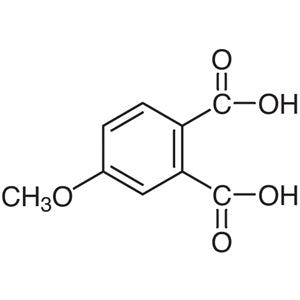
4-Methoxyphthalic Acid is a versatile chemical compound widely used as a building block in the synthesis of complex organic molecules. It plays a crucial role in laboratory settings where researchers aim to create compounds with specific functional properties. Its chemical structure enables participation in various reactions, including esterification, amidation, and substitution, making it an essential tool for synthetic chemists. This compound is particularly valuable in the development of pharmaceuticals, food additives, and specialty chemicals due to its reactivity and stability.
The compound's chemical properties, such as its high reactivity at the carboxyl group and the stabilizing effect of the methoxy group, make it a preferred choice for synthetic applications. Its ability to undergo multiple chemical transformations allows researchers to tailor its structure for specific uses. The stability of the methoxy group ensures that the compound remains reactive without undergoing unwanted side reactions. These characteristics make it a reliable and efficient component in organic synthesis processes.
In Indonesian laboratories, 4-Methoxyphthalic Acid is commonly used by chemists, pharmacologists, and material scientists for a wide range of experiments. It is particularly favored in the development of bioactive compounds, preservatives, and functional materials. Its availability and chemical versatility make it a go-to reagent for researchers working on diverse projects, from drug discovery to polymer chemistry.
TCI brochures (PDF)
- Organic Linker Molecules for Metal Organic Frameworks (MOFs) 2026-05-11 · p. 3
Related TCI products
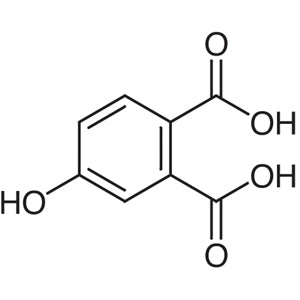
- TCI H0609 610-35-5 4-Hydroxyphthalic Acid
- TCI A0088 142-45-0 Acetylenedicarboxylic Acid
- TCI T3896 160248-28-2 Tetrakis(4-carboxyphenyl)methane
- TCI T3894 1078153-58-8 1,2,4,5-Tetrakis(4-carboxyphenyl)benzene
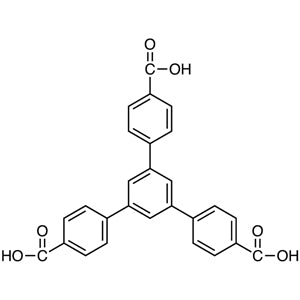
- TCI T2647 50446-44-1 1,3,5-Tris(4-carboxyphenyl)benzene
- TCI B4232 23351-91-9 5-Bromoisophthalic Acid
- Organic synthesis is a key application where 4-Methoxyphthalic Acid is used to build complex molecules through esterification and amidation reactions.
- Pharmaceutical research benefits from its ability to form derivatives with biological activity, aiding in the development of new drugs and therapeutic agents.
- Material science applications leverage its chemical reactivity to create functional polymers and specialty coatings with tailored properties.
- Food additive development utilizes its stability and reactivity to synthesize preservatives and flavor modifiers for the food industry.
- Analytical chemistry uses it as a standard for calibration and as a reagent in various spectroscopic and chromatographic analyses.
| Brand | TCI |
|---|---|
| CAS number | 1885-13-8 |
| Molecular formula | — |
| Purity | — |
| Category | Chemistry > Building Blocks > Non-Heterocyclic Building Blocks |
| Pack sizes | Available in various quantities as per supplier specifications |
| Physical form | Solid |
| Storage | Store in a cool, dry place away from moisture and direct sunlight |
4-Methoxyphthalic Acid should be stored in a cool, dry environment to maintain its chemical integrity. It is recommended to keep it in a sealed container to prevent exposure to moisture and air. The compound is generally stable under normal laboratory conditions but should be handled with care to avoid contamination. Suitable storage containers include glass or high-density polyethylene vessels that are resistant to chemical reactions. In laboratory settings, it is important to ensure proper ventilation and to follow standard safety protocols when handling reactive chemicals. Always store the compound away from incompatible materials to prevent any potential chemical interactions.
—
Product Categories
- Organic-Inorganic Hybrid MaterialsMetal Organic Frameworks (MOF) and Their Raw MaterialsOrganic Linker Molecules [Metal Organic Frameworks (MOFs) Precursors]
- Polymer/Macromolecule ReagentsMetal Organic Frameworks (MOF) and Their Raw MaterialsOrganic Linker Molecules [Metal Organic Frameworks (MOFs) Precursors]
Produk Terkait
-
4-HydroxyphthalicAcid TCI H0609
Regular price Rp 3.895.500,00Regular priceRp 2.739.450,00Sale price Rp 3.895.500,00 -
AcetylenedicarboxylicAcid TCI A0088
Regular price From Rp 1.220.100,00Regular priceRp 868.350,00Sale price From Rp 1.220.100,00 -
Tetrakis(4-carboxyphenyl)methane TCI T3896
Regular price Rp 6.863.850,00Regular priceRp 4.799.550,00Sale price Rp 6.863.850,00 -
1,2,4,5-Tetrakis(4-carboxyphenyl)benzene TCI T3894
Regular price From Rp 2.837.100,00Regular priceRp 1.983.450,00Sale price From Rp 2.837.100,00 -
1,3,5-Tris(4-carboxyphenyl)benzene TCI T2647
Regular price From Rp 3.683.400,00Regular priceRp 2.575.650,00Sale price From Rp 3.683.400,00 -
5-BromoisophthalicAcid TCI B4232
Regular price From Rp 1.193.850,00Regular priceRp 834.750,00Sale price From Rp 1.193.850,00 -
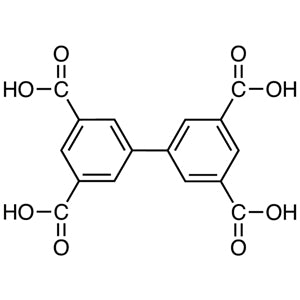
Biphenyl-3,3',5,5'-tetracarboxylicAcid TCI B3792
Regular price Rp 3.949.050,00Regular priceRp 2.761.500,00Sale price Rp 3.949.050,00 -
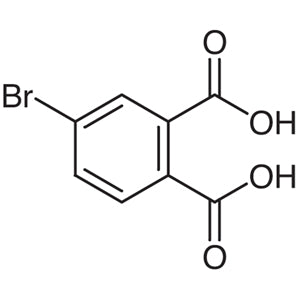
4-BromophthalicAcid TCI B2257
Regular price From Rp 584.850,00Regular priceRp 408.450,00Sale price From Rp 584.850,00