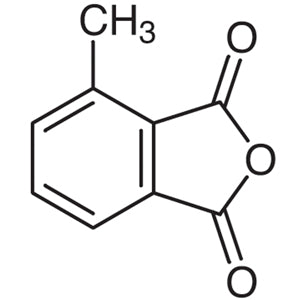
3-Methylphthalic Anhydride (3-MPA) is a chemical compound widely used in laboratory settings for the synthesis of complex organic molecules. As a phthalic anhydride derivative, it serves as a versatile building block in various chemical reactions, particularly in the formation of esters, amides, and heterocyclic compounds. Its reactivity and functional group versatility make it a valuable reagent in synthetic chemistry. In the laboratory, 3-MPA is commonly employed as a catalyst or reagent in esterification and amide formation reactions, contributing to the development of new chemical structures.
One of the key attributes of 3-MPA is its high purity and chemical stability, which ensure consistent results in experimental procedures. Its ability to react with a variety of functional groups enhances its utility in organic synthesis. The presence of carbonyl and anhydride groups further increases its reactivity, making it suitable for applications requiring high chemical activity. These properties make 3-MPA a preferred choice for researchers aiming to produce complex molecules with specific structural features.
In Indonesian laboratories, 3-Methylphthalic Anhydride is extensively used in organic chemistry research, particularly in the pharmaceutical and chemical industries. Its availability in stable quantities and compliance with international quality standards make it a reliable material for scientific investigations. The compound is especially favored for its role in the synthesis of heterocyclic compounds, which are essential in drug development and material science.
- Organic synthesis of heterocyclic compounds due to its reactivity and functional group versatility.
- Esterification reactions where it acts as a key reagent for forming ester linkages.
- Amide formation processes benefiting from its anhydride functionality and chemical stability.
- Pharmaceutical research for the development of new drugs involving complex molecular structures.
- Material science applications in the creation of advanced polymers and chemical intermediates.
| Brand | TCI |
|---|---|
| CAS number | 4792-30-7 |
| Molecular formula | — |
| Purity | — |
| Category | Chemistry > Building Blocks > Non-Heterocyclic Building Blocks |
| Pack sizes | Available in various quantities as per standard laboratory requirements |
| Physical form | Solid, typically in powder or crystalline form |
| Storage | Store in a cool, dry place away from moisture and direct sunlight |
3-Methylphthalic Anhydride should be stored in a cool, dry environment to maintain its chemical stability and prevent degradation. It is recommended to keep the compound in airtight containers to avoid exposure to moisture and air, which can affect its reactivity and purity. Due to its chemical reactivity, it should be handled with care, using appropriate personal protective equipment such as gloves and safety goggles. In laboratory settings, it is important to store it separately from incompatible materials to ensure safety. Regular monitoring of storage conditions is advised to maintain the integrity of the compound for experimental use.
—
Produk Terkait
-
4-MethylphthalicAnhydride TCI M0559
Regular price From Rp 1.193.850,00Regular price -
4-MethylphthalicAcid TCI M0560
Regular price From Rp 2.041.200,00Regular price -
4-Bromo-N-methylphthalimide TCI B3443
Regular price From Rp 2.147.250,00Regular price -
4-Amino-N-methylphthalimide TCI A1561
Regular price From Rp 955.500,00Regular price -
N-Methylphthalimide TCI M0299
Regular price Rp 1.803.900,00Regular price -
N-Hydroxymethylphthalimide TCI H0648
Regular price From Rp 1.060.500,00Regular price -
ValericAnhydride TCI V0006
Regular price From Rp 875.700,00Regular price -
3-BromophthalicAnhydride TCI B4061
Regular price From Rp 1.246.350,00Regular price