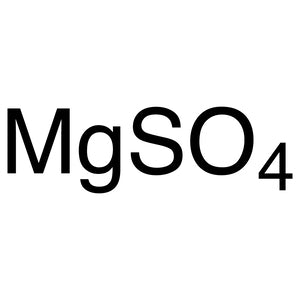
Magnesium Sulfate Anhydrous from TCI, supplied under catalog code M1890, is a magnesium-based inorganic salt that ranks among the most frequently encountered reagents on the benchtop of both organic and inorganic chemistry laboratories. Its anhydrous form — that is, without molecules of water of crystallization — allows the material to act as a highly reliable drying agent, pulling residual water out of an organic phase after liquid-liquid extraction. Beyond that role, the compound also serves as a source of magnesium ions in the preparation of buffer solutions, culture media, and a variety of inorganic reaction and catalysis formulations.
The principal characteristics that make this material the preferred choice are its high water-uptake capacity combined with its chemically neutral nature, so that it does not react with the majority of the organic compounds being dried. Unlike drying agents that are strongly basic or strongly acidic, anhydrous magnesium sulfate is comparatively safe to use on sensitive substrates, including esters, aldehydes, and amines. Filtration is likewise straightforward, because the hydrated solid that forms can be separated directly by simple gravity filtration. Its rapid action further shortens the drying step.
In Indonesian laboratories, this reagent occupies a standard place in the routine workflow of organic synthesis, extraction, and sample preparation. It is typically kept within easy reach of the fume hood and separatory funnel station, where the drying step follows immediately after an aqueous work-up. Academic teaching laboratories, university research groups, and industrial quality-control units alike rely on it as a general-purpose consumable, while its role as a magnesium ion source supports buffer and media preparation in adjacent analytical and biological work.
TCI brochures (PDF)
- Metallic Salts 2025-11-06 · p. 7
- Drying of organic phases after liquid-liquid extraction, where its high water-uptake capacity removes residual moisture quickly without reacting with the dissolved product.
- Sample preparation prior to instrumental analysis, since a chemically neutral drying agent protects the integrity of the analyte before chromatographic or spectroscopic measurement.
- Drying of sensitive substrates such as esters, aldehydes, and amines, which would be degraded by strongly basic or strongly acidic desiccants but tolerate this neutral salt.
- Preparation of buffer solutions in analytical and biological workflows, where the compound supplies magnesium ions in a form that dissolves readily and predictably.
- Formulation of culture media and inorganic reaction or catalysis mixtures, providing a dependable magnesium ion source for systems that require this cation.
| Brand | TCI (Tokyo Chemical Industry) |
|---|---|
| CAS number | 7487-88-9 |
| Molecular formula | — |
| Purity | — |
| Category | Chemistry > Catalysis and Inorganic Chemistry > Metallic Salts [Catalysis and Inorganic Chemistry] |
| Pack sizes | Available in the standard TCI catalog pack sizes; please confirm the currently listed options when ordering |
| Physical form | Anhydrous solid, containing no water of crystallization |
| Storage | Keep in a tightly closed container, protected from atmospheric moisture |
- Catalog Code: M1890
Because the anhydrous form absorbs water readily from the surrounding air, this reagent should be stored in a tightly closed container and kept away from humidity, which in Indonesian laboratory conditions is a particularly relevant concern. Original supplier packaging, a screw-capped glass bottle, or a wide-mouth container with a secure seal is suitable; storing it inside a desiccator further preserves its drying capacity. Open the container only briefly and reseal it immediately after dispensing, using a clean and dry spatula to avoid contaminating the bulk material. Handle the solid with standard laboratory personal protective equipment, including safety glasses, gloves, and a laboratory coat, and dispense powder in a well-ventilated area or fume hood to limit dust inhalation. Consult the supplier safety data sheet before first use.
—
Produk Terkait
-
SodiumSulfate TCI S0566
Regular price Rp 530.250,00Regular priceRp 386.400,00Sale price Rp 530.250,00 -
Vanadium(IV)OxideSulfateHydrate TCI V0171
Regular price From Rp 743.400,00Regular priceRp 519.750,00Sale price From Rp 743.400,00 -
Nickel(II)Sulfate TCI N1264
Regular price From Rp 875.700,00Regular priceRp 612.150,00Sale price From Rp 875.700,00 -
Nickel(II)SulfateHexahydrate TCI N1203
Regular price From Rp 477.750,00Regular priceRp 333.900,00Sale price From Rp 477.750,00 -
Silver(I)Sulfate TCI I1244
Regular price From Rp 795.900,00Regular priceRp 556.500,00Sale price From Rp 795.900,00 -
SodiumThiosulfatePentahydrate TCI O0522
Regular price Rp 477.750,00Regular priceRp 333.900,00Sale price Rp 477.750,00 -
AminoguanidineSulfate TCI A0309
Regular price From Rp 795.900,00Regular priceRp 572.250,00Sale price From Rp 795.900,00 -
AgmatineSulfate TCI A0310
Regular price From Rp 637.350,00Regular priceRp 460.950,00Sale price From Rp 637.350,00