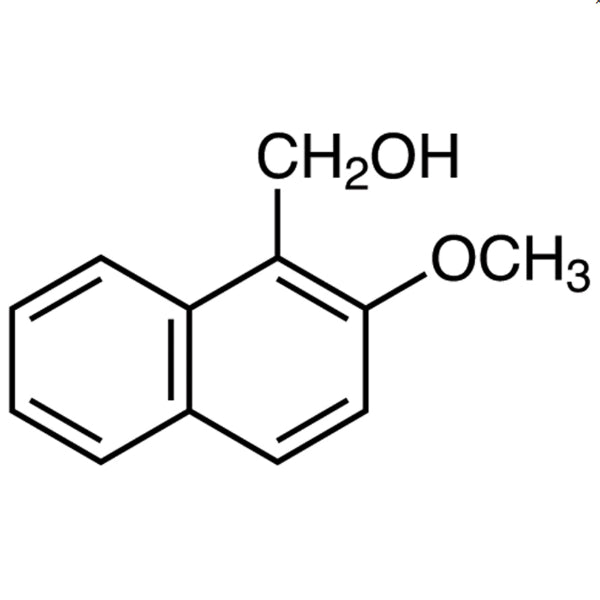
2-Methoxy-1-naphthalenemethanol is a chemical compound widely utilized in organic synthesis reactions within laboratory settings. As a building block in the field of chemistry, it plays a crucial role in the development of more complex molecular structures. Its unique molecular structure makes it a valuable resource for researchers aiming to explore new chemical pathways and reactions. This compound is particularly useful in the synthesis of aromatic compounds and their derivatives, contributing to the advancement of organic chemistry research.
The compound’s reactivity and structural versatility make it a preferred choice for various chemical applications. It exhibits chemical stability under controlled conditions, although it remains sensitive to moisture and air exposure. These properties necessitate careful handling and storage. Its ability to participate in substitution and condensation reactions further enhances its utility in synthetic processes. The compound’s predictable behavior and compatibility with a range of reagents make it a reliable material for laboratory use.
In Indonesian laboratories, 2-Methoxy-1-naphthalenemethanol is commonly used in organic chemistry research, including the development of new compounds and modifications of existing ones. It is also frequently employed in pharmacological and chemical studies, where its structural characteristics support the creation of novel molecular entities. Its role in achieving accurate and consistent results is vital for scientific investigations in the region.
- Organic synthesis reactions benefit from this compound's reactivity and structural versatility, making it ideal for creating complex molecular frameworks.
- It supports the development of aromatic compounds and their derivatives, enhancing the scope of synthetic chemistry research.
- In pharmacological studies, it is used to design and test new molecular structures with potential therapeutic applications.
- Its stability under controlled conditions makes it suitable for use in precision chemical experiments requiring consistent results.
- It is frequently employed in chemical modification processes, allowing researchers to tailor compounds for specific applications.
| Brand | TCI |
|---|---|
| CAS number | 40696-22-8 |
| Molecular formula | — |
| Purity | — |
| Category | Chemistry > Building Blocks > Non-Heterocyclic Building Blocks |
| Pack sizes | Available in various quantities as per standard laboratory supply |
| Physical form | Solid |
| Storage | Store in a cool, dry place away from moisture and air exposure |
This compound should be stored in a cool, dry environment to maintain its chemical stability. It is recommended to use airtight containers to prevent exposure to moisture and air, which can degrade its properties. Due to its sensitivity, it should be kept away from sources of heat and direct sunlight. Proper labeling of containers is essential for safe handling and identification. Laboratory personnel should wear appropriate personal protective equipment when working with this material to ensure safety. Regular monitoring of storage conditions is advised to maintain the integrity of the compound.
—
Produk Terkait
-
6-Methoxy-2-naphthalenemethanol TCI M2931
Regular price From Rp 2.359.350,00Regular price -
4-Methoxy-1-naphthalenemethanol TCI M2086
Regular price From Rp 955.500,00Regular price -
2-Naphthalenemethanol TCI N0881
Regular price From Rp 2.491.650,00Regular price -
1-Naphthalenemethanol TCI N0633
Regular price From Rp 769.650,00Regular price -
2-Bromo-4-methoxy-6-nitrophenol TCI B4723
Regular price From Rp 505.050,00Regular price -
4-Bromo-1-methoxy-2-(3-methoxypropoxy)benzene TCI B4539
Regular price From Rp 848.400,00Regular price -
1-Methoxy-4-propylbenzene TCI P3068
Regular price Rp 1.829.100,00Regular price -
2-Methoxy-6-nitrophenol TCI M3747
Regular price From Rp 2.889.600,00Regular price