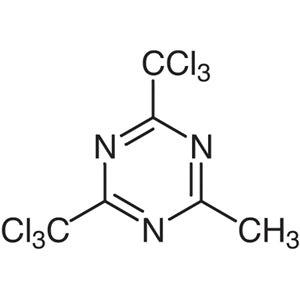
2-Methyl-4,6-bis(trichloromethyl)-1,3,5-triazine is a chemical compound widely used in laboratory settings for the synthesis of complex heterocyclic compounds. As a building block in organic chemistry, it plays a crucial role in the development of various synthetic routes, particularly in the formation of triazine-based structures. Its presence in research and industrial applications highlights its importance in the creation of advanced chemical materials. This compound is essential for chemists working on the design and synthesis of new compounds with specific functional groups and molecular architectures.
The compound's molecular structure is stable, and its reactivity makes it a preferred choice for substitution reactions and other chemical transformations. The presence of trichloromethyl groups enhances its versatility, allowing it to participate in a range of synthetic processes. Its chemical stability and reactivity ensure that it remains a reliable reagent in both academic and industrial laboratories. These properties make it an ideal material for the synthesis of complex organic molecules and for use in research involving heterocyclic chemistry.
In Indonesian laboratories, this compound is commonly used in organic chemistry, pharmaceutical, and material science research. Its ability to participate in chemical reactions and its structural characteristics make it a valuable tool for researchers aiming to develop new compounds and materials. Its widespread use in these fields underscores its importance as a key reagent in modern chemical synthesis.
Related TCI products
- TCI T0384 7673-09-8 Trichloromelamine
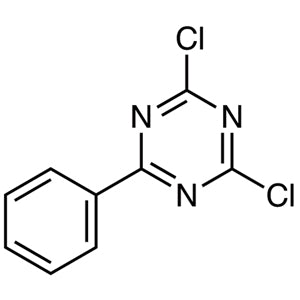
- TCI D4891 2831-66-5 2,4-Dichloro-1,3,5-triazine
- TCI D4814 6601-22-5 2,4-Dichloro-6-morpholino-1,3,5-triazine
- TCI D4805 1700-02-3 2,4-Dichloro-6-phenyl-1,3,5-triazine
- TCI D3747 3638-04-8 2,4-Dichloro-6-methoxy-1,3,5-triazine
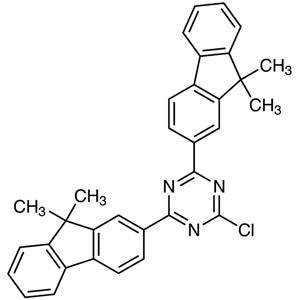
- TCI C3543 1459162-69-6 2-Chloro-4,6-bis(9,9-dimethyl-9H-fluoren-2-yl)-1,3,5-triazine
- Organic synthesis applications benefit from this compound due to its reactivity and ability to form complex heterocyclic structures.
- Pharmaceutical research utilizes it for the development of new drug compounds with specific molecular configurations.
- Material science studies employ it in the creation of advanced chemical materials with unique properties.
- Industrial chemical processes rely on its stability and reactivity for the production of synthetic compounds.
- Academic research in chemistry uses it as a fundamental building block for the synthesis of various organic molecules.
| Brand | TCI |
|---|---|
| CAS number | 949-42-8 |
| Molecular formula | — |
| Purity | — |
| Category | Chemistry > Building Blocks > Heterocyclic Building Blocks |
| Pack sizes | Available in various quantities as per supplier specifications |
| Physical form | Solid |
| Storage | Store in a cool, dry place away from light and moisture |
This compound should be stored in a cool, dry environment, away from direct sunlight and moisture to maintain its stability. It is recommended to use airtight containers to prevent exposure to air and humidity. Due to its chemical reactivity, it should be handled with care, using appropriate personal protective equipment such as gloves and safety goggles. It is important to ensure that it is kept in a well-ventilated area to avoid any potential hazards. Proper storage and handling practices help preserve its chemical integrity and ensure safe usage in laboratory settings.
—
Produk Terkait
-
Trichloromelamine TCI T0384
Regular price From Rp 557.550,00Regular price -
2,4-Dichloro-1,3,5-triazine TCI D4891
Regular price From Rp 1.644.300,00Regular price -
2,4-Dichloro-6-morpholino-1,3,5-triazine TCI D4814
Regular price From Rp 689.850,00Regular price -
2,4-Dichloro-6-phenyl-1,3,5-triazine TCI D4805
Regular price From Rp 1.510.950,00Regular price -
2,4-Dichloro-6-methoxy-1,3,5-triazine TCI D3747
Regular price From Rp 1.378.650,00Regular price -
2-Chloro-4,6-bis(9,9-dimethyl-9H-fluoren-2-yl)-1,3,5-triazine TCI C3543
Regular price From Rp 3.207.750,00Regular price -
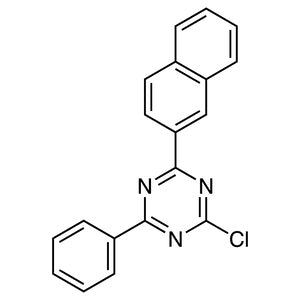
2-Chloro-4-(naphthalen-2-yl)-6-phenyl-1,3,5-triazine TCI C3520
Regular price Rp 1.936.200,00Regular price -
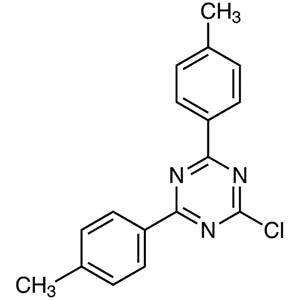
2-Chloro-4,6-di-p-tolyl-1,3,5-triazine TCI C3514
Regular price From Rp 2.199.750,00Regular price