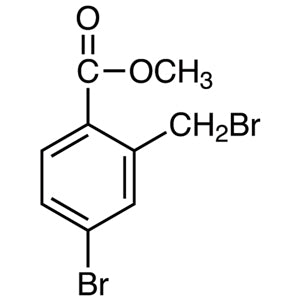
Methyl 4-Bromo-2-(bromomethyl)benzoate is a chemical compound widely used in organic reactions for the synthesis of complex molecules. This compound plays a crucial role in laboratory settings, particularly in the development of new chemical structures and functional groups. Its unique molecular structure, featuring two bromo substituents, makes it a versatile building block for various synthetic pathways. Due to its reactivity and structural complexity, it is frequently employed in research involving organic synthesis and functional group transformations.
The compound's reactivity stems from its bromo groups, which are strategically positioned to facilitate substitution and electrophilic reactions. These properties make it an ideal choice for chemists aiming to create a wide range of molecular structures. Its stability under specific conditions also contributes to its practicality, allowing for easier handling and storage. This combination of reactivity and stability ensures that it remains a valuable tool in both academic and industrial research environments.
In Indonesian laboratories, Methyl 4-Bromo-2-(bromomethyl)benzoate is commonly used by chemists and researchers working in organic synthesis. Its relevance extends to fields such as pharmaceuticals, materials science, and environmental chemistry. The compound's ability to participate in diverse reactions makes it a key component in the development of new compounds with potential applications in various scientific disciplines.
Related TCI products
- TCI B2224 1129-28-8 Methyl 3-(Bromomethyl)benzoate
- TCI B2053 2417-72-3 Methyl 4-(Bromomethyl)benzoate
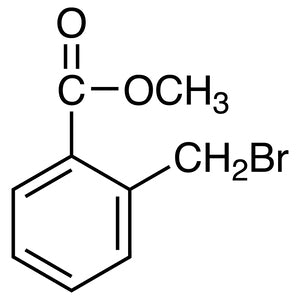
- TCI M2122 2417-73-4 Methyl 2-(Bromomethyl)benzoate
- TCI M1806 114772-38-2 Methyl 2-[4-(Bromomethyl)phenyl]benzoate
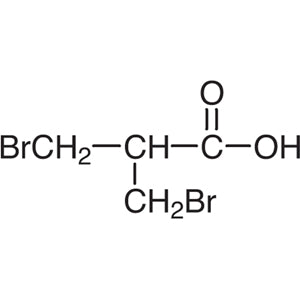
- TCI B3081 41459-42-1 3-Bromo-2-(bromomethyl)propionic Acid
- TCI M2066 22262-60-8 Methyl 3-Bromo-2-(bromomethyl)propionate
- Organic synthesis is a primary application where this compound serves as a versatile building block for creating complex molecular structures.
- Drug development benefits from its reactivity, allowing researchers to design and synthesize compounds with specific biological activities.
- Material science research utilizes its structural properties to develop new polymers and functional materials with unique characteristics.
- Environmental chemistry studies employ it to investigate the behavior of brominated compounds in various ecosystems.
- Analytical chemistry uses it as a standard for identifying and quantifying similar brominated compounds in samples.
| Brand | TCI |
|---|---|
| CAS number | 78471-43-9 |
| Molecular formula | — |
| Purity | — |
| Category | Chemistry > Building Blocks > Non-Heterocyclic Building Blocks |
| Pack sizes | Available in various quantities as per supplier specifications |
| Physical form | Solid |
| Storage | Store in a cool, dry place away from light and moisture |
This compound should be stored in a cool, dry environment, away from direct light and moisture to maintain its chemical stability. It is recommended to use airtight containers to prevent exposure to air and humidity, which could affect its reactivity. Due to its brominated nature, it should be handled with appropriate personal protective equipment, including gloves and safety goggles, to ensure laboratory safety. It is important to avoid contact with incompatible substances and to store it separately from strong oxidizers or flammable materials. Proper ventilation should be maintained in the workspace to minimize inhalation risks. Regular monitoring of storage conditions ensures the compound remains suitable for use in research applications.
—
Produk Terkait
-
Methyl3-(Bromomethyl)benzoate TCI B2224
Regular price From Rp 1.856.400,00Regular price -
Methyl4-(Bromomethyl)benzoate TCI B2053
Regular price From Rp 1.353.450,00Regular price -
Methyl2-(Bromomethyl)benzoate TCI M2122
Regular price From Rp 1.298.850,00Regular price -
Methyl2-[4-(Bromomethyl)phenyl]benzoate TCI M1806
Regular price From Rp 795.900,00Regular price -
3-Bromo-2-(bromomethyl)propionicAcid TCI B3081
Regular price From Rp 1.510.950,00Regular price -
Methyl3-Bromo-2-(bromomethyl)propionate TCI M2066
Regular price From Rp 3.392.550,00Regular price -
Ethyl3-Bromo-2-(bromomethyl)propionate TCI E0791
Regular price From Rp 3.127.950,00Regular price -
2-(Bromomethyl)acrylicAcid TCI B4048
Regular price From Rp 3.817.800,00Regular price


![114772-38-2 Methyl 2-[4-(Bromomethyl)phenyl]benzoate - AMI Scientific](http://amiscientific.com/cdn/shop/files/TCI2510M1806.jpg?v=1767125598&width=533)